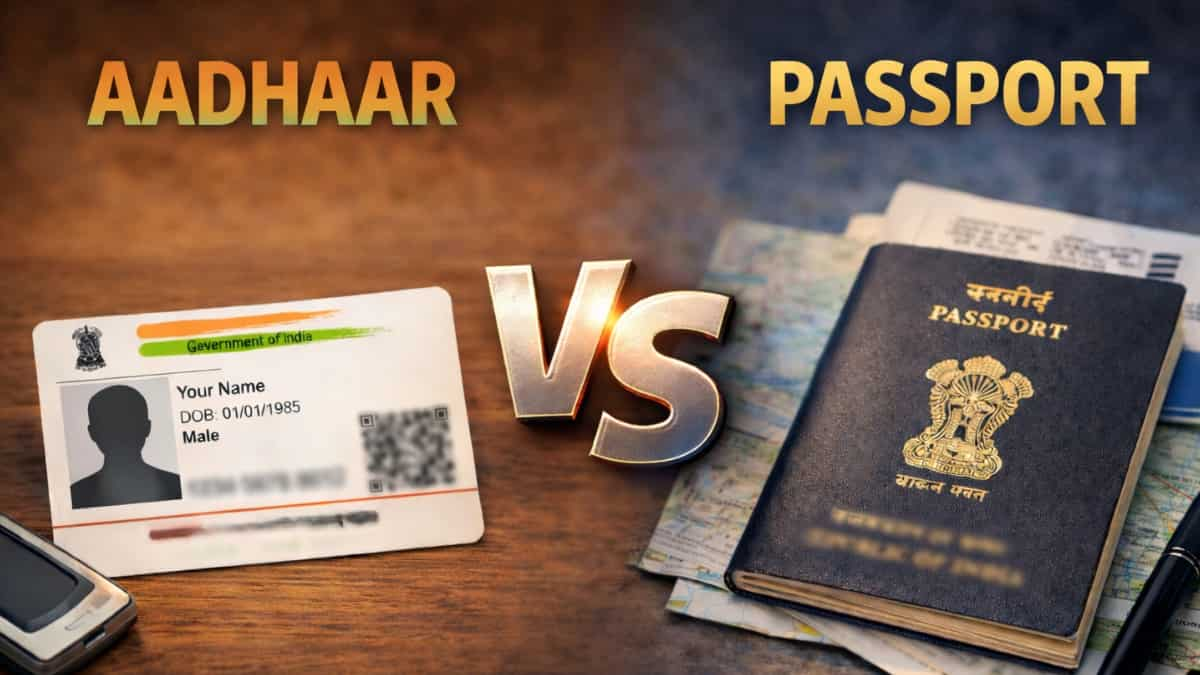
Aadhaar vs Passport: 12 key differences that set 12-digit ID apart from citizenship-bearing booklet
Published on 29/01/2026 11:33 PM
In everyday life, Aadhaar has become India’s default identity document—asked for while opening a bank account, accessing welfare schemes or completing a digital transaction. Its sheer reach has led many to assume that Aadhaar carries the same legal weight as a passport. Indian law, however, places the two documents in entirely different categories.
While Aadhaar is designed to establish identity and residence, a passport exists to certify citizenship and represent the sovereign authority of the Indian state. The difference is not symbolic; it is rooted in statute, verification standards and constitutional responsibility. A passport, by contrast, is issued under the signature of a Regional Passport Officer an IAS or IFS officer acting on behalf of the President of India. Even where private players operate Passport Seva Kendras, all sovereign and fiduciary functions remain with the Ministry of External Affairs.
Aadhaar, introduced decades later, serves a very different administrative purpose—efficient service delivery, not citizenship determination.
Aadhaar makes it easier to get welfare benefits, open bank accounts, and use digital government services. A passport, on the other hand, proves citizenship, allows international travel, and represents India globally. Treating the two as equivalent risks weakening the legal meaning of citizenship and obscuring the constitutional responsibility involved in issuing a passport. Aadhaar is widespread and essential, while a passport is less common but carries far greater legal authority.
Q. Does Aadhaar prove Indian citizenship?
No. Aadhaar is proof of identity, not citizenship.
Q. Can a foreigner legally obtain Aadhaar?
Yes. Residency of 182 days makes a foreign national eligible.
Q. Can a non-citizen get an Indian passport?
Only in rare cases, if the Central government considers it necessary in public interest.
Q. Why is police verification mandatory for passports but not Aadhaar?
Because a passport certifies citizenship and carries sovereign responsibility.
Q. Why does scale matter in understanding the difference?
Because Aadhaar is designed for universal inclusion, while passports are intentionally restricted.