BIS brings 124 new products under mandatory certification in 2025
Published on 07/01/2026 12:43 PM
The year 2025 has been a landmark year for the Bureau of Indian Standards (BIS), which has witnessed the most remarkable growth in the areas of standardisation, certification and compliance becoming easier.
As per Sanjay Garg, Director General of BIS, the agency managed to create more than 600 new standards within the year which brought the total of Indian Standards to 23,293,
The new standards not only include traditional industries but also new and future-oriented sectors like AYUSH, robotics, artificial intelligence, ecology and other tech.
Garg noted that among all the standards, certification of products saw one of the largest increments in 2025.
The fast-track certification scheme certified products snook up massively from 758 to 1,288 denoting enhanced efficiency and an increase in industry participation.
In 2025 only, the BIS issued almost 9,700 new licences, mainly through the rapid issuance process of less than 30 days. This led to a steep increase in active product certification licences, above the limit of 51,500.
The new fast-paced operation has been supported by the whole sector, particularly by the startups and MSMEs that depend on the quick availability of their products in the market.
The first time in 2025 that 124 new products were subjected to mandatory BIS certification was a remarkable milestone. This has resulted in a total number of certified products going over 1,437.
Among the remarkable products were currency note sorting machines that were made together with the Reserve Bank of India and injection moulding machines that were made per ISO machinery safety standards.
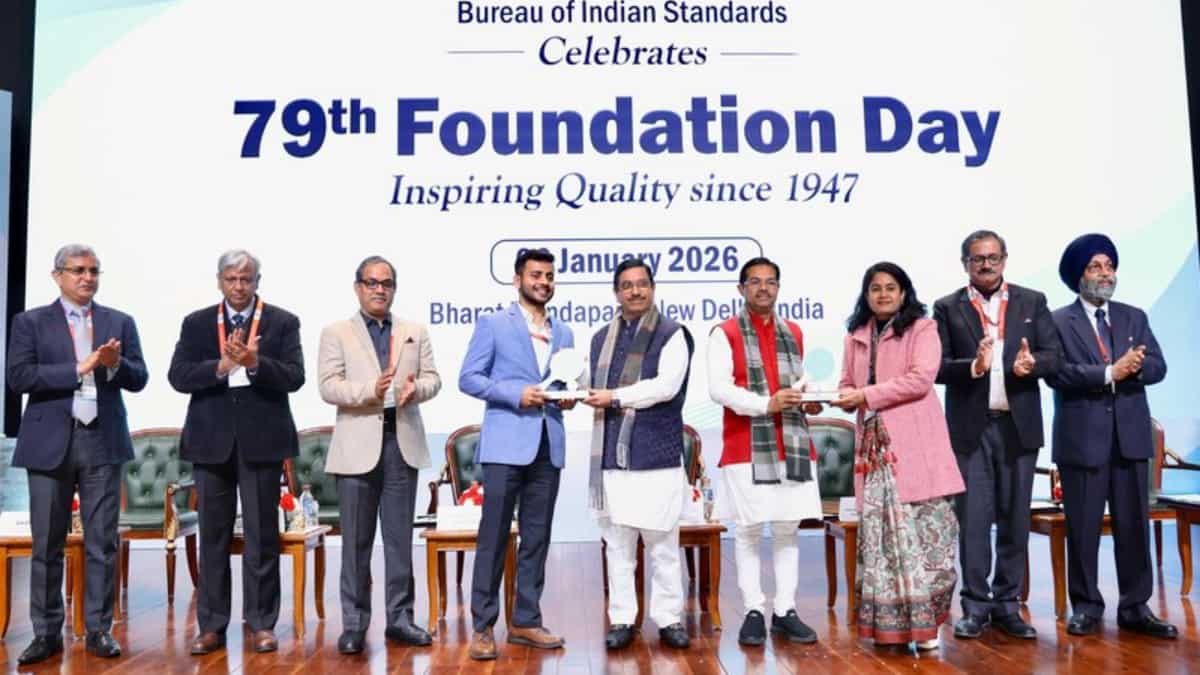
Garg mentioned at the 79th BIS Foundation Day that the BIS had actually gone digital in all its service departments.
The digitalisation of the Manak Online Portal, simpler licensing systems, fast-track trial licences, cluster-based testing facilities, and stronger testing infrastructure are just a few of the digitalisation initiatives that have tipped the industry towards 98 per cent of licences under simplified procedure and 85 per cent under normal procedure being issued within 30 days as opposed to the former lengthy timelines which were indeed quite a lot shorter than the present ones.
The Union Minister Prahlad Joshi stated that the Bureau of Indian Standards (BIS) is constantly evolving, with the incorporation of international best practices in standardization.
He observed that the Indian Standards today are not only the ones that are normally used but also the standards that have been set that include renewable energy, electric mobility, smart infrastructure, digital technologies, sustainability, and green products.
It is no longer a government-run agency only that sells the certificates of quality but an organization that promotes good practices and a culture of excellence not just through regulatory compliance.
The changes that have been made to the regulations as a result have been in line with the government’s “Ease of Doing Business” initiative; thus, BIS has simplified compliance processes, placed additional fee subsidies for MSMEs and laboratories, made laboratory tests not required for large industries, and put market surveillance in place to provide consumers with safe and standard products.
In addition to that, to help MSMEs even more, BIS has also made it known that the micro-, small- and medium-sized enterprises will be granted a percent of concession on the Annual Minimum Marking Fee: 80 per cent for micro enterprises, 50 per cent for small enterprises, and 20 per cent for medium enterprises, which in turn will be the declaration of its active participation through the promotion of industrial growth.