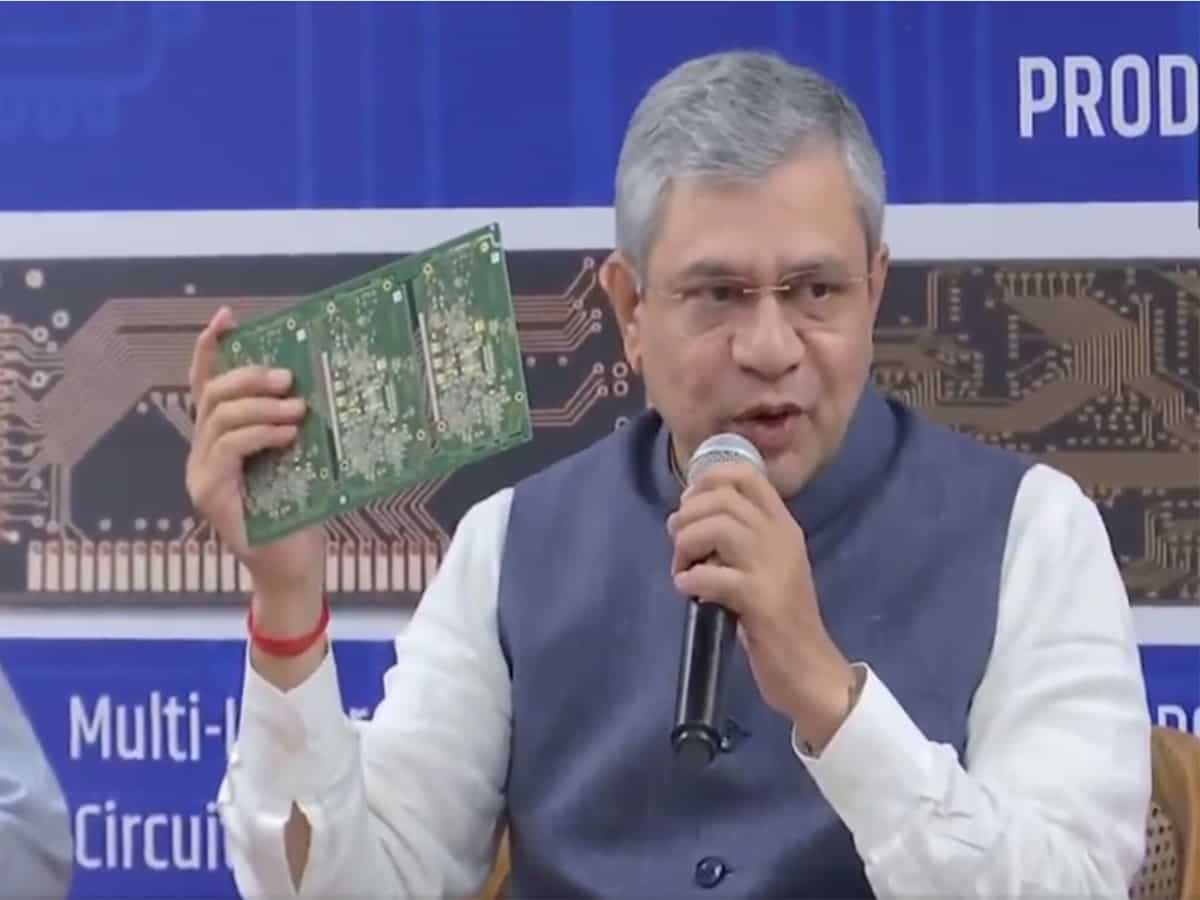
Centre approves Rs 5,500 crore investment under ECMS for seven electronic component projects to expand local manufacturing
Published on 27/10/2025 07:34 PM
The Centre has approved the first set of seven electronic component manufacturing projects worth Rs 5,532 crore under the Electronics Components Manufacturing Scheme (ECMS), Union Minister for Electronics and IT Ashwini Vaishnaw announced on Monday, October 27. The projects mark a major step toward strengthening domestic production of key components such as multi-layer printed circuit boards (PCBs), camera modules, and laminates.
Vaishnaw said the projects will help India move beyond assembling finished electronic products to manufacturing the modules and materials that form the backbone of the industry. “This will substantially cut our import dependence and reinforce the local supply chain,” he said, adding that the initiative aligns with Prime Minister Narendra Modi’s ‘Make in India’ and ‘Atmanirbhar Bharat’ missions.
According to the official statement, five of the seven approved projects will be established in Tamil Nadu, one in Andhra Pradesh, and one in Madhya Pradesh. Together, they represent a total investment of Rs 5,532 crore, expected to generate component output worth Rs 36,559 crore and create over 5,100 direct jobs.
The Ministry of Electronics and IT said the approved proposals include investments from Kaynes Circuits India Pvt Ltd, SRF Ltd, Syrma Strategic Electronics Pvt Ltd, and Ascent Circuits Pvt Ltd. Of these, Kaynes Circuits alone accounts for four projects in Tamil Nadu, focused on manufacturing multi-layer and high-density interconnect (HDI) PCBs, laminates, and camera module sub-assemblies. These four projects involve an investment of Rs 3,280 crore, with an expected output value of Rs 28,315 crore and employment generation for around 2,480 people.
Explaining the project’s technical scope, Vaishnaw said the plants will manufacture ultra-pure copper laminates used in PCBs, polypropylene films used in capacitors, and camera modules used in devices like smartphones and tablets. “Each layer of a multi-layer PCB is interconnected, like a multi-storey building with its own wiring and plumbing,” he explained.
According to the minister, these new facilities will meet around 20 per cent of India’s demand for PCBs, 15 per cent for camera modules, and nearly 100 per cent for laminates. The move could help India save an estimated Rs 20,000 crore in import costs annually.
Launched in April as a complement to the India Semiconductor Mission, the ECMS has a total outlay of Rs 22,919 crore. The ministry said the scheme has received an “overwhelming response”, with 249 applications so far, proposing investments worth Rs 1.15 lakh crore and projected production of about Rs 10.34 lakh crore. The projects are also expected to create over 1.42 lakh jobs.
Electro-mechanical components and multi-layer PCBs attracted the largest number of applicants, with 87 and 43 companies respectively. Industry leaders welcomed the government’s quick rollout of the scheme. “These investments will catalyse large-scale domestic capabilities, leveraging the momentum created by mobile phone and electronics manufacturing,” said Pankaj Mohindroo, Chairman of the India Cellular and Electronics Association (ICEA).
Vaishnaw said the initiative reflects the government’s focus on building a complete electronics manufacturing ecosystem within India. “Because of this focus, electronics exports are already among the top three export categories,” he said.
Ankit Kumar is a Senior Sub Editor at Zee Business. He covers international affairs, politics, climate change, business, finance and global elections. With experience acros