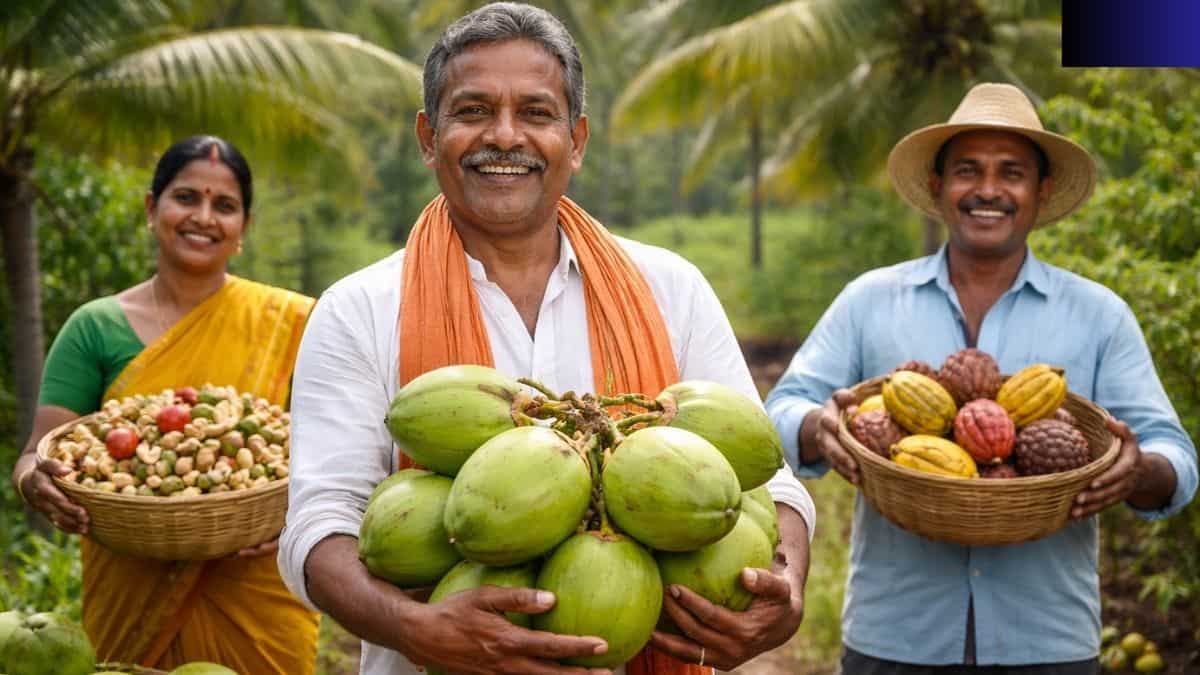
Coconut, Cashew, Cocoa: How Budget 2026’s AI-driven farm push could change farmers’ lives
Published on 01/02/2026 02:02 PM
Union Budget 2026-27: FM Nirama Sitharaman announced a major push to support high-value crops such as coconut, cashew, cocoa, sandalwood, and nuts, to increase farm income, improve productivity, and create more jobs in rural areas. Finance Minister Nirmala Sitharaman shared these plans while presenting the Union Budget 2026.
The government said the new programmes will focus on crops that give better returns to farmers and suit local conditions. Special schemes will be launched for coconut production, while cashew and cocoa will also get targeted support. The Budget also highlighted the use of technology, including Artificial Intelligence (AI), to boost agriculture.
Coconut received special attention in the Budget. The Finance Minister announced a coconut promotion scheme to make coconut farming more competitive and productive.
India is the world’s largest producer of coconuts. Around 30 million people, including nearly 10 million farmers, depend on the coconut for their livelihood. Despite this, many coconut trees are old and give low yields.
Under the new scheme, the government plans to increase production and productivity through several steps. These include replacing non-productive coconut trees with new and better saplings and promoting improved varieties in major coconut-growing states. The goal is to help farmers earn more from the same land while keeping costs under control.
Along with coconut, the Budget announced a focused programme for cashew and cocoa. The aim is to make India more self-reliant in raw cashew and coconut production and processing.
The government also wants to improve export competitiveness and build Indian cashew and cocoa as globally recognised premium brands by 2030. This means better support for farmers, improved processing, and stronger market links. For growers, this could lead to more stable prices and better income opportunities in the coming years.
The Budget follows a region-based approach to farming. Instead of promoting the same crops everywhere, the government plans to support crops that naturally grow well in specific regions.
Coastal areas will get support for coconut, cocoa, cashew, and sandalwood.
The Northeast will focus on other suitable tree crops.
The hilly terrain of the region deals with nut cultivation, which includes almonds, walnuts and pine nuts as its main output.
The method creates two advantages for farmers because it decreases their risk and increases their chances of successful harvests. The government aims to achieve permanent income growth through its crop selection system, which matches local climate and soil conditions.
The Budget showed how agricultural productivity will benefit from using artificial intelligence and contemporary technological solutions. Farmers will receive improved agricultural tools together with data and expert guidance, which will assist them in making more effective farming choices.
The Centre announced that farmers would receive assistance for their various needs through the programs, which provide crop-specific support together with new farming methods, productivity improvements and risk management solutions. The government intends to establish fish breeding facilities while supporting high-value crop agricultural operations, which will generate additional economic opportunities for rural communities.
Special steps were announced to support women entrepreneurs, including the formation of She-Marts, which will help women sell and promote their products more easily.
Supporting these efforts is the Coconut Development Board, a statutory body set up in 1981 under the Ministry of Agriculture and Farmers Welfare.
The Board works for the overall development of coconut farming and the coconut industry in India. Its key roles include:
The new Budget proposals show a strong connection to ongoing initiatives, which include state-level programs that provide quality saplings and endorse environmentally sustainable agricultural methods.
With a strong focus on coconut, cashew, cocoa, and other high-value crops, Budget 2026 signals a clear intent to diversify agriculture and raise farmer incomes. The Centre plans to achieve three goals through its regional planning methods and technological solutions and its specific implementation programs, which will increase farming profits and sustainability.