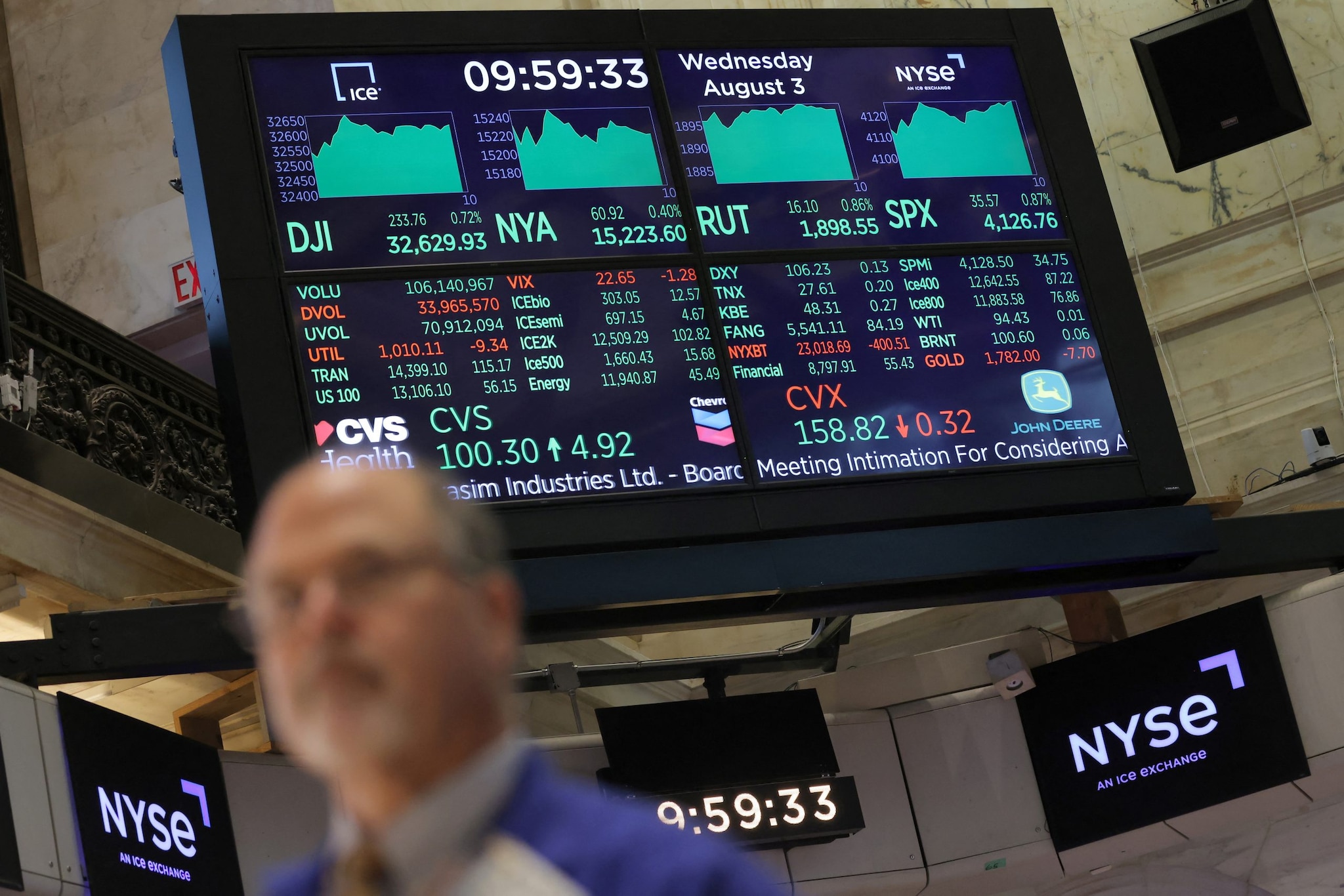
Dow Jones Today | US Stock Market LIVE Updates: S&P 500 is under pressure again from oil crisis, heads for third-straight losing week
Published on 13/03/2026 10:51 PM
European stocks whipsawed on Friday, ultimately ending the week lower, as oil prices moved back above $100 a barrel and traders reduced risk ahead of the weekend.
The Stoxx Europe 600 closed 0.5% lower, notching the index’s first back-to-back weekly declines this year. Energy and utilities shone, rising by more than 1%, while energy-intensive cyclicals such as miners and industrials underperformed.
Bitcoin has lost almost half its value since October, and a set of indicators that have historically marked the end of past downturns suggest the selloff could be entering its final phase, according to a crypto fund manager who has invested through three prior boom-and-bust cycles.
Brett Munster at Blockforce Capital tracks four measures to gauge where Bitcoin stands in its crash cycle. One has already crossed into territory associated with past lows.
Two others converge near $54,000 to $58,000 — still below Bitcoin’s current price of about $73,800. And the token briefly touched $60,000 in February before rebounding, meaning it has already grazed the upper edge of what Munster considers a probable bottoming zone.
New York City Mayor Zohran Mamdani wants to slash New York state’s estate tax exemption threshold by almost 90%, from a more than $7 million limit to $750,000, and raise the top estate tax rate from 16% to 50%.
The proposal was included among nearly a dozen potential revenue-raising ideas Mamdani’s office circulated in a memo in recent weeks to state lawmakers negotiating the state budget. Mamdani is facing a $5.4 billion city budget deficit for the fiscal year that begins July 1, and is seeking help from the state legislature in raising money to close the gap.
Boeing Co is repairing damaged wiring in as many as 25 undelivered 737 Max jets, disrupting near-term deliveries of the aircraft, people familiar with the matter said. While some March deliveries will be delayed, the impact isn’t likely to be as extensive as the company had initially anticipated, one of the people said.
Boeing has handed over just three 737 Max jets so far this month, and the last deliveries were on March 4, according to data from Cirium Ltd, an aviation analytics company. That’s a sharp drop from February, when the company handed over 43 of the jets, the best tally for that month in nearly a decade.
JPMorgan Chase & Co. and Partners Group Holding AG have cancelled upcoming gatherings in the UAE as the Iran war prompts a rethink of events that were meant to underscore the region’s growing heft as a financial center.
Partners Group has moved its annual global gathering of investors to Switzerland from Abu Dhabi, people familiar with the matter said, declining to be identified discussing the matter. The client AGM will be held on April 13 and 14 near Zurich, they said.
JPMorgan is rescheduling its MENA Global Opportunities Conference, an invitation-only event for institutional investors, corporate executives, and financial sponsors, other people said. The event was due to be held in Dubai on March 30 and 31.
Investors who rushed to lend money to real estate developers in the United Arab Emirates are nursing losses as the Iran war hammers their bonds and threatens to stall a borrowing binge.
Property companies had been leaning increasingly on the bond market as they raced to secure locations for residential projects in Dubai and Abu Dhabi.
With both cities under sustained attack from Iran, that debt is being sold off. UAE corporate bonds are the worst performers in emerging markets this month, with real estate names suffering the heaviest losses, according to a Bloomberg index.
Volatility gripped Wall Street, with a rally in stocks waning as the war in Iran dragged into a 14th day, with no signs of easing. Brent erased losses. Bond traders revived bets on policy easing after sluggish economic data.
The S&P 500 erased a nearly 1% gain as the Wall Street Journal reported the Pentagon is moving a Marine expeditionary unit to the Middle East, as Iran steps up its attacks on the Strait of Hormuz. Brent climbed back above $100.
Short-dated Treasuries outperformed, with traders almost fully pricing in one Federal Reserve rate cut this year. The dollar headed toward its highest since December.
US President Donald Trump said the US has Iranians who are residing in the country “under watch” amid new concerns about the potential for domestic terrorism during the war with Iran. “We are watching them very, very carefully. We have them under watch now,” Trump said during an interview on Fox News Radio with Brian Kilmeade that aired Friday morning.
Trump, who has moved to tighten border security, conducted the interview on Thursday. He was asked about the potential threat posed by Iranians who crossed into the US under his predecessor, Joe Biden, and the danger of potential “sleeper cells” in the country, following a pair of violent incidents on Thursday.
European stocks edged lower on Friday as investors continued to assess the economic fallout from the ongoing conflict in West Asia. The pan-European STOXX Europe 600 hovered just below the flatline in afternoon trading in London, with sector performance mixed across the region.
Energy-related stocks performed relatively well, with oil and gas, insurance, and utilities sectors leading gains. Meanwhile, industrial and mining companies lagged the broader market.
Currency markets also reflected the cautious mood. The British Pound Sterling weakened against both the Euro and the US Dollar after data showed the UK economy stalled in January.
Among individual stocks, shares of Deutsche Bank edged higher after the lender disclosed a $30 billion exposure to the private credit market. Meanwhile, BE Semiconductor Industries jumped more than 8% on takeover speculation, bucking the cautious broader market trend.
Job openings in the United States rose more than expected in January, pointing to continued resilience in the labour market. Data from the Bureau of Labor Statistics showed job vacancies increased to 6.9 million during the month, up by about 396,000 from December.
The figures come from the closely watched Job Openings and Labor Turnover Survey (JOLTS), which tracks hiring demand across the economy. The vacancy rate also ticked higher to 4.2% of the labour force.
Despite the increase in openings, other indicators in the survey showed little change. Meanwhile, the labour market has shown mixed signals recently, with payrolls rising in January before declining in February.
Consumer confidence in the United States edged lower in March as geopolitical tensions escalated following military strikes involving United States, Israel and Iran.
The latest survey from the University of Michigan showed its consumer sentiment index slipping to 55.5 in March, slightly below February’s level and broadly in line with expectations. While the measure of current economic conditions rose modestly, the expectations index dropped more sharply, reflecting growing uncertainty about the outlook.
Survey director Joanne Hsu said early interviews had shown improving sentiment, but the escalation in the Middle East erased those gains. Meanwhile, inflation expectations remained relatively stable, with the one-year outlook holding at 3.4%.
US stocks opened higher on Friday, with all three major benchmarks posting early gains as investors reacted to improving market sentiment. The Dow Jones Industrial Average rose about 301 points, or roughly 0.7%, in early trading.
The broader S&P 500 advanced around 0.5%, reflecting gains across multiple sectors of the market. Meanwhile, the tech-heavy Nasdaq Composite also climbed about 0.5% at the open.
The positive start suggests investors remain cautiously optimistic about economic conditions and corporate performance, even as markets continue to watch global developments and policy signals for clues about the outlook ahead.
Pete Hegseth, the US defence secretary, has downplayed concerns that a potential disruption in the Strait of Hormuz could become a prolonged crisis amid tensions with Iran.
Speaking at a Pentagon briefing, Hegseth said the United States has long prepared for such a scenario and is actively managing the situation. “We have been dealing with it, and don’t need to worry about it,” he said, dismissing fears that a closure of the key shipping route could severely disrupt global trade and energy flows.
The Strait of Hormuz is one of the world’s most critical maritime chokepoints, carrying a significant share of global oil shipments. Any disruption typically raises concerns about energy supply shocks and rising crude prices.
Hegseth also rejected reports suggesting the US military lacked a plan to respond to such a scenario before the conflict escalated. According to him, contingency planning had already been in place, and actions would be carried out “sequentially” based on strategic priorities and operational needs.
US Treasuries advanced on signs of a more discerning consumer, sticky inflation and weaker growth, helping to pare weekly losses spurred by concern that a war-driven rally in oil prices would fan price pressures and prevent US interest-rate cuts.
The modest increases following Friday’s economic data pushed yields on two-year notes, the most sensitive to the Fed’s policy changes, lower by almost five basis points to 3.7%. The 10-year was two basis points lower to 4.24%.
Economic growth was much slower than expected in the final three months of 2025, while core inflation rose to start 2026, the Commerce Department reported Friday.
Gross domestic product, a measure of all the goods and services produced across the sprawling U.S. economy, rose at a seasonally and inflation-adjusted annual rate of just 0.7% in the fourth quarter, according to the department’s Bureau of Economic Analysis.
The first revision of the GDP reading was a sharp step down from the previous estimate of 1.4% and well below the Dow Jones consensus forecast for 1.5%. It also marked a considerable slowdown from the 4.4% gain in the prior period.
European natural gas is headed for a weekly drop, with many market players pulling back from trading futures after wild price swings and focusing instead on options.
Benchmark futures swung on Friday, with the most recent headlines from the Middle East pushing prices lower. Turkey said it’s got permission from Iranian authorities for one ship to pass through the Strait of Hormuz, according to state-run Anadolu Agency. Meanwhile, President Donald Trump said the US will be hitting Iran “very hard” next week, but added, “Hopefully things are going to go very well.”
German Chancellor Friedrich Merz criticised the US decision to ease sanctions against Russia by temporarily allowing oil sales to try to ease pressure on prices triggered by the Iran war.
The Trump administration has issued its second authorisation for buyers to take Russian oil cargoes already at sea, expanding a temporary waiver given last week to India. The move stoked concern among Ukraine’s allies that the Kremlin stands to benefit from the spike in energy prices and will use the extra funds to bankroll its four-year war on its western neighbour.
“Let me be very clear: we believe it would be wrong to ease sanctions now, for whatever reason,” Merz said Friday at a joint news conference with his Norwegian counterpart, Jonas Gahr Støre.
World shares retreated on Friday (March 13) while oil prices again popped above $100 per barrel as anxiety remained over the Iran war and its impact on supplies of crude oil and gas.
In early European trading, Britain’s FTSE 100 fell 0.7% to 10,235.29. Germany’s DAX lost 1% to 23,345.90, while France’s CAC 40 dropped 1.2% to 7,887.18.
In Asian trading, Tokyo’s Nikkei 225 index slipped 1.2% to 53,819.61. Technology-related stocks saw some of the bigger losses, with SoftBank Group falling 4.5%. South Korea’s Kospi fell 1.7% to 5,487.24. Hong Kong’s Hang Seng lost 1% to 25,465.60, while the Shanghai Composite index was down 0.8% at 4,095.45.
Watch this space for all the live updates on the US Stock Market.NewsLive TVMarketPopular CategoriesCalculatorsTrending NowLet's Connect with CNBCTV 18Network 18 Group :©TV18 Broadcast Limited. All rights reserved.