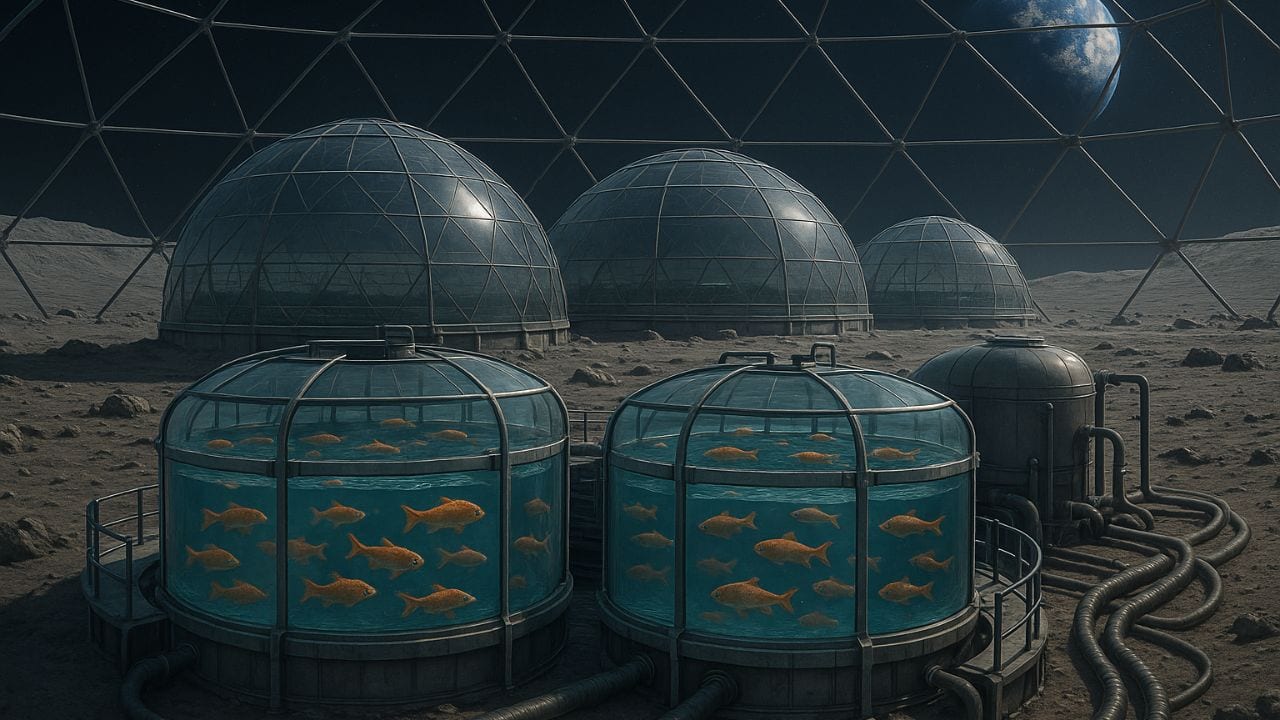
Fish Farming on Moon? Scientists plan to feed astronauts seafood farmed on the Moon
Published on 02/05/2025 01:00 PM
At a quiet research base near the French coast, a bold idea is swimming its way into space. Here, under the watch of scientists, sea bass may soon play a key role in future lunar life.
Lunar Hatch project eyes future Moon missionsIn southern France, sea bass circle tanks unaware of destiny. The Lunar Hatch experiment hopes to send their eggs to space. Scientists want to raise fish on the Moon itself. This mission could support astronauts during long space stays.
Led by Dr Cyrille Przybyla from Ifremer, the project explores food production beyond Earth. He believes fish could help astronauts stay healthy and strong. Rich in protein, omega-3 and key vitamins, sea bass offer nutrition that is easy to digest.
The plan involves fertilising eggs on Earth, then launching them. The journey to the Moon matches the eggs’ hatching period. Fish could hatch mid-flight or after landing on the Moon.
Water from polar lunar ice would fill their tanks. The fish would live in a closed-loop tank system. Waste from fish would feed algae and other species. Shrimp and worms would eat the rest of the waste. These species would also become fish food.
This sustainable method mimics aquaculture systems used on Earth. The goal is zero waste and full self-sufficiency in space. Scientists hope to feed a seven-member crew twice weekly. That would need 200 fish for a 16-week mission.
Testing sea bass survival in space conditionsThe idea of animals in space is not new. But this is the first attempt to farm fish on the Moon.
Missions from the 1970s carried guppies and mummichogs. Zebrafish have also visited the International Space Station. But these were only for scientific study.
Now, Lunar Hatch hopes to farm fish for real use. Scientists tested if eggs can survive launch stress. Using simulators, they mimicked rocket vibrations and conditions. Tests show eggs stayed strong and developed normally.
Radiation, weightlessness and shaking did not damage them. These results give researchers hope for a future Moon mission.
ESA support and future mission plansPrzybyla proposed the idea back in 2016 to ESA. He wanted it to be part of a future Moon base. Funding came in 2018 from France’s CNES space agency.
Lunar Hatch is now among 100 shortlisted Moon projects. ESA may use its Argonaut landers starting in 2034. These landers can carry over a tonne of equipment. Among their cargo may be sea bass eggs.
This effort may inspire new life-support systems for space. It may even help solve food problems back on Earth. In remote areas or conflict zones, closed food systems could help.
For now, sea bass near Palavas-les-Flots swim calmly. They may never reach space, but their young might. And that could help humans survive far beyond Earth.
Discover the latest Business News, Budget 2025 News, Sensex, and Nifty updates. Obtain Personal Finance insights, tax queries, and expert opinions on Moneycontrol or download the Moneycontrol App to stay updated!
${res.must_watch_article[0].headline}
Stock Market Holiday Jammu Kashmir News Live Tim Cook Delhi Rain Heatwave in India Odisha 10th Result 2025 WB Madhyamik Result SSLC Result 2025 Kolkata News IPL Points Table 2025
Business Markets Stocks India News City News Economy Mutual Funds Personal Finance IPO News Startups
Home Currencies Commodities Pre-Market IPO Global Market Bonds
Home Loans up to 50 Lakhs Credit Cards Lifetime Free Finance TrackerNew Fixed Deposits Fixed Deposit Comparison Fixed Income
Home MC 30 Top Ranked Funds ETFs Mutual Fund Screener
Income Tax Calculator EMI Calculator Retirement Planning Gratuity Calculator
Stock Markets
News18 Firstpost CNBC TV18 News18 Hindi Cricketnext Overdrive Topper Learning
About Us Contact Us Advisory Alert Advertise with Us SupportDisclaimer Privacy Policy Cookie Policy Terms & Conditions Financial Terms (Glossary) Sitemap Investors
You are already a Moneycontrol Pro user.