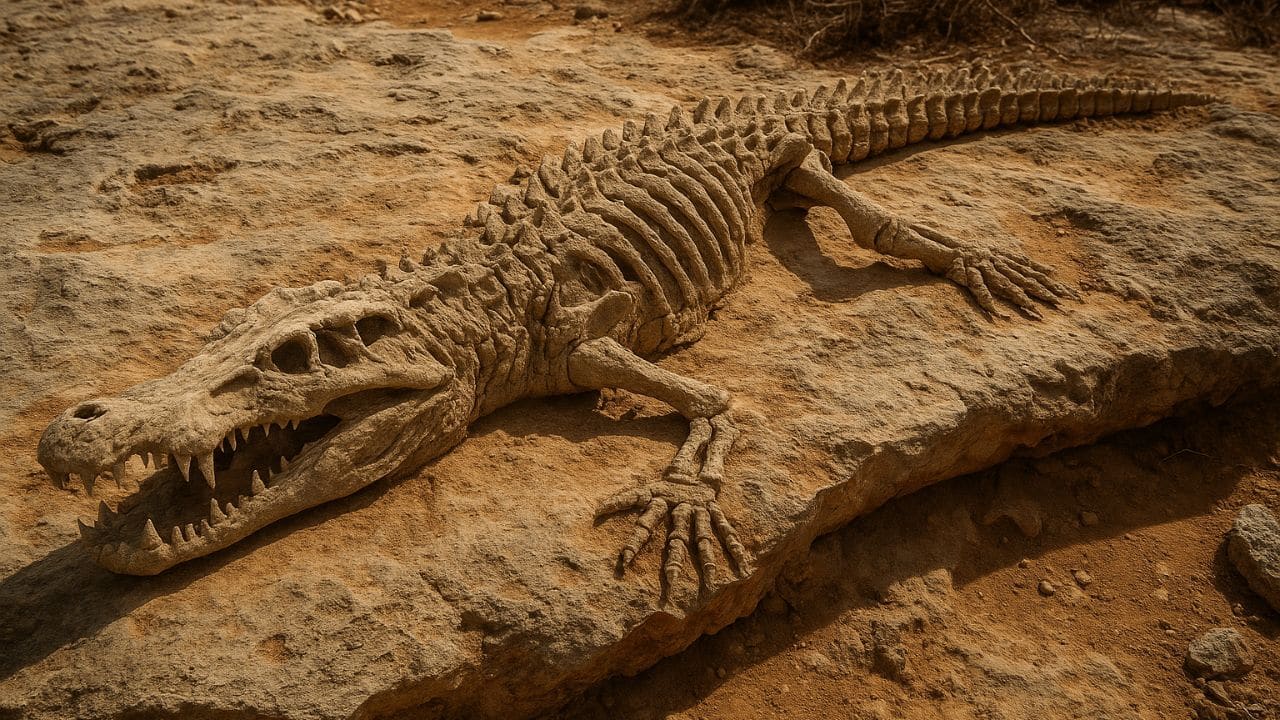
Fossil of terrifying prehistoric land crocodile discovered in the Caribbean islands
Published on 30/04/2025 03:37 PM
It’s hard to imagine crocs chasing prey on land. But long ago, the Caribbean was home to fast, terrifying crocodile cousins. These predators lived long after dinosaurs and had sharp teeth built to tear meat.
Ferocious Crocs Outlived Others on Island Hideout
After dinosaurs vanished, mammals ruled Earth’s lands. Yet in South America, fierce crocs known as sebecids fought for dominance. New fossils suggest they lived longer than thought, hiding in the Caribbean. These crocs were powerful hunters with upright limbs and deep jaws. Their teeth were sharp, with edges like saws.
Fossils from the Dominican Republic now show they survived until around 5 to 7 million years ago. Earlier, the last known sebecid fossils came from Colombia, dated to 10.5 to 12.5 million years ago. The new discovery narrows the gap by millions of years.
The fossils found in 2023 included a single tooth and two spine bones. The tooth matches those of South American sebecids. The bones confirmed the animal’s identity. This sebecid was smaller than others, only about 2 metres long. The biggest of its kind once reached 6 metres.
“These crocs looked like they belonged to dinosaur times,” said lead author Lazaro Vinola Lopez, a palaeontology student at the University of Florida. He added they ruled alongside terror birds and saber-toothed marsupials.
Meat-Eating Crocs Once Raced Across the Islands
Sebecids walked and ran on land with speed. They had long legs, strong bodies, and deep skulls for hunting. Unlike today’s crocs, which swim and lurk in rivers, these crocs lived and hunted on dry ground. Their teeth and bones show they were built for speed and meat-eating.
They wore natural armour too, with bony plates called scutes under their skin. This made them both deadly and well-protected hunters.
Jonathan Bloch, co-author and expert at the Florida Museum of Natural History, said it was incredible to imagine such predators roaming the Caribbean. They likely fed on sloths, rodents and whatever prey they found.
Old fossil teeth from Cuba and Puerto Rico show this croc group lived across the West Indies. The oldest of them go back nearly 29 million years.
Islands May Have Linked South America to the Caribbean
Scientists now wonder how these land crocs reached the islands. They believe that long ago, a trail of islands or land bridges connected South America to the Caribbean. That journey may have started about 32 to 35 million years ago.
At that time, the sea was narrower, and travel easier. These land links let animals like sebecids move island to island.
“This shows how islands protect ancient life,” said Vinola Lopez. “They preserve the last members of species now gone elsewhere.”
Discover the latest Business News, Budget 2025 News, Sensex, and Nifty updates. Obtain Personal Finance insights, tax queries, and expert opinions on Moneycontrol or download the Moneycontrol App to stay updated!
${res.must_watch_article[0].headline}
Sensex Today Jammu Kashmir News Live DC vs KKR Live Score Canada Election Results Q4 Results 2025 Live Ather Energy IPO GMP JKBOSE 10th Result 2025 TS SSC Results 2025 NEET Admit Card 2025 IPL Points Table 2025
Business Markets Stocks India News City News Economy Mutual Funds Personal Finance IPO News Startups
Home Currencies Commodities Pre-Market IPO Global Market Bonds
Home Loans up to 50 Lakhs Credit Cards Lifetime Free Finance TrackerNew Fixed Deposits Fixed Deposit Comparison Fixed Income
Home MC 30 Top Ranked Funds ETFs Mutual Fund Screener
Income Tax Calculator EMI Calculator Retirement Planning Gratuity Calculator
Stock Markets
News18 Firstpost CNBC TV18 News18 Hindi Cricketnext Overdrive Topper Learning
About Us Contact Us Advisory Alert Advertise with Us SupportDisclaimer Privacy Policy Cookie Policy Terms & Conditions Financial Terms (Glossary) Sitemap Investors
You are already a Moneycontrol Pro user.