From Rs 3 Lakh to 4 Lakh in 10 Days: Silver rally signals rising global risks, says Economic Survey
Published on 29/01/2026 05:58 PM
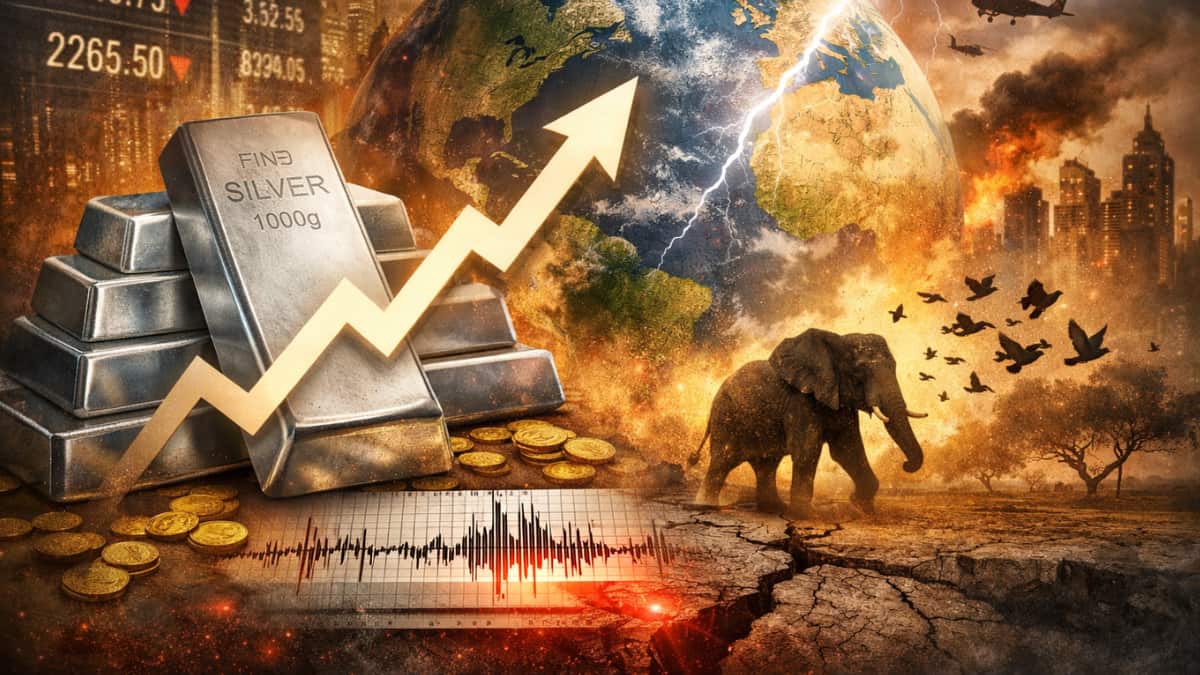
Much like how animals are known to behave weird before earthquakes—sensing some vibrations and changes in the environment that human beings cannot—investors are also increasingly turning to safe-haven assets such as silver in response to these subtle signs of volatility in global markets. The Economic Survey 2025–26 pointed out this trend, emphasising on the fact that the sudden jump in gold and silver prices are more a reflection of rising global financial and geopolitical tensions than of domestic demand.
Silver’s recent price movements clearly demonstrate this trend. The white metal first touched Rs 2 lakh per kilogram on December 17, 2025, climbed to Rs 3 lakh per kg by January 19, 2026, and then shot up to Rs 4 lakh per kg on January 29, 2026, marking the fastest Rs 1-lakh increase in just 10 days ever recorded for silver.
Also read: Economic Survey sees 1 in 5 chance of a scenario worse than 2008 financial crisis
The silver rally is not limited to India. Internationally, prices shot up nearly 12 per cent, crossing $118 an ounce, while gold rose more than 9 per cent to $5,558 an ounce. In the last month alone, silver has gained roughly 50 per cent, driven by a mix of geopolitical tensions, trade disruptions, and supply concerns.
The rally gained further momentum after the US Federal Reserve decided to hold interest rates steady, even as US 10-year bond yields briefly spiked to 4.897 per cent, underscoring volatility in global markets.
According to the Economic Survey, gold and silver act as barometers of global risk, reflecting shifts in the international system rather than local economic conditions. Growing tensions between countries, ongoing trade disputes, and highly leveraged investments—particularly in technology and AI-related projects—have made investors more cautious.
Silver’s rapid rise over the past six weeks is more than a record-setting price move; it is a signal that markets are sensing underlying instability, much like animals detect subtle changes in their environment before a storm or earthquake.
The Economic Survey specifically excludes gold and silver from core inflation calculations, pointing out that their price swings are largely influenced by global financial conditions. When these metals are left out, core inflation remains low, suggesting that supply-side conditions in India are strengthening and that domestic price pressures are under control.
The jump in silver prices—from Rs 2 lakh to Rs 4 lakh per kilogram in just over six weeks—serves as a reminder that markets often react to early warning signs long before the wider economy shows any impact. According to the Survey, these sharp rallies reflect investor caution amid growing global fragility, effectively acting as a market “early-warning system” for potential turbulence ahead.