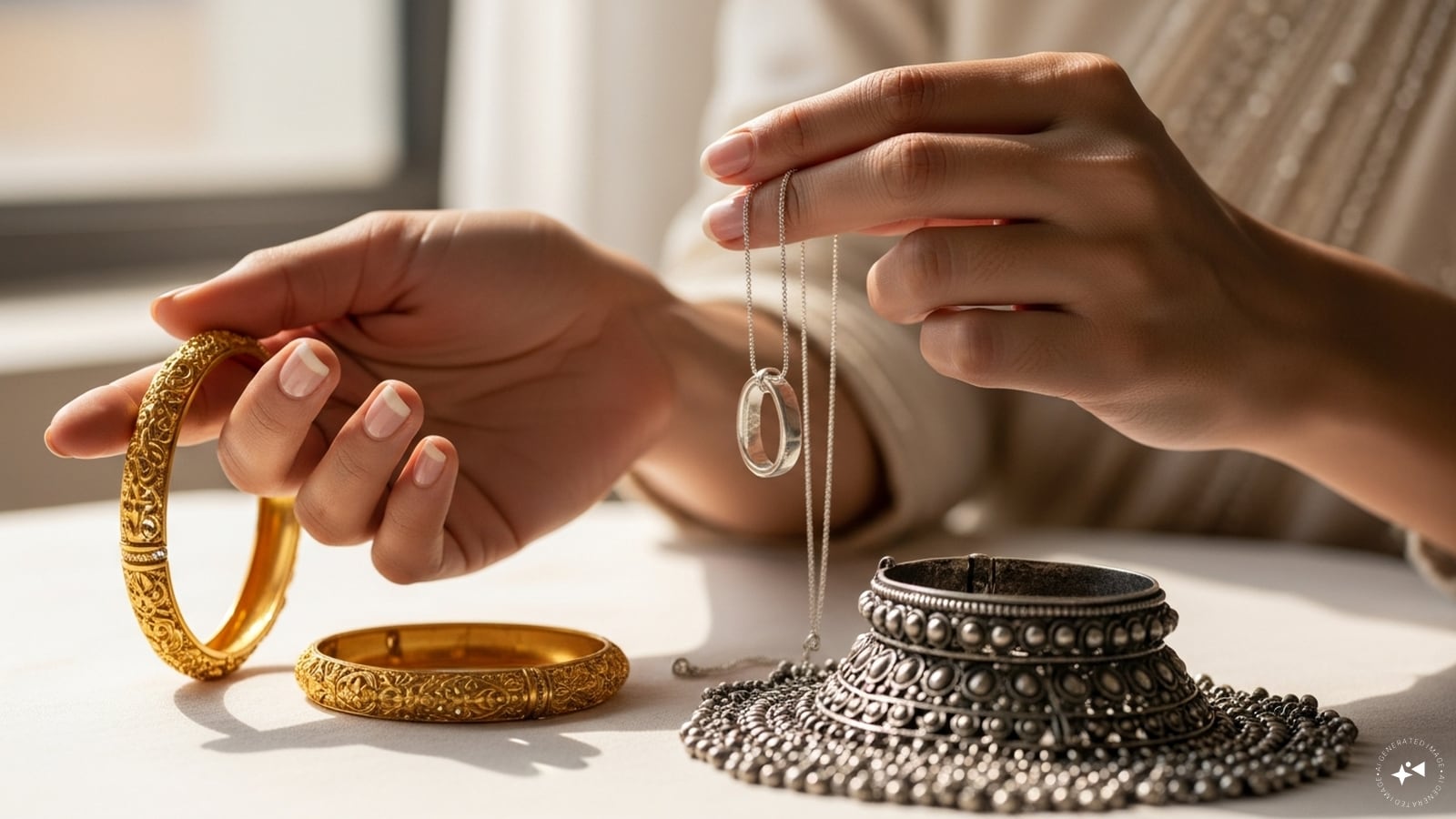
How India’s jewellery buyers are rethinking gold, silver and styling
Published on 24/02/2026 05:12 PM
How India’s jewellery buyers are rethinking gold, silver and stylingIndia’s jewellery market shows changing consumer tastes, with brands noting shifts in metal choices, styles, and a rise in digital purchases.By Anshul February 24, 2026, 5:12:29 PM IST (Published)4 Min ReadIndia’s jewellery market is not undergoing a simple shift from gold to silver, or from heavy to lightweight designs. Instead, retailers say consumer behaviour is fragmenting along sharper lines, defined by design sensibility, price awareness, lifestyle shifts and digital influence.
Conversations with brands across segments indicate that buyers are navigating metals and formats with greater intent, rather than following a single dominant trend.
Silver for gemstones: Substitution or self-expression?
Whether silver is replacing gold in coloured gemstone jewellery depends largely on the customer cohort.
At Dhirsons Jewellers, Creative Director Riva Dhir said consumers continue to prefer gold for coloured gemstones, primarily for its visual richness and inherent value. In traditional retail environments, gold remains the reference metal.
Yet, Suresh Krishnan, Vice President–Sales at PNG Jewellers, described a parallel shift. He said silver is gaining ground as both an affordability play and a matter of evolving choice, particularly among younger buyers. In several instances, silver is stepping in where gold prices stretch budgets.
For design-led brands, the narrative tilts differently.
Saumen Bhaumik, Managing Director at CaratLane, said silver’s appeal lies in experimentation. It allows customers to engage with expressive, contemporary styling at accessible price points, expanding its role beyond cost-driven substitution.
The result is a split market: gold retaining dominance in value-driven segments, while silver expands through design-led experimentation and budget flexibility.
ALSO READ | New baggage rules: How much gold and silver jewellery can be carried duty-free to India
The economics beneath the display counters
Behind these consumer choices lies a widening divergence in metal economics.
Krishnan noted that gold margins are under pressure amid elevated and volatile prices, requiring complex hedging and compliance structures. Silver, with lower input costs, offers greater pricing flexibility and comparatively healthier margins.
Bhaumik added that while craftsmanship and stone-setting standards remain consistent across metals, the pricing architecture differs. Silver supports lower entry thresholds; gold carries intrinsic value weight.
This divergence means that metal strategy today is as much about balance-sheet management as it is about consumer demand.
Discovery online, decision in-store
If there is one clear behavioural shift, it is the hybrid buying journey.
Bhaumik said roughly 70% of purchases at CaratLane are digitally influenced. Customers browse and shortlist online before visiting one of the brand’s 366 stores for physical evaluation.
He added that ticket sizes tend to be higher offline, supported by assisted selling and broader exposure to inventory.
ALSO READ | Titan stays upbeat on jewellery demand as gold swings push buyers to plan smarter
Supriya Kataria, Founder of Kumari Fine Jewellery, observed a similar pattern. Customers often arrive at stores having already defined their style preferences and budget range. The in-store visit becomes less about discovery and more about validation — assessing finish, feel and alignment with personal aesthetic.
Krishnan said browsing duration has not materially changed, though ticket values have risen — driven in part by the appreciation in silver prices rather than higher quantities per purchase.
The store, in effect, has evolved into the final checkpoint in a digitally led funnel.
Styling: From add-on to advisory layer
Jewellery styling is emerging as a structured service, though its role varies by segment.
Dhir described styling in bridal as a specialised advisory function requiring alignment with the bride’s aspirations and appearance — moving beyond transactional selling.
Krishnan framed styling as tiered: a standalone, loyalty-building proposition in luxury retail, and a marketing-driven engagement tool in the mass segment.
Kataria said styling support is central to her brand’s approach, with associates guiding customers on pairing jewellery across Indian and western wardrobes.
As product ranges widen and customer expectations sharpen, styling is becoming a differentiator — particularly in high-involvement categories like bridal.
Versatility rises, but occasion wear endures
Lifestyle changes are reshaping format preferences, especially in gold.
Kataria pointed to increasingly active routines — work, travel, leisure — driving demand for adaptable pieces that transition across settings. Bhaumik similarly noted a growing inclination toward lighter, stackable formats, partly influenced by elevated gold prices.
ALSO READ | Jewellery sales slump despite strong earnings; silver may revisit $64–$68: IBJA’s Surendra Mehta
However, occasion jewellery remains resilient. Dhir reported sustained interest in traditional, heavier designs alongside everyday formats.
Krishnan identified a metal-specific divergence: lightweight designs gaining traction in gold due to affordability constraints, while heavier, gold-finish silver pieces are seeing uptake in wedding-related purchases as customers seek visual impact at lower cost.
ALSO READ | PNGS Reva Diamond Jewellery IPO opens today: Should you subscribe to the ₹380 crore issue?Continue ReadingNote To ReadersDisclaimer: This article is for informational purposes only and should not be construed as investment advice. Readers should consult certified experts before making any investment decisions.(Edited by : Shoma Bhattacharjee)Tagsgoldgold jewellerysilver