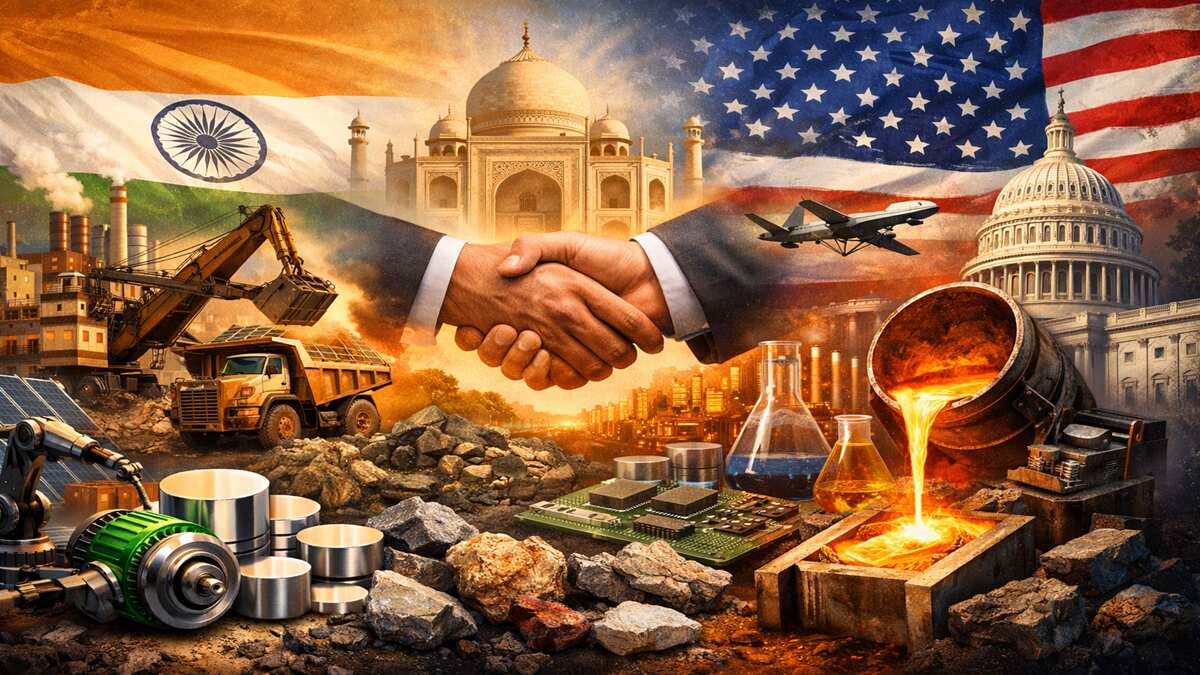
India accelerates rare earth push after India–US trade deal, Budget 2026 backs Rs 7,280 crore plan
Published on 03/02/2026 05:13 PM
Rare earth permanent magnets are small but extremely powerful, which is why they are used in everything from EV motors and wind turbines to electronics, defence equipment and precision sensors.India already has a solid base of rare earth resources to work with.
The country holds about 13.15 million tonnes of monazite, containing an estimated 7.23 million tonnes of rare earth oxides, spread across Odisha, Kerala, Andhra Pradesh, Tamil Nadu, West Bengal, Gujarat, Maharashtra and Jharkhand. Additional in-situ resources have been identified in hard-rock areas of Gujarat and Rajasthan.
The scheme provides Rs 6,450 crore in sales-linked incentives over five years and a Rs 750 crore capital subsidy to support advanced processing facilities. The plan is to pick up to five companies through a global bidding process. They will get two years to set up operations, after which incentives will be paid based on actual production. The idea is simple: build a dependable local supply of rare earth magnets for EVs, renewable energy, electronics, aerospace and defence.
The initiative builds on the long-standing presence of IREL (India) Limited, which has been operating under the Department of Atomic Energy since 1963.
IREL has a processing capacity of 10 lakh tonnes per annum and produces strategic minerals including ilmenite, rutile, zircon, sillimanite and garnet.
Crucially, it already operates a rare earth extraction plant in Odisha and a rare earth refining unit at Aluva in Kerala. Integrating these facilities with new corridor-based investments is expected to shorten development timelines and accelerate India’s transition towards advanced rare earth manufacturing.
India’s domestic push is now being reinforced by developments on the global stage. The three-day meeting will focus on securing and diversifying supply chains for minerals critical to technological innovation, economic competitiveness and national security. External Affairs Minister Jaishankar is attending the ministerial, which follows closely on the heels of a landmark India–US trade agreement announced after months of tariff-related tensions.
Parallel efforts have included a Finance Ministerial convened earlier this month by US Treasury Secretary Scott Bessent to explore ways to diversify rare earth and critical mineral supply chains, with India represented by Union Minister Ashwini Vaishnaw. India–US defence ties have also continued to deepen, reinforcing the strategic context in which mineral cooperation is taking place.
India is trying to cover both bases - build at home, and tie up abroad. Through KABIL, India is already involved in projects like lithium exploration in Argentina. These overseas assets are meant to backstop domestic manufacturing and reduce the risk of sudden global supply disruptions.
Taken together, the Rs 7,280 crore rare earth magnet scheme, the Budget’s rare earth corridors and closer strategic engagement with the US signal a clear shift in approach. India is no longer just looking at owning resources; the focus is now on controlling more of the value chain, securing supplies and working with global partners.