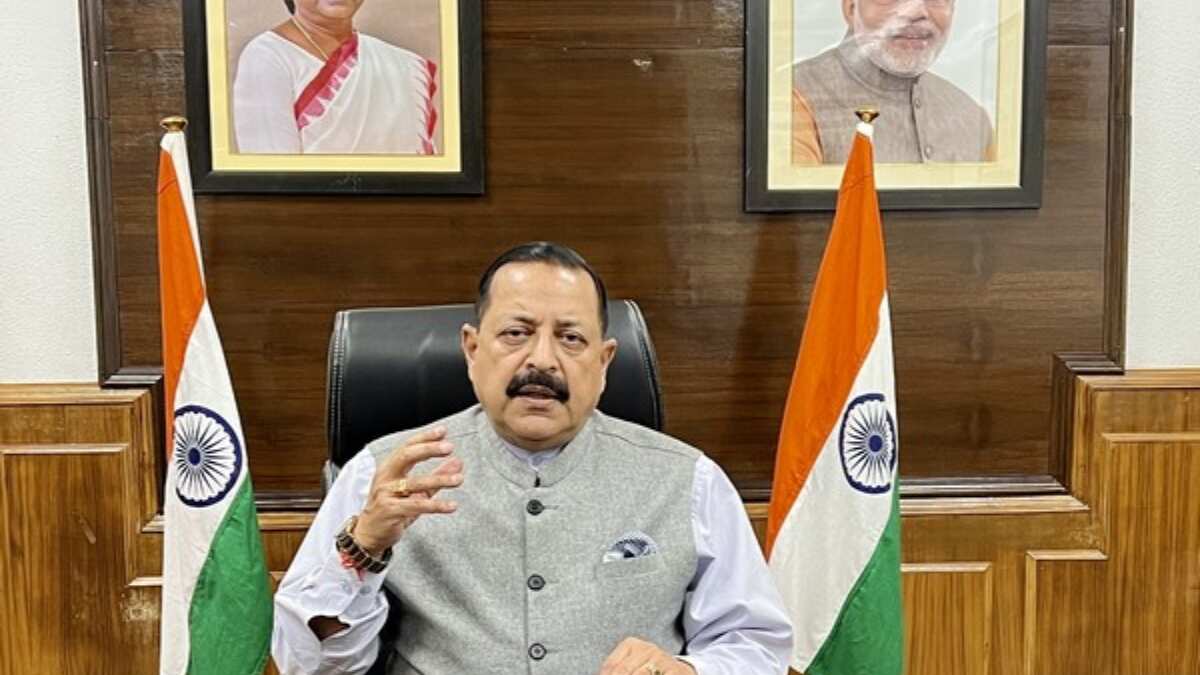
India advances renewable energy with new solar and eco research center
Published on 06/01/2026 12:35 PM
The facilities coming up at CSIR-National Physical Laboratory (NPL) like the world's second "National Environmental Standard Laboratory" and the world's fifth "National Primary Standard Facility for Solar Cell Calibration" will pave the way for the Indian environment and renewable energy sector to take a giant leap, claimed Union Minister of State for Science and Technology (Independent Charge).
The Minister opened the top national laboratories during the 80th anniversary celebration of CSIR-NPL here.
In an address, Singh characterized the National Environmental Standard Laboratory as a vital move towards enhancing India’s environmental governance framework.
“Calibration and certification of air pollution monitoring systems that are reliable and India-specific were very much needed and the facility would now make it possible to have the environmental data which is accessible, traceable and accurate. Moreover, the facility will not only assist the regulatory authorities and industries, but also startups, because the monitoring devices will have been tested under Indian climatic conditions which will in turn lead to better policy compliance under the National Clean Air Programme and such like,” Singh said.
The Minister referred to the Solar Energy Complex as “a future-ready facility that not only India but also a few other global leaders in photovoltaic measurement standards can count as being amongst them”.
The meter which is based on the laser and developed in cooperation with PTB, Germany has achieved the lowest uncertainty in the world at 0.35 percent (k=2) for reference solar cell calibration.
Singh highlighted that the new laboratory will bring down India’s dependence on foreign certifying agencies, also saving the country money, having quicker calibration services, and boosting trust of investors in India’s fast growing solar power industry.
The Minister predicted that science and tech reforms will be the main drivers determining the direction of India’s socio-economic development.
In attributing to India’s top scientific institutions the title of “monuments of 20th and 21st century India,” Singh argued that labs like CSIR-NPL represent India’s remarkably long and gradual path of scientific advancements beginning from pre-Independence existence to global technological leadership.
The Minister mentioned that the laboratory was already functioning during the colonial rule and eventually became one of the pillars of India’s scientific foundation post-Independence.
He pointed out that CSIR indeed has a longer history than independent India, thus making NPL one of the “siblings” among the 37 CSIR laboratories.
The Minister referred to the laboratory as having been supported by eminent national leaders like Dr. Syama Prasad Mukherjee and Sardar Vallabhbhai Patel, and he proposed NPL as a rare institution where history and science come together, as reported by IANS.
“For so many years, the atomic clock of NPL was half the country’s reference time,” the Minister said, thus pointing out the laboratory’s contribution to the establishment of Indian Standard Time (IST).
Singh remarked that Indian researchers are not anymore limited to working in labs isolated from society but rather are at the very core of national hopes and dreams.