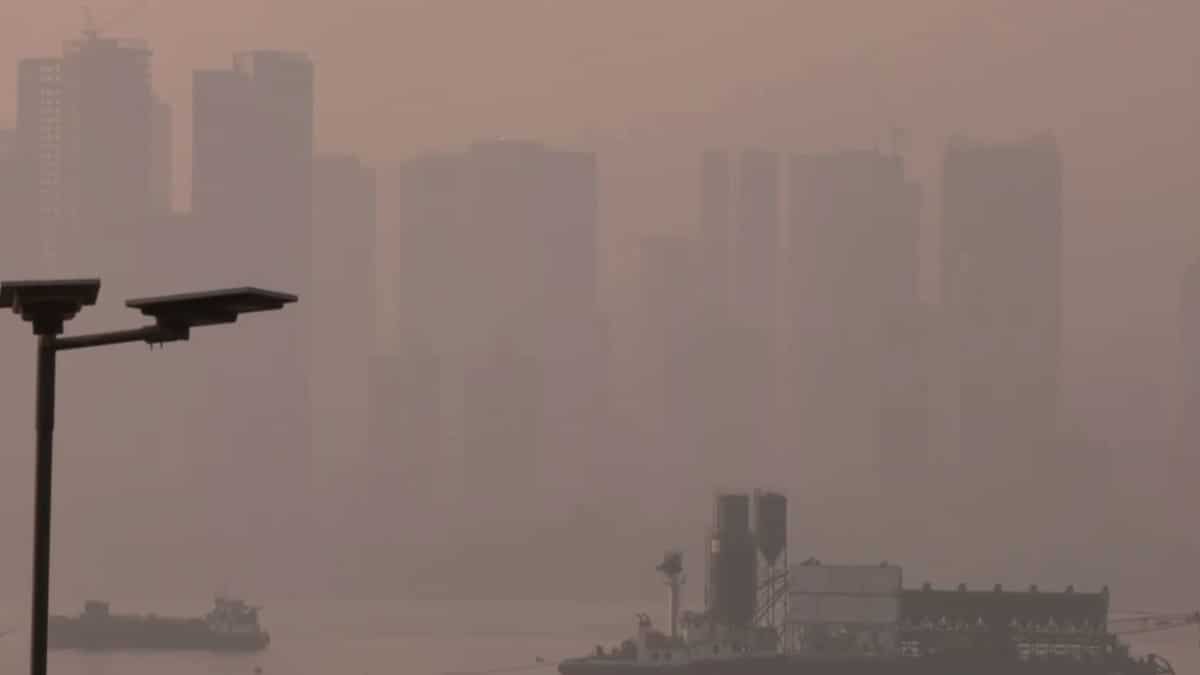
Mumbai sees moderate haze while Delhi chokes under severe air pollution
Published on 18/12/2025 12:03 PM
Mumbai's Bandra Kurla Complex residents got up to hazy skies today as the area's Air Quality Index (AQI) reached 148.
The Central Pollution Control Board says that these levels are now categorized as "moderate," which means that there is less clarity in the atmosphere.
The AQI was reported to be 182 in Chembur, 126 in Kurla, 114 in Chakala-Andheri East-IITM, 91 in Mazgaon, 51 in Malad West, 161 in Ghatkopar and 106 in Worli.
The AQI categorization classifies readings of 0-50 as 'good', 51-100 as 'satisfactory', 101-200 as 'moderate', 201-300 as 'poor', 301-400 as 'very poor', and 401-500 as 'severe'.
On the other hand, the capital city experienced heavy smoke in the morning of Sunday, with the average Air Quality Index (AQI) was recorded highest of 461 at 7 am, which was in the 'severe' category despite the Graded Response Action Plan (GRAP)-IV being implemented across Delhi and the National Capital Region (NCR), as stated by the Central Pollution Control Board (CPCB).
Extremely limited visibility was caused by the thick fog in Ghazipur, the ITO area, and Anand Vihar, with the CPCB stating that several localities throughout the city still had "severe" air quality registered.
A thick layer of toxic smog engulfed the area outside ISBT Kashmere Gate, with an Air Quality Index that was recorded at 384. According to the AQI categorization, 0-50 is 'good', 51-100 is 'satisfactory', 101-200 is 'moderate', 201-300 is 'poor', 301-400 is 'very poor' and 401-500 is 'severe'.
Anand Vihar is under a coat of hazardous smoke that has pushed the air quality index reported by the Central Pollution Control Board to 491, which is the highest 'severe' category.
The Indira Gandhi International Airport (IGI) in the capital city came up with a passenger advisory due to the thick fog on Thursday morning, saying that LVP had been put in place while the flights were being operated as per normal schedule.
In a travel alert given at 4.30 am, the authorities at Delhi Airport told the passengers that the foggy weather had caused the visibility to be very low, and that LVP was being applied so that there would be no chance of accidents during the taking off and landing of the planes.