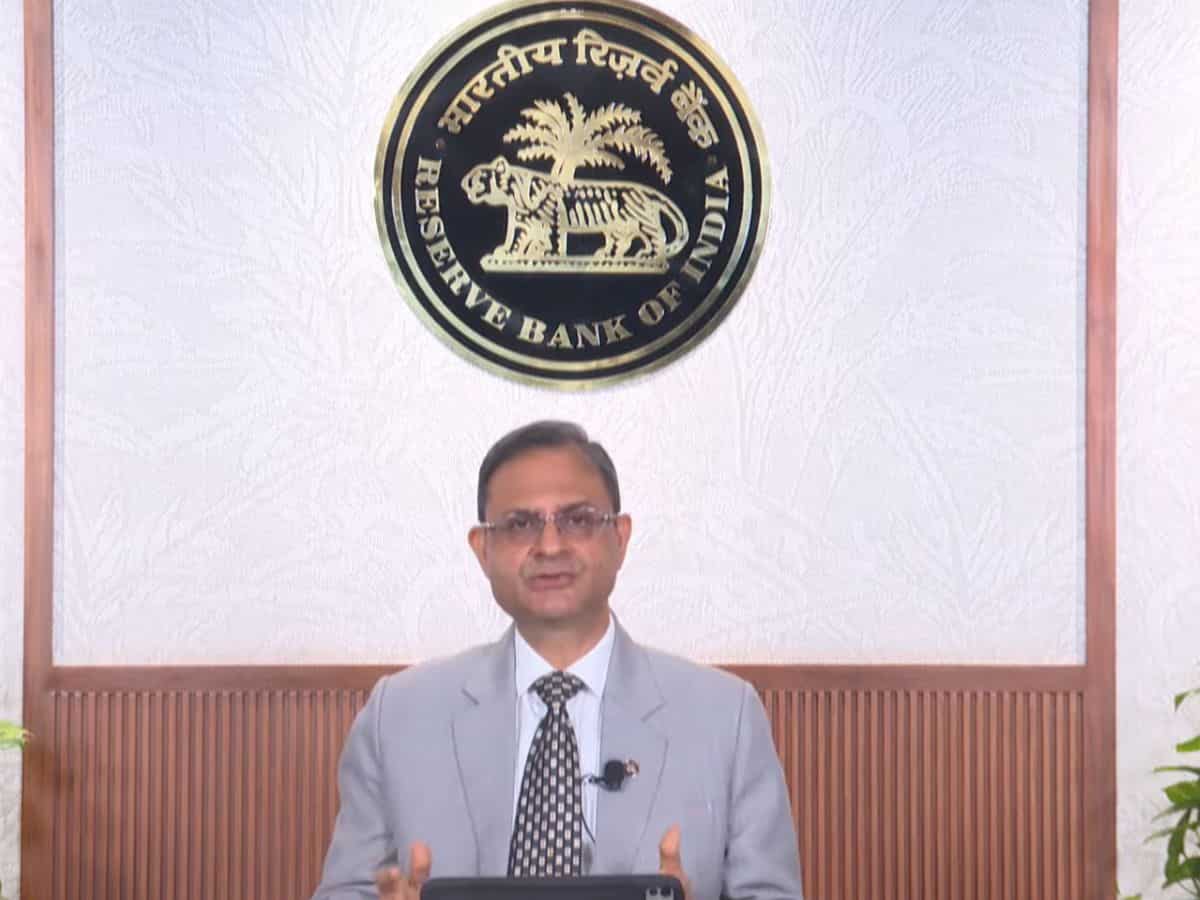
RBI August MPC Meeting: Should lenders and borrowers prepare for a rate cut? What you can expect from Sanjay Malhotra
Published on 05/08/2025 07:13 PM
Can the RBI cut the repo rate in its August review? After the RBI Governor Sanjay Malhotra-chaired committee’s bigger-than-expected 50-basis-point reduction in June, economists are divided with four in every 10 expecting half of that cut in the August review. Here’s a 10-point guide on key expectations and economic indicators ahead of the bi-monthly policy meeting, which began on Monday:
Sixty per cent of the participants expect no change in the key lending rate in the forthcoming review. Currently, the repo rate—or the key interest rate at which the RBI lends short-term funds to commercial banks—stands at 5.50 per cent, following three back-to-back bi-monthly cuts starting in February.
Participating economists are also divided over the expected rate cuts in the remaining three scheduled reviews after August this financial year.
Six in every 10 economists expect a 25-basis-point cut through the October, December, and February reviews, with the remaining participants anticipating the cut to be of 50 bps.
Currently, the repo rate is at its lowest since August 2022. In terms of both number and magnitude, the RBI has delivered the biggest rate-easing spree since the pandemic year.
None of the polled economists expects the MPC to change its current stance on the policy. In June, the six-member panel switched to a ‘neutral’ stance from ‘accommodative’.
A neutral stance indicates the RBI is willing to act in either direction with key lending rates, contrary to the previous stance, which indicated its intent to ease the monetary policy.
According to the economists polled, the MPC is expected to revise its inflation projections in the August review. Currently, the RBI expects consumer inflation at 3.7 per cent for FY26, with 2.9 per cent in Q1, 3.4 per cent in Q2, 3.9 per cent in Q3, and 4.4 per cent in Q4.
Ninety per cent of the respondents expect no change in the GDP forecasts in this review. In the last review, the RBI projected GDP growth at 6.5 per cent in FY26, with 6.5 per cent in Q1, 6.7 per cent in Q2, 6.6 per cent and Q3, and 6.3 per cent in Q4.
Bankers, borrowers, and economists will closely track the RBI’s commentary on the trade situation after the US President warned of "substantially" increasing a 25 per cent tariff on India while criticising its oil trade-based relations with Russia.
The RBI’s outlook on factors like liquidity measures, economic fallout from tariff changes, above-average monsoon rains, easing crude oil prices, and the financial conditions in the banking system.
The Narendra Modi 3.0 government pushed back strongly against Trump’s latest remarks, calling his remarks about India along with the tariff threat “unjustified and unreasonable”.
The external affairs ministry defended the country’s energy strategy, stating that its crude oil buys from Russia are “a necessity” related to “global market conditions”.
Speaking at an event last month, Malhotra reiterated that going forward, any rate cuts will depend on the RBI’s outlook on growth and inflation instead of the latest available numbers. He also stated that maintaining price stability while supporting economic growth remains the central bank’s top priority.
The RBI governor also stated commercial banks’ rate transmission has covered the February and April cuts so far, indicating room for the lenders to further pass on the benefit of lower borrowing costs to their customers.
It is the benchmark interest rate at which the RBI lends short-term funds to commercial banks like SBI and HDFC Bank.
The repo rate determines borrowing costs for commercial banks. Simply put, these costs influence the loan interest rates that these lenders charge from people and businesses.
A rate cut means lowering the repo rate, making borrowing cheaper for banks and subsequently for borrowers. This phenomenon is also known as ‘monetary policy easing’ or ‘monetary easing’.
Several types of loans are linked to the repo rate, including repo-linked home loan rates, external benchmark-linked personal loan and auto loan rates, and even some mortgage loans (those with floating interest rates). These loans tend to get impacted by repo rate changes as their benchmark rate moves with policy changes.
As loans become cheaper, monthly loan payments—known as EMIs—may decrease.
Inflation is the rate at which the prices of select goods and services increase over a given period of time. Rising inflation means reducing purchasing power.
The RBI tracks consumer inflation—measured by Consumer Price Index—to formulate its monetary policy.
Tariffs, which are taxes on imports or exports, can influence economies. While higher tariffs protect local businesses while raising costs for consumers, lower tariffs promote trade and efficiency but may make it more difficult for local industries.
The RBI adjusts the key lending rates to keep inflation low while ensuring economic growth.
Rate transmission refers to the act of banks passing on revisions in benchmark interest rates to their customers, especially borrowers. Commercial banks are not mandated to transmit repo rate changes to their customers.
However, they are required to link new floating rate loans to individuals and MSMEs to external benchmarks, with the repo being a primary option.
Get Latest Business News, Stock Market Updates and Videos; Check your tax outgo through Income Tax Calculator and save money through our Personal Finance coverage. Check Business Breaking News Live on Zee Business Twitter and Facebook. Subscribe on YouTube.
LATEST NEWSBy accepting cookies, you agree to the storing of cookies on your device to enhance site navigation, analyze site usage, and assist in our marketing efforts.