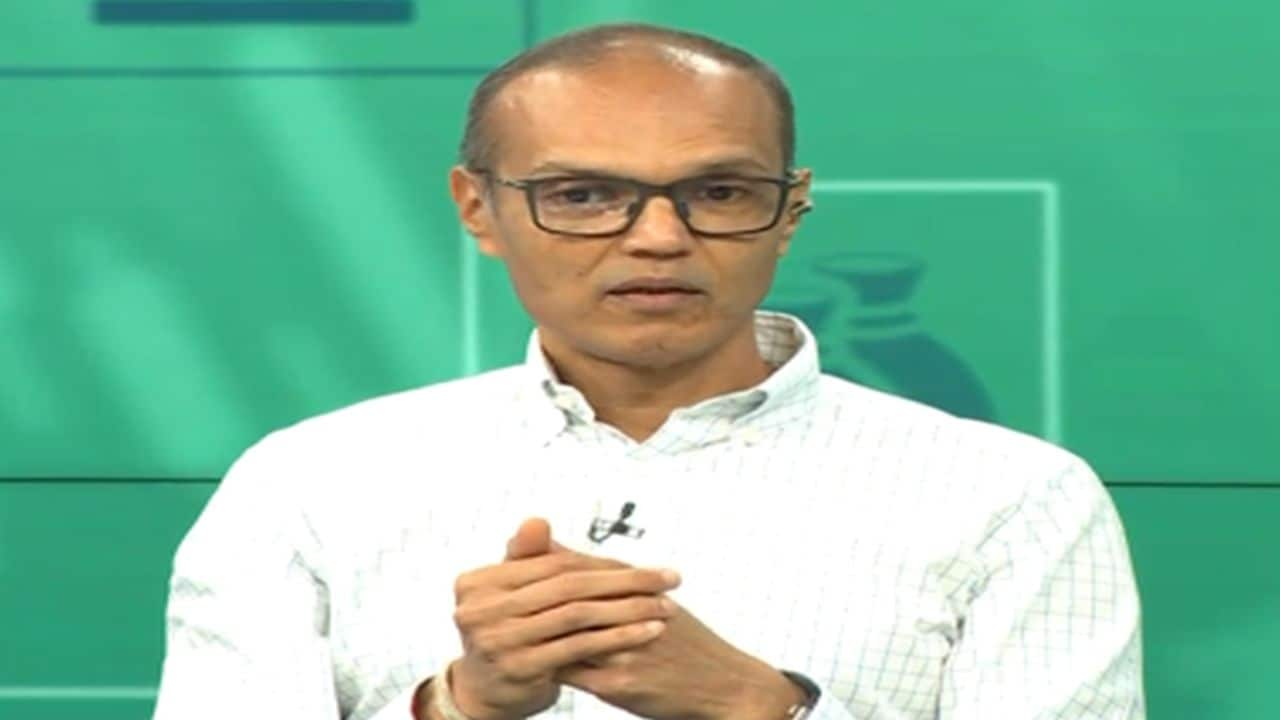
Ridham Desai says India’s retail money isn’t short-term, it’s here to stay
Published on 04/06/2025 02:00 PM
Ridham Desai says India’s retail money isn’t short-term, it’s here to stayRidham Desai of Morgan Stanley believes India’s rising global stature, sticky retail flows, and predictable growth are keeping market sentiment strong. Speaking at the firm’s India Investment Forum, he also explained why foreign interest is growing and Indian stocks still look cheap.By Surabhi Upadhyay | Nimesh Shah June 4, 2025, 2:00:33 PM IST (Published)11 Min ReadIndia’s retail investors aren’t going anywhere anytime soon. That’s the view of Ridham Desai, Managing Director and Head of India Research at Morgan Stanley, who believes this segment of the market is far more stable than many assume.
“Retail in India is not looking at their prices every day… they’re buying the stocks and just going to sleep,” he told CNBC-TV18 from the sidelines of the firm’s India Investment Forum.
Desai noted that the average holding period for retail investors in India is 36 months, much longer than anywhere else in the world.
These are edited excerpts of the interview.
Q.: How's the josh at the conference and otherwise?
A: There's a lot of interest in India. There's no doubt that people need to understand India from multiple angles. I'll tell you how these things have changed. We've been doing this for 27 years. Many years ago, people would come because they had portfolios or they were looking to buy stocks in India, and they had to check on companies and understand the macro. That has now changed. People still do that for a living, but they also need to understand India from a global perspective.
So you're not now just coming to India because you have a couple of investments in India. You're also coming to India because India is moving the world. The world may not slip into recession this year because of India. It's important to know whether India is going to do well or not, because if India is not going to do well, then the world may have a recession, which has implications on everyone else. India's stature in global markets and macro has completely changed in the last 10 years. We're now significant.
Q: Are a lot of newer foreign investors looking to register and understand the India story?
A: That's not restricted to just equity clients. Over the last two years, I've met as many corporate CEOs as I've met CIOs. There's actually a lot greater interest in the corporate world than in the equity world. And the reason for that is that equity markets are still not easy for what I call ‘tourist money’. If you're an entrenched investor with ample resources to understand the market, then you've got yourself registered, etc. But if you're just passing by like a tourist, you have to go through a process, and that is where tourist money struggles to engage.
Corporates come with a longer duration on the table, and they need to understand India. Depending on what product or service you sell to your customers, India is somewhere between 10% and 150% of your growth in the next two calendar years. If you're growing your business, India is accounting for most of it. India this year will be nearly a quarter of global GDP growth, and probably the same next year.
Q: There's a lot of talk about whether India can seize this opportunity due to a dislocation in global supply chains. Do you see that happening, especially as you're overweight industrials? What does this new Trump-led global order mean for Indian companies?
A: The decision on setting up a local manufacturing facility in India doesn't have much to do with the tariffs that President Trump is proposing. A lot of these plans were already underway pre-April, and I don't think they're changing dramatically because of the tariffs. There may be some delays, because people want clarity. That's exactly why global growth is slowing down—because companies are pushing back investment plans, waiting to see how the environment pans out over the next few months.
That aside, there's really no impact on these investment plans. India is still a favoured destination for what we call China Plus One. One of the primary drivers for that is India's home market, which is very critical to many multinational corporations. Look at the industrial companies from Europe—they're all saying that India is going to be a big driver of their growth. Look at the electronics sector, look at phone companies—India is a major part of their growth. That story is continuing, and India will continue to attract that.
One thing to bear in mind: India is not becoming the next China. I don't think the world has the appetite to create capacities like it did in China over the last 20 years. The world is heavily indebted and ageing. So growth on a structural basis for the world at large, excluding India, is likely to be much slower than it has been over the last 15 to 20 years. But the appetite to diversify supply chains and build facilities in India to cater to its home market—that's clearly there. India's manufacturing share of GDP will rise, but don’t hold your breath for a China-like scale. It's not happening, in my view.
Q: Let's talk about earnings. You’ve said that due to a confluence of positive factors, you're expecting sustained mid- to high-teens earnings growth. That's a little above consensus. What makes you confident that earnings are coming back?
A: We are in an earnings upcycle. Very simply put, earnings tend to move around the nominal GDP trend. The nominal GDP trend in India is largely a straight line, except for the COVID dip. Earnings don't go up in a straight line. We're somewhere here right now. Trendline GDP is here. The damage happened between 2011 and 2015—earnings fell well below trend, and now we are playing catch-up. Then again, we got a setback during COVID, and now we're catching up again.
It's very simple mathematics; earnings will catch up with nominal GDP, then go above it, and that will be the peak of the cycle. We're somewhere halfway through that. We consider the COVID bottom as the start of this earnings cycle, though it started slightly before that. COVID distorted the data, so we are somewhere halfway through. It's largely driven by a slow and steady rise in capex.
This cycle looks more durable than the previous one from 2004 to 2008, because capex isn’t going to shoot up rapidly. Back then, capex and earnings went up sharply, then came down. This time, it looks more gradual. A lot of people say there's no capex in India. I think they feel that way because the nature of capital spending has changed. We're not going to build massive steel and cement plants like in that era. A lot of the capex is being written off on the balance sheets—not capitalised—because that's the nature of capex now.
And most importantly, in the last 10 years, India's incremental capital output ratio has fallen. Labour productivity has gone up. All-factor productivity is higher. Our infrastructure is better. Our labour is better. That means we need less capex to drive the same amount of growth.
Q: So no point saying that private sector capex is not picking up. Animal spirits are not firing. We need to go beneath the surface to see the reality.
A: There is an element of animal spirits, and they did get dampened last year, when the government contracted its fiscal deficit a lot, especially in the first half of the last fiscal. By the end of September, the fiscal deficit was tracking 3.4% of GDP versus 6% in the previous year. That's not the type of fiscal consolidation any economy can take. Though there were one-off factors, it started normalising. It took about three months to normalise, and now we have arrived in this year, and the first quarter was very good.
Added to that is the fact that the central bank has become far more dovish, rightfully so, and that is fueling a recovery from that soft patch we went through, which triggered the small- and mid-cap selloff.
And I tell this to people now. What has happened in the last six months? You've had a precipitous selloff in small and mid caps. Some stocks went down 70–80%. We had these major announcements on tariffs. We had a little bit of a skirmish with Pakistan. And we had this slowdown in growth, which everybody thought was the end of the cycle. So imagine, we digested all of this, and the market is like 4–5% from all-time highs.
So my instinct is, technically, the market wants to go up. It doesn't want to go down. So you are bearish at your own risk.
Q: The other factor has been the technical factor of supply of paper. We've seen massive blocks and massive promoter and PE exits in the last few weeks. How do you read that development? Is that a red flag, according to you?
A: Two things. Most people thought that the mid-cap index fell 20-25%, and retail will run away. Let us accept that retail is not a short-term player. If you talk to the really large distributors on the ground, they will tell you that retail in India is not looking at their prices every day. They're buying the stocks and just going to sleep. And the average holding period of Indian retail investors is 36 months. Nowhere on the planet does any class of investors hold stocks that long, as the average investor in India.
As far as supply is concerned, we had a little bit of bunching up, but that was in 2023. But you have to add up the numbers and divide them by the market cap. Whatever number you see — whether it's a weekly or a monthly number — if it's a monthly number, multiply by 12 and divide by market cap. That number, if it starts crossing 2.5-3%, then I will get worried.
What is 2.5-3%? It's $10 billion of issuance every month for 9-10 months on the trot. We're not there yet. When we get there, the market will have to correct, because that will then exceed the debate on stocks.
Q: When are these foreign investors coming back? The narrative is strong, the macros are strong, and there's this big shift about diversifying away from US assets. But where do we figure in that? China is a great competitor, and maybe they have valuations on their side.
A: So the China valuations have always been on the Chinese side. For 25 years, there's not been a single year that China traded at a premium to Indian stocks. Yet in the last 25 years, India has handsomely beaten Chinese stocks. So if you invest in stocks looking at P/E ratios, it's a disaster. Price-to-earnings has nothing to do with value. It’s just another way of expressing price. You can express price in US dollars — I can say this is worth $6, or it's worth half a gram of gold, or it's worth ₹500, or it's five times earnings. It’s just price.
Value is something very different. It's about a company's ability to generate cash flows and what expected return I have from that. So the reason I can't explain this is because a lot of the tourist money economy is also very lazy and wants convenient thumb rules to make their decisions — and they're very wrong.
You look at private sector banks in India 25 years ago, they all traded significantly higher price multiples than today. Yet, for 20 years, they were among the best-performing stocks in India.
If the starting point of price-to-book or price-to-earnings is going to determine what delivers, then investing would be a very easy game. So it's not so simple. I think stocks are cheap. Stocks are inexpensive in India.
I wrote that day before yesterday — my title of the report is: “Equities are inexpensive.” Bond yield in India — 10-year bond yield — is 6.2%. The equity yield is 5%. India is a growth market. The gap is minus 1%. This is cheap. Look at Nifty in gold ounces — either gold prices fall or Nifty goes up. It's cheap.
Q: Refreshing. Indian stocks are cheap — we don’t hear that every day.
A: So, to complete, the reason I’m saying that is because, as a consequence of the policy decisions that we have made in the last few years, we have dampened our inflation volatility — which therefore means we have dampened our interest rate vols. And if interest rate vols are low, growth vols are low. Equities thrive in a predictable growth environment.
If you can figure that a company has a 20% CAGR in growth for the next five years, you will pay 60 times earnings for it. You’re not going to say, “Oh, 60 is expensive,” because predictability of earnings — or predictability of dividends, to be more precise — is the trickiest thing in equities.
It’s not the issue in bonds. In bonds, you know the coupon, and you know it exactly for how many years. So there’s no valuation debate in bonds. The debate arises because your forecast and my forecast on cash flows is different.
Continue ReadingCheck out our in-depth Market Coverage, Business News & get real-time Stock Market Updates on CNBC-TV18. Also, Watch our channels CNBC-TV18, CNBC Awaaz and CNBC Bajar Live on-the-go!Tagsfund managerfund managersglobal market outlook