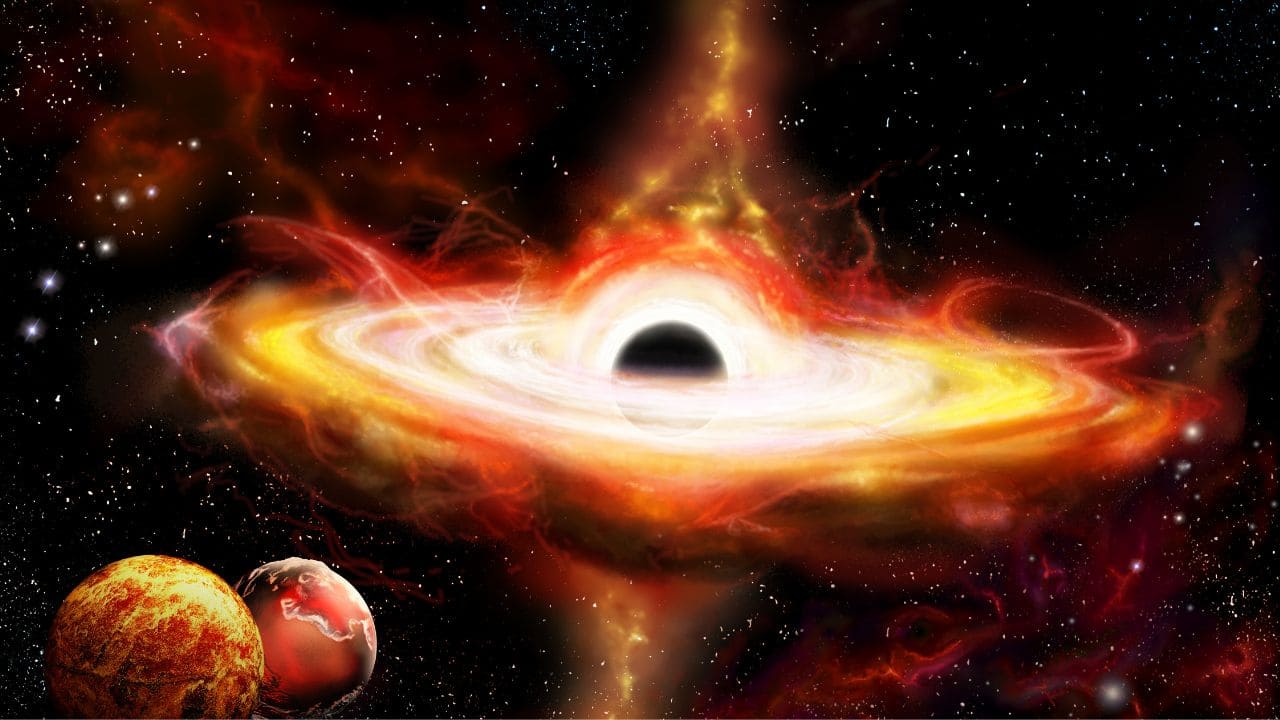
Scientists confirm lone black hole wandering through Milky Way
Published on 28/04/2025 12:45 PM
Among the countless starry expanse of our galaxy, a lone black hole had been silently gliding — unrecognised until today. Due to decades of determination, a group of researchers has successfully proven its presence.
Discovery Years in the Making
Earlier this month, the discovery was confirmed in a study published in the Astrophysical Journal. The black hole was originally discovered in 2022 by Kailash Sahu and his team at the Space Telescope Science Institute. They had discovered a dark object that was wandering in the Sagittarius constellation.
At the time, the discovery sparked debate among astronomers. Some experts suggested the object might instead be a neutron star. Refusing to let the mystery linger, Mr Sahu's team returned to the data for answers.
By examining data from the Hubble Space Telescope and Gaia space probe, which were gathered from 2021 to 2022, the team discovered even more robust evidence. Their recent analysis reinforced their initial suspicion that the object really was a black hole.
A Black Hole Without a Companion
Until now, all the black holes found in the Milky Way galaxy were accompanied by a partner star. Black holes are hard to detect without a companion star because they don't emit light.
But Mr Sahu's group used a method known as gravitational lensing to find the outlawed object. They saw the light from a distant star briefly get bigger and change color as the black hole crossed in front of it.
This phenomenon enabled researchers to measure the weight of the object. They estimated it to be approximately seven times more massive than our Sun, which made it impossible for it to be a neutron star.
The single black hole is situated approximately 5,000 light-years from us. It is much nearer to us than the iconic Sagittarius A*, the supermassive black hole at the Milky Way's core.
Hope for Future Discoveries
Encouraged by their triumph, Mr Sahu and his colleagues are eyeing the future. They intend to find more such marauding black holes with the Nancy Grace Roman Space Telescope.
The telescope, whose launch is due in 2027, promises a new era in the search for these ghostly cosmic drifters.
Discover the latest Business News, Budget 2025 News, Sensex, and Nifty updates. Obtain Personal Finance insights, tax queries, and expert opinions on Moneycontrol or download the Moneycontrol App to stay updated!
${res.must_watch_article[0].headline}
Sensex Today Jammu Kashmir News Live Ather Energy IPO JNU Poll Results GIFT Nifty India Economy Apple App Store Dalai Lama TS SSC Results 2025 IPL Points Table 2025
Business Markets Stocks India News City News Economy Mutual Funds Personal Finance IPO News Startups
Home Currencies Commodities Pre-Market IPO Global Market Bonds
Home Loans up to 50 Lakhs Credit Cards Lifetime Free Finance TrackerNew Fixed Deposits Fixed Deposit Comparison Fixed Income
Home MC 30 Top Ranked Funds ETFs Mutual Fund Screener
Income Tax Calculator EMI Calculator Retirement Planning Gratuity Calculator
Stock Markets
News18 Firstpost CNBC TV18 News18 Hindi Cricketnext Overdrive Topper Learning
About Us Contact Us Advisory Alert Advertise with Us SupportDisclaimer Privacy Policy Cookie Policy Terms & Conditions Financial Terms (Glossary) Sitemap Investors
You are already a Moneycontrol Pro user.