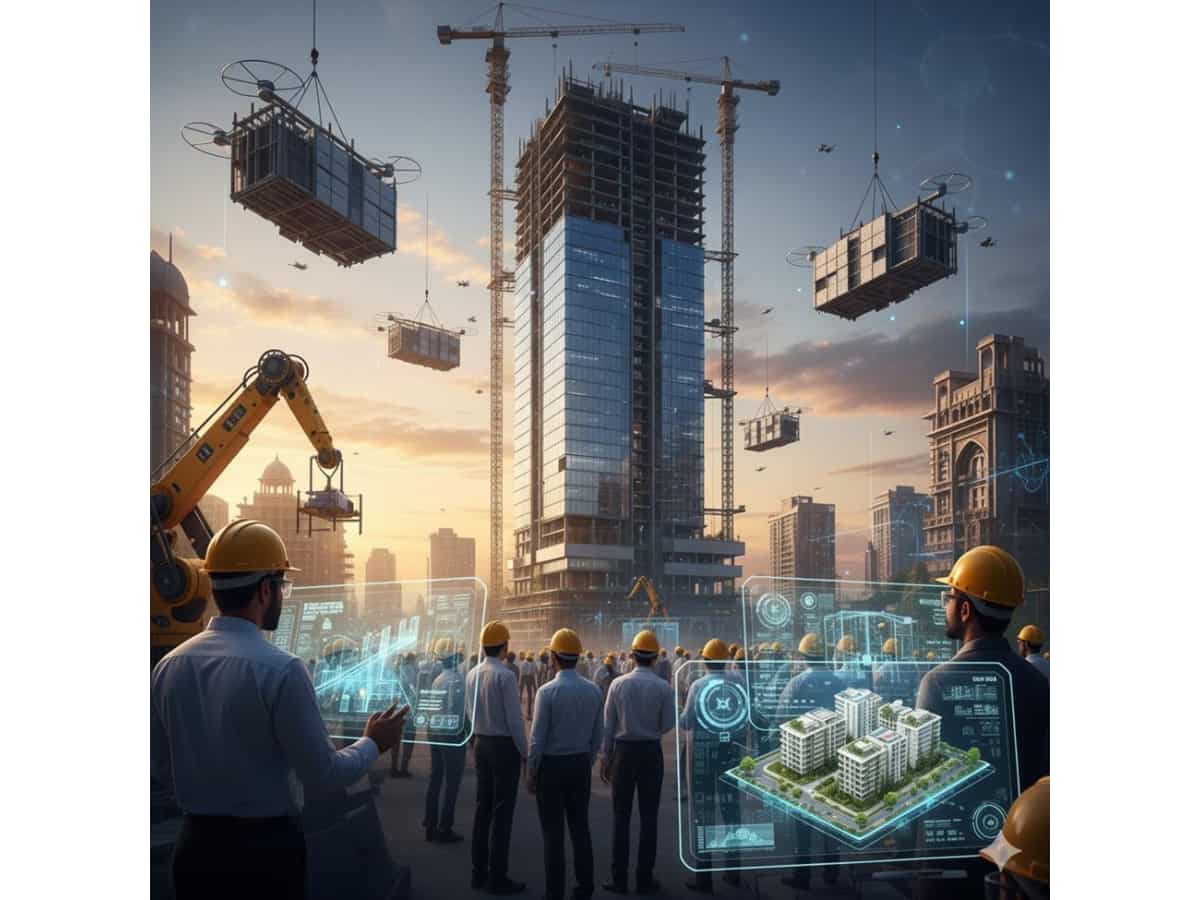
The Future of Home Construction: From blueprints to AI-powered execution
Published on 27/10/2025 03:21 PM
Nowadays, India's home construction industry is experiencing a technological revolution that aims at easing the construction process and reducing overall costs by enhancing efficiency. Initially, the building process is a very time-consuming task, like creating detailed blueprints and manual supervision at every stage of construction. In today's world, it has developed into a digital process that is not only facilitated by Artificial Intelligence (AI) but also covers 3D features like modelling and automation, and smart project monitoring tools. There are various companies that are working in this context. Companies like Brick & Bolt are leading this transformation, using the most updated technology to streamline construction, manage costs, and also ensure timely delivery.
Nowadays, developing the future of construction is not limited to making promises, and is also technology-driven and eco-friendly as compared to traditional ways. It offers more transparency, fast project completion surety, and better quality construction that has enhanced the overall development globally.
3D Modeling: Visualising homes before construction
Traditionally, the design of the house was done with paper drawings and these outdated 2D plans require a lot of time and effort to get completed in a precise manner. The plans are not easy to understand, and most of the investors get confused during execution.
All these complications can be solved in a precise manner by using dedicated 3D modelling and BIM (Building Information Modelling). With BIM, even a single change that has been made in a 3D model will automatically update other features like structural load, materials, and estimated cost for all users, including structural engineers, contractors, and builders. With these modern construction technologies, it becomes easier for designers, architects, and civil engineers to understand by both the contractors and investors.
As per the recently released industrial report, up to 30 per cent of construction costs are spent on executing in reworks like repairing works, design modifications, and unforeseen issues. The use of BIM can also help to minimise cost variation by up to 40 per cent as compared to traditional planning methods.
Artificial Intelligence: The smart construction brain
AI is another game changer in the construction sector. This is because it can improve almost all stages of construction. Currently, it can be optimised from design planning, material accumulation and risk management. Now, AI algorithms can assess all possible datasets that help to make the most suitable recommendations. Let us tell you with an example: AI-powered tools can assess soil conditions, and deliver the insights of real-time local weather conditions, and deliver material strength to create cost-efficient structural designs. Therefore, AI predictive analytics can predict potential delays or budget variations, enabling proactive action as compared to reactive corrections.
As per the study, making use of Artificial Intelligence in construction can generate more accurate estimates. Not only this, it helps in reducing budget and timeline deviations by an estimated 10-20% and engineering hours by 10-30%.
Automation and Robotics: The future workforce
The application of automation and robotics for residential projects is limited.
In future times, there is a higher chance of innovations in advanced robots that reduces the requirements of manual workers. It saves manpower for heavy or repetitive tasks for example: laying bricks, pouring concrete, or site surveying.
Currently, drones with high resolution cameras are trending. They are useful for fulfilling several requirements like regular inspections of the construction site, building assessments, tracking the construction process, inspection and performing maintenance planning. So, builders can recognise possible issues earlier and make possible corrections that directly helps in avoiding the need for costly repairs. Also, it helps to ensure that the structure is built by following all essential safety regulations, and track progress preciously.
Project Monitoring Apps: Empowering homeowners
Each and every construction involves management of multiple tasks, teams, and resources. Sometimes, it can be tricky for many, causing delays, cost overruns, and even miscommunication that affects the effectiveness of construction. Project monitoring apps can solve this issue. These apps address the communication gap between clients and contractors and add transparency in work.
Nowadays, most building firms have their own apps, including Brick & Bolt’s digital project dashboard that offers:
Here, builders can access details of their construction site from anywhere at any time, not only helps in easing communication but also leads to reduced disputes related to timelines or budgets.
Sustainability through smart construction
The adoption of technology not only helps in easing the construction process but also transforms the construction method completely. As India aims to realise the goal of net-zero carbon emissions by 2070. The integrated sustainable construction practices are not just a rule but a necessity.
The application of AI is extensive, which attains trial-and-error simulations on various house design options to achieve energy efficiency. By analysing factors like building orientation, window placement, and ventilation angles, builders can now select or customize the most efficient design for energy performance. Also, builders can include innovative materials like aerogel for insulation, fly-ash bricks and self-healing concrete for construction.
Data-driven precision and predictability
Traditionally, all that data gathered and checked manually on the construction site. But in the current scenario, this task is made easy with maximum accuracy through the use of data analytics and AI notifications. IoT (Internet of Things) sensors and digital dashboards can easily check each and every detail of construction in real time that attains curing settings (temperatures), material usage and moisture levels in presented concrete. By using these smart systems, builders can now ensure that ongoing projects follow the essential building and safety standards and maintain quality requirements. Now, builders can build the structure with least possibility of errors, long-term durability and by maximising the quality in construction.
The Road Ahead: AI-driven, customer-centric construction
The Indian government is investing about $1.4 trillion in infrastructure development by the end of 2025. That investment mainly focused on urban infrastructure and transportation-based constructions. It increases the demand for reliable and high-quality housing. To achieve this long-term success, the construction firms need to utilise technology for their various construction requirements. It can be AI, 3D modelling for design, 3D printing, a digital construction cost calculator for preliminary cost estimation, drones for monitoring, and a lot more.
From a future perspective on construction, we can predict the construction that is done in a controlled environment. With the help of various tools, engineers can check the real-time data, drones will be used to scan rooftops, and AI that audit every stage with the highest accuracy. In coming time, homes will no longer be constructed using the trial-and-error method because of the newly updated practices like maximum precision, automation, and innovative materials have introduced.
Disclaimer: This article is from the Brand Desk. User discretion is advised.