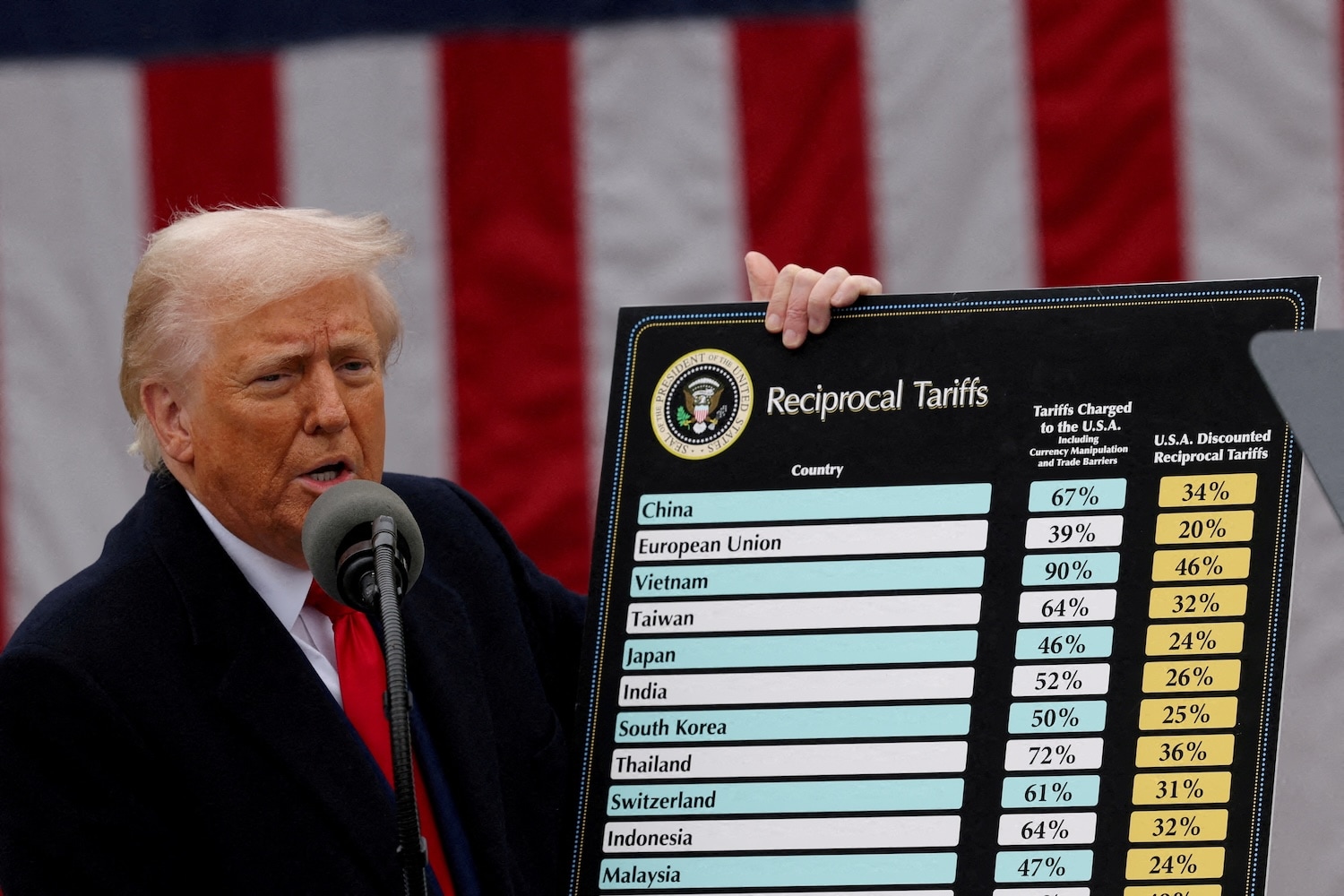
Trump tariff highlights: US Prez adds 10% global tariffs over and above the existing rates after Supreme Court setback
Published on 21/02/2026 02:43 AM
In a significant legal setback for Donald Trump, the Supreme Court of the United States on Friday ruled 6–3 against his sweeping global tariff regime.The US President lashed out at the justices, calling them a 'disgrace to the nation' and blamed them for being swayed by 'foreign interests and small political movements'.Trump claimed that at least three statutes, including The Trade Expansion Act 1962, allow him to charge higher tariffs, if he needed to.The majority held that the statute used to justify the import duties “does not authorize the President to impose tariffs”, effectively invalidating the unilateral measures imposed on multiple countries. The court, however, did not address whether affected parties would be eligible for tariff refunds.The ruling carries broader implications for executive authority in trade policy and could reshape the legal framework governing future tariff actions.US markets reacted positively. The S&P 500 climbed 0.69%, while the Nasdaq Composite gained 0.9%, and the Dow Jones rose 230.81 pointsHere are the live updates
The S&P 500 climbed 0.69%, while the Nasdaq Composite gained 0.9%, and the Dow Jones rose 230.81 points, rebounding from an early 200-point loss triggered by weak economic data. Tech and consumer-focused stocks led the upside after the Supreme Court struck down Trump-era tariffs. Amazon, which sources a large share of its products from China, jumped 2%, benefiting from the removal of import duty pressures that had threatened higher prices for customers. Other retailers like Home Depot and Five Below also moved higher.
Thanks for watching CNBC TV18’s live updates on the Supreme Court striking down Trump’s tariffs. Stay tuned for more market reactions and analysis as the story develops.
The US government may owe over $175 billion in refunds to importers following the Supreme Court’s 6-3 ruling that President Trump’s tariffs, imposed under the International Emergency Economic Powers Act (IEEPA), were illegal. The tariffs, unilaterally levied without congressional approval, have been in place for years, and multiple companies already have pending lawsuits seeking refunds.
Supreme Court Justice Brett Kavanaugh, dissenting, warned the refund process would be “messy,” as importers may have already passed costs to consumers, and billions in collected tariffs could need to be returned. The tariffs, which previously supported trade deals with China, the UK, Japan, and other nations, now face uncertainty.
Economists, including Brian LeBlanc of PNC, estimate the illegal IEEPA tariffs accounted for roughly 60% of all US tariffs to date, dropping the effective tariff rate from about 9.5% to 5%. While refunds will be complex, the Trump administration is expected to replace most lost tariff revenue using alternative legal authorities.
Treasury Secretary Scott Bessent clarified that the Supreme Court ruling did not invalidate President Donald Trump’s tariffs, but only restricted the use of IEEPA authority to raise revenue. Speaking at the Economic Club of Dallas on Friday, Bessent said six justices ruled that IEEPA could not be used to generate even a single dollar, leaving the core tariff policy intact.
He added that the administration plans to invoke alternative legal authorities to maintain tariff enforcement, including Section 122, with potential enhancements to Section 232 and Section 301 measures. According to Treasury estimates, this approach would result in virtually unchanged tariff revenue in 2026, ensuring continuity of the trade strategy.
Bessent’s comments signal that despite the Supreme Court’s technical limitation, the administration can continue its broader trade agenda with China and other partners, maintaining economic leverage while staying within legal frameworks. Markets and businesses are now assessing the implications for imports, tariffs, and related supply chains.
US President Donald Trump will travel to China from March 31 to April 2 for talks with President Xi Jinping, in his first visit to Beijing since 2017.
A central issue had been whether to extend a tariff truce that prevented further escalation between the two economies. After the Supreme Court ruling, it remains unclear whether Trump can restore tariffs on Chinese imports and under what authority. The administration has defended the tariffs on national security grounds, citing trade imbalances and China’s alleged role in producing fentanyl-related chemicals.
The leaders last met in October in South Korea, where Trump agreed to trim tariffs in exchange for increased Chinese soybean purchases and continued rare earth exports.
The S&P 500 surged to near the day’s high after the US President decided to reverse the Supreme Court’s decision to strike down the tariffs imposed on America’s trading partners.The yield on the benchmark 10-year bonds fell as much 10 basis points after moving close to 5% after the SC decision earlier. The yield fell to 4.09% as of 12:33 am (IST) on Feb 21, after rising as high as 4.107% earlier in the day. The S&P 500 moved up 0.6%, while the Nasdaq Composite rose 0.9%. The Dow Jones Industrial Average added 139 points, or 0.3%, recovering from a 200-point loss earlier in the session on disappointing economic data.
Donald Trump said the India-US trade agreement will remain unchanged even as he sharply criticised the US Supreme Court for limiting his use of emergency tariff powers. He signalled that trade deals that do not hold up will be replaced with new tariffs, raising the prospect of another round of global trade tensions.
“Some of the trade deals stand, ones which don’t will be replaced by new tariffs,” Trump said, adding twice that “nothing changes on the trade agreement with India.” He also described a “little flip” in trade terms, claiming the US is no longer paying tariffs to India while India is paying tariffs to the US. However, he added, “My relationship with India is fantastic.”
Trump tariffs LIVE updates: Trump says 32,000 people have been killed in Iran protestsMAKE AMERICA GREAT AGAIN! https://t.co/5UudUfHe42 pic.twitter.com/un5zFbSEJl
— The White House (@WhiteHouse) February 20, 2026
“The good news is that there are methods, practices, statutes and authorities as recognized by the entire court… that are even stronger than the IEEPA tariffs available to me as President of the United States.” – President Donald J. Trump ???????? pic.twitter.com/v2juxmYHiR
— The White House (@WhiteHouse) February 20, 2026
President Donald Trump said Friday he expects the Supreme Court’s decision invalidating his tariffs to prompt an extensive legal fight over whether his administration now has to pay companies billions of dollars in refunds. “Wouldn’t you think they would have put one sentence in there saying, keep the money or don’t keep the money, right?” Trump said during a press briefing. “It’s not discussed. We’ll end up being in court for the next five years.”
Trump: Nothing changes with respect to the trade deal with India.
Prime Minister Modi is a great man, but he was much tougher in negotiations with others than he was in the deal with the United States. We made a fair agreement with India.
We are not paying tariffs to India now — they are paying tariffs to us.“Effective immediately, all National Security TARIFFS, Section 232 and existing Section 301 TARIFFS, remain in place, and in full force and effect. Today I will sign an Order to impose a 10% GLOBAL TARIFF, under Section 122, over and above our normal TARIFFS already being… pic.twitter.com/B3bv5f5KW1
— The White House (@WhiteHouse) February 20, 2026
President Donald Trump said he’s ashamed of the Supreme Court justices — some of whom he appointed — who ruled against his tariffs. “The Supreme Court’s ruling on tariffs is deeply disappointing, and I’m ashamed of certain members of the court, absolutely ashamed for not having the courage to do what’s right for our country,” Trump said in the White House briefing room on Friday. “They’re against anything that makes America strong, healthy and great again. They also are a frankly disgrace to our nation those justices,” he added. “I’d like to thank and congratulate justices Thomas Alito and Kavanaugh for their strength and wisdom and love of our country,” Trump said. “When you read the dissenting opinions, there is no way that anyone can argue against them.”
President Donald Trump said Friday he’s immediately going to enact a 10% global tariff under a trade law known as Section 122 following the Supreme Court’s landmark ruling earlier in the day. But unlike the prior tariffs Trump imposed, the new levies can only be in place for a maximum of 150 days, barring congressional approval for an extension, according to a CNN report.
Trump also told reporters he will be initiating several new investigations that are necessary precursors to imposing tariffs under a separate trade law known as Section 301.
President Donald Trump says there are alternative methods to apply tariffs that could potentially generate more revenue than the emergency powers now off limits.
“Other alternatives will now be used to replace the ones that the court incorrectly rejected. We have alternatives,” he told reporters at the White House.
He said the new avenues had been “approved by the decision” the court handed down today.
In a sweeping escalation of his protectionist trade agenda, US President Donald Trump will sign an executive order imposing a 10% global tariff on imports, effective immediately, over and above the existing tariff structure, he announced in his White House press briefing responding to the Supreme Court ruling on emergency tariffs. The new levy will be enforced under Section 122, while the current national security tariffs imposed under Sections 301 and 232 will remain fully in place and continue in “full force and effect”. This effectively creates a layered tariff regime, significantly raising the overall duty burden on goods entering the United States across sectors and geographies.
Trump further said that broader executive powers remain available beyond those granted under the International Emergency Economic Powers Act. He claimed that tariff measures used over the past year have been effective in advancing national economic and security objectives.
Trump added, “Foreign nations that have been ripping us off for years are ecstatic, but they won’t be dancing for long. The justices who have voted against tariffs are a disgrace to our nation. The Court has been swayed by foreign interests and a small political movement. Certain justices are afraid of doing the right thing.”
IEEPA stands for International Emergency Economic Powers Act. “I can destroy the trade, I can destroy the country.. I can do anything I want, but I can’t charge them a dollar,” Trump said in his first reaction to the Supreme Court striking down the tariffs.
The US President launched an attack on the justices of the Supreme Court who struck down the tariffs imposed on America’s trading partners.
Addressing the media at the White House, hours after the Supreme Court ruling on emergency tariffs, US President Trump said, “The SC ruling on tariffs is deeply disappointing.”
The Environmental Protection Agency on Friday weakened limits on mercury and other toxic emissions from coal-fired power plants, the Trump administration’s latest effort to boost the fossil fuel industry by paring back clean air and water rules.
Toxic emissions from coal- and oil-fired plants can harm the brain development of young children and contribute to heart attacks and other problems in adults. The plants are also a major source of greenhouse gas emissions that drive climate change. The EPA announced the move at a massive coal plant next to the Ohio River in Louisville, Kentucky.
“The Trump EPA’s action follows the rule of law and will reduce of cost of generating baseload power, lowering costs and improving reliability for consumers,” EPA Deputy Administrator David Fotouhi said in a statement. The agency said the change should save hundreds of millions of dollars.
President Donald Trump warned on Friday that limited strikes against Iran are possible even as the country’s top diplomat said Tehran expects to have a proposed deal ready in the next few days following nuclear talks with the United States.
In response to a reporter’s question on whether the U.S. could take limited military action as the countries negotiate, Trump said, “I guess I can say I am considering that.” Earlier, Iranian Foreign Minister Abbas Araghchi said in a TV interview that his country was planning to finalize a draft deal in “the next two to three days” to then send to Washington.
“I don’t think it takes long, perhaps, in a matter of a week or so, we can start real, serious negotiations on the text and come to a conclusion,” Araghchi said on MSNOW’s “Morning Joe” show.
The Supreme Court 6-3 majority offered no clarity on the specific practical question of what to do with the money the administration has already collected through President Donald Trump’s tariffs. That question will likely need to be sorted out by lower courts. In his dissent, Justice Brett Kavanaugh noted that the court said “nothing today about whether, and if so how, the government should go about returning the billions of dollars that it has collected from importers.”
The ruling leaves tariffs implemented under Section 232 of the Trade Expansion Act of 1962 — which cite national-security concerns — unchanged, keeping in place a ream of import duties on products ranging from copper and semiconductors to automobiles and wood products such as cabinetry.
Section 232 tariffs include 50% levies on imports of semi-finished copper products, 25% levies on certain imported semiconductors — including Nvidia’s (NVDA) H200 chips — and automobile tariffs, including 25% levies on trucks and 10% levies on buses.
The administration has also proposed 100% tariffs on specific pharmaceutical products, which, if implemented, would be done so under Section 232.
The US Supreme Court’s ruling on Friday that struck down President Trump’s widespread tariff regime is bullish for the tech industry, Wedbush Securities managing director Dan Ives said in a client note after the ruling was announced, according to a Yahoo Finance report. “We believe this would act as a net positive for tech with financial relief for many companies while creating greater supply chain visibility, especially coming from the Asia supply chain,” the article quotd Ives as writing on Friday.
The Supreme Court’s decision is welcome news for businesses and consumers. Over the past year, the Chamber has been working with small and midsize businesses around the country that have seen significant cost increases and supply chain disruptions as a result of these tariffs.
Swift refunds of the impermissible tariffs will be meaningful for the more than 200,000 small business importers in this country and will help support stronger economic growth this year. We encourage the administration to use this opportunity to reset overall tariff policy in a manner that will lead to greater economic growth, larger wage gains for workers, and lower costs for families.
Congressional Democrats rejoiced on Friday and Republicans remained divided in the wake of a momentous Supreme Court decision striking down a large portion of President Donald Trump’s tariff agenda, according to a report on CNBC.
“Trump’s chaotic and illegal tariff tax made life more expensive and our economy more unstable. Families paid more. Small businesses and farmers got squeezed. Markets swung wildly,” Senate Minority Leader Chuck Schumer, D-N.Y., said in a statement following the decision. “We’ve said from day one: a president cannot ignore Congress and unilaterally slap tariffs on Americans. That overreach failed.”
“It was the biggest showdown between this (Chief Justice John Roberts)-controlled court and President Trump. And finally, they said no,” according to CNN’s Chief Supreme Court analyst Joan Biskupic. “This was an easy one for the Supreme Court to say no on.” The decision, delivered in 21 pages after a 20 minute hearing, reflected a broader trend of limiting executive authority. “He, the Chief Justice, tried to really emphasize that, ‘Look, we ruled in a certain way when President Biden was in, and we’re going to rule the same way here,’” Biskupic explained. “If the president wants to assume some authority in a congressional law, that the law must state clearly that he has this authority.”NewsLive TVMarketPopular CategoriesCalculatorsTrending NowLet's Connect with CNBCTV 18Network 18 Group :©TV18 Broadcast Limited. All rights reserved.