Trump Tariffs Highlights: India-US trade framework may need review after 10% US levy, say experts
Published on 21/02/2026 07:02 PM
Stay tuned for other updates on our website: CNBCTV18.com.
You can follow us on Twitter: @CNBCTV18Live @CNBCTV18News
And on Facebook, LinkedIn, Instagram and Telegram
“We have noted the US Supreme Court judgment on tariffs delivered yesterday. President Trump has also addressed a press conference in that regard, and certain steps have been announced by the US Administration. We are studying all these developments and assessing their implications.”
On the US Supreme Court’s order on the US tariffs, Congress MP Pramod Tiwari said to ANI, “I respect the US Supreme Court’s decision and want to say that the tariffs imposed were wrong. The US President had no authority… I demand that the US repeal them… He (Donald Trump) also said that the tariffs would benefit the US… Congress opposes them. We oppose the way the interests of farmers and small businesses have been placed in the US Treasury.”On the US Supreme Court’s order on US tariffs, Congress MP Manish Tewari said to ANI that the 6-3 verdict is a message to constitutional courts around the world that they are responsible for checking executive excess. He added, “The decision of the US Supreme Court is a welcome decision. However, it also sets the stage for an unprecedented confrontation between the Trump administration and the judiciary on the one hand, with the legislature on the other hand. Because the US Supreme Court has clearly said that the power to levy tariffs does not rest in the executive, it rests with the legislature.” He stated, “Now it’s for the US Congress to assert itself, exert itself and appropriate the authority that is legitimately according to the US constitutional scheme.”
T V Narendran, CEO and Managing Director of Tata Steel Ltd, said that while steel is not directly impacted by the 10% US tariff, exports to the US—such as auto components—could feel the effect. “There is no negative impact; in some sense it’s structured on what was being expected,” he noted, adding that he is also watching developments in Europe, where EU steel exports to the US had faced 50% tariffs. Narendran emphasised the ongoing uncertainty: “It is very difficult for supply chains to keep adjusting and readjusting on a short-term basis. If you ship something today, it will take a month or two to reach the US. We are not going to overreact to the announcements, we will wait and see. What is sure is the uncertainty.” He added that President Trump has indicated he may use other measures to bring back tariffs, making supply chain planning particularly challenging for manufacturers.
Nikhil Sawhney, Vice Chairman and Managing Director of Triveni Turbine Limited, said that while the 10% US tariff provides a framework, it brings additional uncertainties for Indian manufacturers. “What is quite certain is there is more uncertainty around tariffs,” he noted. He added that the 150-day period is insufficient for planning manufacturing and supply chains. “For Indian manufacturing, it does present another set of uncertainties. The issue is how do you transfer price between Indian and US operations,” Sawhney said, emphasizing the importance of the US market, a $30 trillion economy, for India to preserve and grow its market share.
Sanjay Kirloskar, Chairman and Managing Director of Kirloskar Brothers Ltd, welcomed the move, calling it a positive step that could improve global trade. “There was a lot of disruption, volatility earlier; hopefully things will be stable,” he said.
Vishal Kampani, Vice Chairman and Managing Director of JM Financial Ltd, said that while the 10% US tariffs are temporary and set for only 150 days, it is too early to predict their full impact. “Trump and the administration will try and find ways to come around the 10% tariff,” he said, adding that markets should be prepared for volatility and uncertainty.Kanwal Sibal – former Foreign Secretary of India; reaction: “This poses a big diplomatic challenge for India” – commenting on the broader diplomatic implications of the US tariff move.Jayant Das Gupta – former trade negotiator; reactions: “US-India deal will need to be reviewed thoroughly” and “India should not agree to an 18% tariff now, it’s illogical” – highlighting trade strategy and tariff logic.
Abhijit Das, international trade expert and former head of the Centre for WTO Studies says India may need to revisit the concessions it has offered in its ongoing trade negotiations with the United States after Washington announced a fresh 10% tariff on imports. He said the development calls for a more coordinated response from countries that are similarly affected by the move.
“Our negotiators should recalibrate the concessions we have offered,” Das told CNBC-TV18, adding that India should reach out to countries such as Indonesia, Malaysia and Argentina to evolve a common position on the new 10% tariff.
Former commerce secretary Anup Wadhawan says the India -US trade agreement will need to be revised, after White House officials clarified that there will be a fresh 10% levy on all nations from Feb 24, which effectively brings down US tariffs on India to 10% from 18%.
“India-US trade deal framework needs to be revised… Hope better sense will prevail from the US side as well,” he told CNBC-TV18.
Indian government sources told CNBC-TV18 that the US tariff on Indian goods will be reduced to 10% following the latest notification from the White House.
All goods that were earlier subject to a 25% reciprocal tariff will now see the rate drop to 10%.
An earlier proposed cut to 18% had not yet been notified, which means the applicable tariff will now move directly from 25% to 10%.White House officials have clarified to CNBC that countries with trade agreements with the United States, including India, will see tariff rates lowered to 10% under the latest proclamation signed by US President Donald Trump.According to officials, the revised ad valorem tariff rate of 10% will apply for a period of 150 days, as outlined in the proclamation issued earlier this week. The temporary duty is set to take effect from February 24 at 12:01 a.m. Eastern Standard Time.
The S&P 500 climbed 0.69%, while the Nasdaq Composite gained 0.9%, and the Dow Jones rose 230.81 points, rebounding from an early 200-point loss triggered by weak economic data. Tech and consumer-focused stocks led the upside after the Supreme Court struck down Trump-era tariffs. Amazon, which sources a large share of its products from China, jumped 2%, benefiting from the removal of import duty pressures that had threatened higher prices for customers. Other retailers like Home Depot and Five Below also moved higher.
Thanks for watching CNBC TV18’s live updates on the Supreme Court striking down Trump’s tariffs. Stay tuned for more market reactions and analysis as the story develops.
The US government may owe over $175 billion in refunds to importers following the Supreme Court’s 6-3 ruling that President Trump’s tariffs, imposed under the International Emergency Economic Powers Act (IEEPA), were illegal. The tariffs, unilaterally levied without congressional approval, have been in place for years, and multiple companies already have pending lawsuits seeking refunds.
Supreme Court Justice Brett Kavanaugh, dissenting, warned the refund process would be “messy,” as importers may have already passed costs to consumers, and billions in collected tariffs could need to be returned. The tariffs, which previously supported trade deals with China, the UK, Japan, and other nations, now face uncertainty.
Economists, including Brian LeBlanc of PNC, estimate the illegal IEEPA tariffs accounted for roughly 60% of all US tariffs to date, dropping the effective tariff rate from about 9.5% to 5%. While refunds will be complex, the Trump administration is expected to replace most lost tariff revenue using alternative legal authorities.
Treasury Secretary Scott Bessent clarified that the Supreme Court ruling did not invalidate President Donald Trump’s tariffs, but only restricted the use of IEEPA authority to raise revenue. Speaking at the Economic Club of Dallas on Friday, Bessent said six justices ruled that IEEPA could not be used to generate even a single dollar, leaving the core tariff policy intact.
He added that the administration plans to invoke alternative legal authorities to maintain tariff enforcement, including Section 122, with potential enhancements to Section 232 and Section 301 measures. According to Treasury estimates, this approach would result in virtually unchanged tariff revenue in 2026, ensuring continuity of the trade strategy.
Bessent’s comments signal that despite the Supreme Court’s technical limitation, the administration can continue its broader trade agenda with China and other partners, maintaining economic leverage while staying within legal frameworks. Markets and businesses are now assessing the implications for imports, tariffs, and related supply chains.
US President Donald Trump will travel to China from March 31 to April 2 for talks with President Xi Jinping, in his first visit to Beijing since 2017.
A central issue had been whether to extend a tariff truce that prevented further escalation between the two economies. After the Supreme Court ruling, it remains unclear whether Trump can restore tariffs on Chinese imports and under what authority. The administration has defended the tariffs on national security grounds, citing trade imbalances and China’s alleged role in producing fentanyl-related chemicals.
The leaders last met in October in South Korea, where Trump agreed to trim tariffs in exchange for increased Chinese soybean purchases and continued rare earth exports.
The S&P 500 surged to near the day’s high after the US President decided to reverse the Supreme Court’s decision to strike down the tariffs imposed on America’s trading partners.The yield on the benchmark 10-year bonds fell as much 10 basis points after moving close to 5% after the SC decision earlier. The yield fell to 4.09% as of 12:33 am (IST) on Feb 21, after rising as high as 4.107% earlier in the day. The S&P 500 moved up 0.6%, while the Nasdaq Composite rose 0.9%. The Dow Jones Industrial Average added 139 points, or 0.3%, recovering from a 200-point loss earlier in the session on disappointing economic data.
Donald Trump said the India-US trade agreement will remain unchanged even as he sharply criticised the US Supreme Court for limiting his use of emergency tariff powers. He signalled that trade deals that do not hold up will be replaced with new tariffs, raising the prospect of another round of global trade tensions.
“Some of the trade deals stand, ones which don’t will be replaced by new tariffs,” Trump said, adding twice that “nothing changes on the trade agreement with India.” He also described a “little flip” in trade terms, claiming the US is no longer paying tariffs to India while India is paying tariffs to the US. However, he added, “My relationship with India is fantastic.”
Trump tariffs LIVE updates: Trump says 32,000 people have been killed in Iran protestsMAKE AMERICA GREAT AGAIN! https://t.co/5UudUfHe42 pic.twitter.com/un5zFbSEJl
— The White House (@WhiteHouse) February 20, 2026
“The good news is that there are methods, practices, statutes and authorities as recognized by the entire court… that are even stronger than the IEEPA tariffs available to me as President of the United States.” – President Donald J. Trump ???????? pic.twitter.com/v2juxmYHiR
— The White House (@WhiteHouse) February 20, 2026
President Donald Trump said Friday he expects the Supreme Court’s decision invalidating his tariffs to prompt an extensive legal fight over whether his administration now has to pay companies billions of dollars in refunds. “Wouldn’t you think they would have put one sentence in there saying, keep the money or don’t keep the money, right?” Trump said during a press briefing. “It’s not discussed. We’ll end up being in court for the next five years.”
Trump: Nothing changes with respect to the trade deal with India.
Prime Minister Modi is a great man, but he was much tougher in negotiations with others than he was in the deal with the United States. We made a fair agreement with India.
We are not paying tariffs to India now — they are paying tariffs to us.“Effective immediately, all National Security TARIFFS, Section 232 and existing Section 301 TARIFFS, remain in place, and in full force and effect. Today I will sign an Order to impose a 10% GLOBAL TARIFF, under Section 122, over and above our normal TARIFFS already being… pic.twitter.com/B3bv5f5KW1
— The White House (@WhiteHouse) February 20, 2026
President Donald Trump said he’s ashamed of the Supreme Court justices — some of whom he appointed — who ruled against his tariffs. “The Supreme Court’s ruling on tariffs is deeply disappointing, and I’m ashamed of certain members of the court, absolutely ashamed for not having the courage to do what’s right for our country,” Trump said in the White House briefing room on Friday. “They’re against anything that makes America strong, healthy and great again. They also are a frankly disgrace to our nation those justices,” he added. “I’d like to thank and congratulate justices Thomas Alito and Kavanaugh for their strength and wisdom and love of our country,” Trump said. “When you read the dissenting opinions, there is no way that anyone can argue against them.”
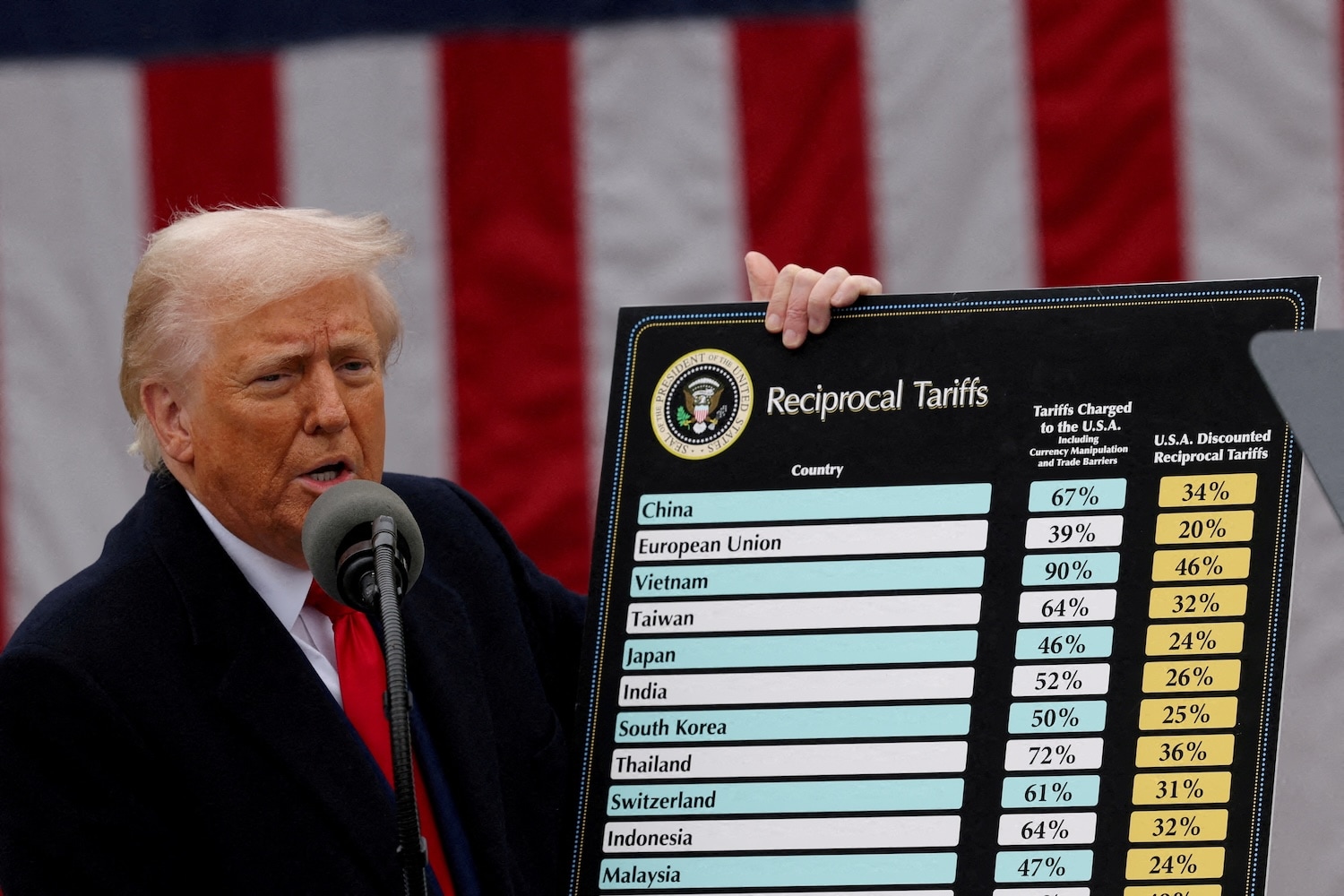
President Donald Trump said Friday he’s immediately going to enact a 10% global tariff under a trade law known as Section 122 following the Supreme Court’s landmark ruling earlier in the day. But unlike the prior tariffs Trump imposed, the new levies can only be in place for a maximum of 150 days, barring congressional approval for an extension, according to a CNN report.
Trump also told reporters he will be initiating several new investigations that are necessary precursors to imposing tariffs under a separate trade law known as Section 301.
President Donald Trump says there are alternative methods to apply tariffs that could potentially generate more revenue than the emergency powers now off limits.
“Other alternatives will now be used to replace the ones that the court incorrectly rejected. We have alternatives,” he told reporters at the White House.
He said the new avenues had been “approved by the decision” the court handed down today.
In a sweeping escalation of his protectionist trade agenda, US President Donald Trump will sign an executive order imposing a 10% global tariff on imports, effective immediately, over and above the existing tariff structure, he announced in his White House press briefing responding to the Supreme Court ruling on emergency tariffs. The new levy will be enforced under Section 122, while the current national security tariffs imposed under Sections 301 and 232 will remain fully in place and continue in “full force and effect”. This effectively creates a layered tariff regime, significantly raising the overall duty burden on goods entering the United States across sectors and geographies.
Trump further said that broader executive powers remain available beyond those granted under the International Emergency Economic Powers Act. He claimed that tariff measures used over the past year have been effective in advancing national economic and security objectives.NewsLive TVMarketPopular CategoriesCalculatorsTrending NowLet's Connect with CNBCTV 18Network 18 Group :©TV18 Broadcast Limited. All rights reserved.