Trump tariffs LIVE updates: US Prez adds 10% global tariffs over and above the existing rates
Published on 21/02/2026 12:08 AM
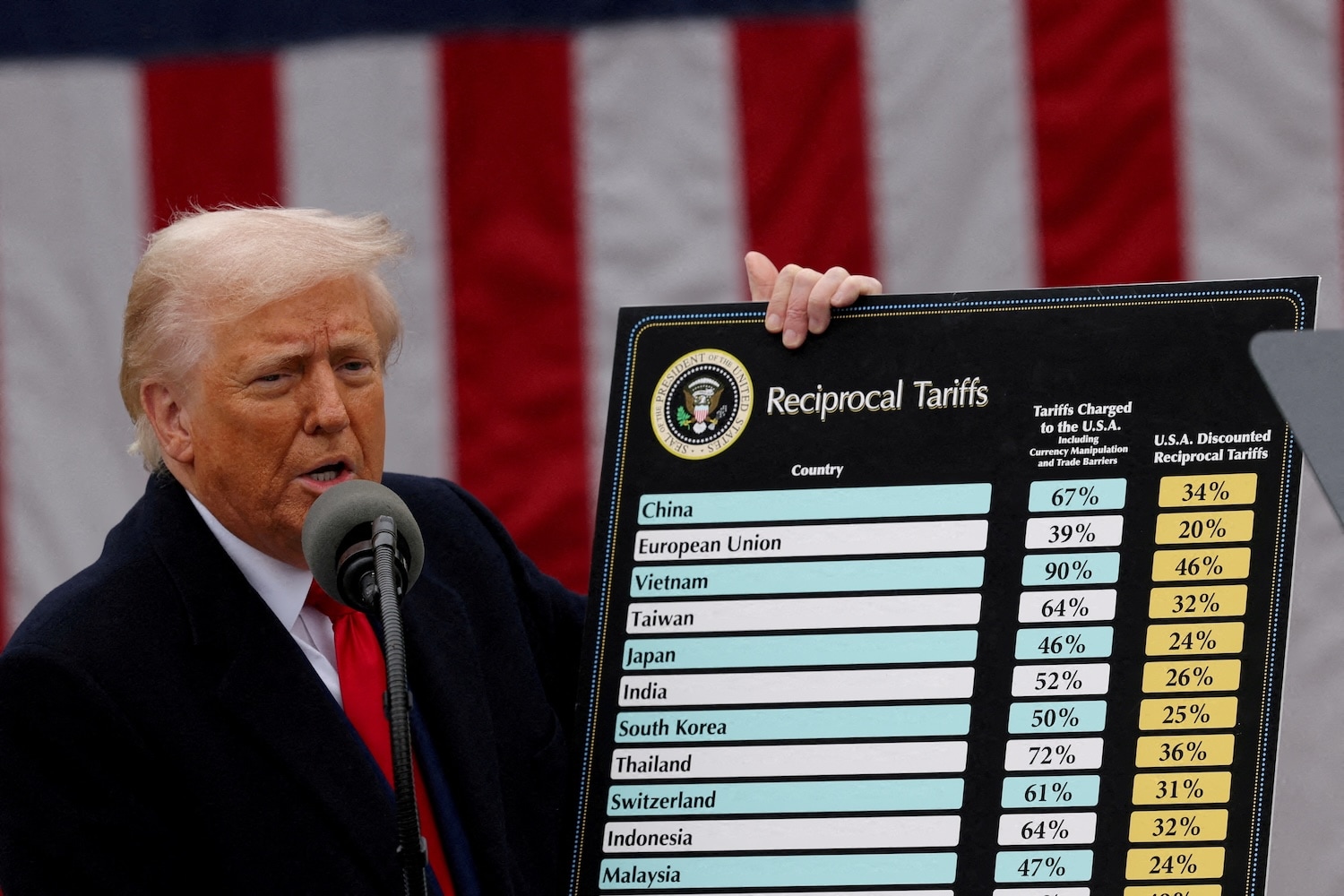
US Supreme Court Trump Tariffs Ruling LIVE Updates: In a significant legal setback for Donald Trump, the Supreme Court of the United States on Friday ruled 6–3 against his sweeping global tariff regime.The US President lashed out at the justices, calling them a 'disgrace to the nation' and blamed them for being swayed by 'foreign interests and small political movements'.Trump claimed that at least three statutes, including The Trade Expansion Act 1962, allow him to charge higher tariffs, if he needed to.The majority held that the statute used to justify the import duties “does not authorize the President to impose tariffs”, effectively invalidating the unilateral measures imposed on multiple countries. The court, however, did not address whether affected parties would be eligible for tariff refunds.The ruling carries broader implications for executive authority in trade policy and could reshape the legal framework governing future tariff actions.US markets reacted positively. The Dow Jones Industrial Average rose 93.81 points, or 0.2%, while the S&P 500 gained 0.3%. The tech-heavy Nasdaq Composite advanced 0.5%, supported by a 2% rise in Alphabet Inc. shares.Here are the live updates
Trump further said that broader executive powers remain available beyond those granted under the International Emergency Economic Powers Act. He claimed that tariff measures used over the past year have been effective in advancing national economic and security objectives.
Trump added, “Foreign nations that have been ripping us off for years are ecstatic, but they won’t be dancing for long. The justices who have voted against tariffs are a disgrace to our nation. The Court has been swayed by foreign interests and a small political movement. Certain justices are afraid of doing the right thing.”
IEEPA stands for International Emergency Economic Powers Act. “I can destroy the trade, I can destroy the country.. I can do anything I want, but I can’t charge them a dollar,” Trump said in his first reaction to the Supreme Court striking down the tariffs.
The US President launched an attack on the justices of the Supreme Court who struck down the tariffs imposed on America’s trading partners.
Addressing the media at the White House, hours after the Supreme Court ruling on emergency tariffs, US President Trump said, “The SC ruling on tariffs is deeply disappointing.”
The Environmental Protection Agency on Friday weakened limits on mercury and other toxic emissions from coal-fired power plants, the Trump administration’s latest effort to boost the fossil fuel industry by paring back clean air and water rules.
Toxic emissions from coal- and oil-fired plants can harm the brain development of young children and contribute to heart attacks and other problems in adults. The plants are also a major source of greenhouse gas emissions that drive climate change. The EPA announced the move at a massive coal plant next to the Ohio River in Louisville, Kentucky.
“The Trump EPA’s action follows the rule of law and will reduce of cost of generating baseload power, lowering costs and improving reliability for consumers,” EPA Deputy Administrator David Fotouhi said in a statement. The agency said the change should save hundreds of millions of dollars.
President Donald Trump warned on Friday that limited strikes against Iran are possible even as the country’s top diplomat said Tehran expects to have a proposed deal ready in the next few days following nuclear talks with the United States.
In response to a reporter’s question on whether the U.S. could take limited military action as the countries negotiate, Trump said, “I guess I can say I am considering that.” Earlier, Iranian Foreign Minister Abbas Araghchi said in a TV interview that his country was planning to finalize a draft deal in “the next two to three days” to then send to Washington.
“I don’t think it takes long, perhaps, in a matter of a week or so, we can start real, serious negotiations on the text and come to a conclusion,” Araghchi said on MSNOW’s “Morning Joe” show.
The Supreme Court 6-3 majority offered no clarity on the specific practical question of what to do with the money the administration has already collected through President Donald Trump’s tariffs. That question will likely need to be sorted out by lower courts. In his dissent, Justice Brett Kavanaugh noted that the court said “nothing today about whether, and if so how, the government should go about returning the billions of dollars that it has collected from importers.”
The ruling leaves tariffs implemented under Section 232 of the Trade Expansion Act of 1962 — which cite national-security concerns — unchanged, keeping in place a ream of import duties on products ranging from copper and semiconductors to automobiles and wood products such as cabinetry.
Section 232 tariffs include 50% levies on imports of semi-finished copper products, 25% levies on certain imported semiconductors — including Nvidia’s (NVDA) H200 chips — and automobile tariffs, including 25% levies on trucks and 10% levies on buses.
The administration has also proposed 100% tariffs on specific pharmaceutical products, which, if implemented, would be done so under Section 232.
The US Supreme Court’s ruling on Friday that struck down President Trump’s widespread tariff regime is bullish for the tech industry, Wedbush Securities managing director Dan Ives said in a client note after the ruling was announced, according to a Yahoo Finance report. “We believe this would act as a net positive for tech with financial relief for many companies while creating greater supply chain visibility, especially coming from the Asia supply chain,” the article quotd Ives as writing on Friday.
The Supreme Court’s decision is welcome news for businesses and consumers. Over the past year, the Chamber has been working with small and midsize businesses around the country that have seen significant cost increases and supply chain disruptions as a result of these tariffs.
Swift refunds of the impermissible tariffs will be meaningful for the more than 200,000 small business importers in this country and will help support stronger economic growth this year. We encourage the administration to use this opportunity to reset overall tariff policy in a manner that will lead to greater economic growth, larger wage gains for workers, and lower costs for families.
Congressional Democrats rejoiced on Friday and Republicans remained divided in the wake of a momentous Supreme Court decision striking down a large portion of President Donald Trump’s tariff agenda, according to a report on CNBC.
“Trump’s chaotic and illegal tariff tax made life more expensive and our economy more unstable. Families paid more. Small businesses and farmers got squeezed. Markets swung wildly,” Senate Minority Leader Chuck Schumer, D-N.Y., said in a statement following the decision. “We’ve said from day one: a president cannot ignore Congress and unilaterally slap tariffs on Americans. That overreach failed.”
“It was the biggest showdown between this (Chief Justice John Roberts)-controlled court and President Trump. And finally, they said no,” according to CNN’s Chief Supreme Court analyst Joan Biskupic. “This was an easy one for the Supreme Court to say no on.” The decision, delivered in 21 pages after a 20 minute hearing, reflected a broader trend of limiting executive authority. “He, the Chief Justice, tried to really emphasize that, ‘Look, we ruled in a certain way when President Biden was in, and we’re going to rule the same way here,’” Biskupic explained. “If the president wants to assume some authority in a congressional law, that the law must state clearly that he has this authority.”
The US Supreme Court’s decision to strike down reciprocal tariffs imposed by the Trump administration has provided significant relief to Indian exporters, but over $8 billion worth of trade will continue to face higher duties under national security provisions.The ruling effectively eliminates the 18 percent reciprocal tariff agreed earlier under the India–US trade framework, bringing tariffs on most Indian goods back to Most Favoured Nation (MFN) levels, which historically averaged around 3 percent before the tariff escalation. However, Section 232 duties remain in force, covering sectors deemed critical to US national security such as steel, aluminium, automobiles, timber, copper and certain machinery products.
The Canadian government said the Supreme Court of the United States decision striking down tariffs imposed under the International Emergency Economic Powers Act reinforces Ottawa’s long-held position that such duties were “unjustified”.
In a statement, the Government of Canada said the ruling supports its argument that the IEEPA-based tariffs imposed by the United States lacked proper legal grounding.
The response adds to a series of international reactions.Union Commerce and Industry Minister Piyush Goyal said he had a “constructive virtual interaction” with the Director-General of the World Trade Organization on a range of trade-related issues.In a post on X, Goyal said the discussion covered preparations for the upcoming ministerial-level engagements. He added that the conversation provided an opportunity to exchange perspectives on current global trade developments.
Global responses are beginning to emerge after the Supreme Court of the United States ruled against former President Donald Trump’s sweeping tariff regime.
The Government of the United Kingdom said the ruling is “a matter for the US to determine” but added that it will continue to support UK businesses as further details become clear.
Meanwhile, the British Chambers of Commerce flagged potential commercial implications. The trade body said the court’s decision raises questions about how US importers may reclaim levies already paid under the tariff framework.
It also pointed to uncertainty over whether UK exporters could receive a share of any potential rebates, depending on commercial trading terms agreed with US counterparts.
Separately, the Swiss Federal Council said it acknowledges the decision of the US Supreme Court and has no further comment.
President Donald Trump said he has a “backup plan” to pursue tariffs after the Supreme Court of the United States struck down key elements of his global tariff framework, according to CNN.
In remarks following the ruling, Trump also described the court’s decision as a “disgrace”. The Supreme Court had ruled 6–3 that the International Emergency Economic Powers Act does not authorise the President to impose sweeping import duties, dealing a major blow to his trade strategy.
The court noted that “had Congress intended to convey the distinct and extraordinary power to impose tariffs” under IEEPA, “it would have done so expressly, as it consistently has in other tariff statutes.”
The Supreme Court affirmed earlier rulings by lower courts that had blocked the tariffs, agreeing that Trump exceeded his authority by invoking emergency powers to impose across-the-board levies. A federal trade court in May had already found the measures unlawful.
SCOTUS rules 6–3 against IEEPA-based tariffsIn a 6–3 ruling, the court held that the International Emergency Economic Powers Act does not authorise the President to impose sweeping import tariffs, dealing a major blow to former President Donald Trump’s trade agenda.
In its majority opinion, the court stressed that the Constitution vests the power to levy taxes, including tariffs, with Congress — not the executive branch. Chief Justice John Roberts wrote that the Framers “did not vest any part of the taxing power in the Executive Branch.”
The European Union said it has taken note of the decision by the Supreme Court of the United States and is carefully analysing its implications. An EU spokesperson indicated the bloc is assessing the potential trade and policy impact.
The Supreme Court of the United States on Friday struck down a significant portion of former President Donald Trump’s sweeping tariff agenda, ruling that the statute cited to justify the duties did not grant the President authority to impose them unilaterally.
In a 6–3 decision, the majority held that the law underpinning the import duties “does not authorize the President to impose tariffs.” Chief Justice John Roberts delivered the opinion of the court.
Justices Clarence Thomas, Samuel Alito and Brett Kavanaugh dissented.
The ruling marks a major judicial check on executive trade powers and could have far-reaching implications for the legal basis of tariff actions taken during Trump’s presidency.NewsLive TVMarketPopular CategoriesCalculatorsTrending NowLet's Connect with CNBCTV 18Network 18 Group :©TV18 Broadcast Limited. All rights reserved.