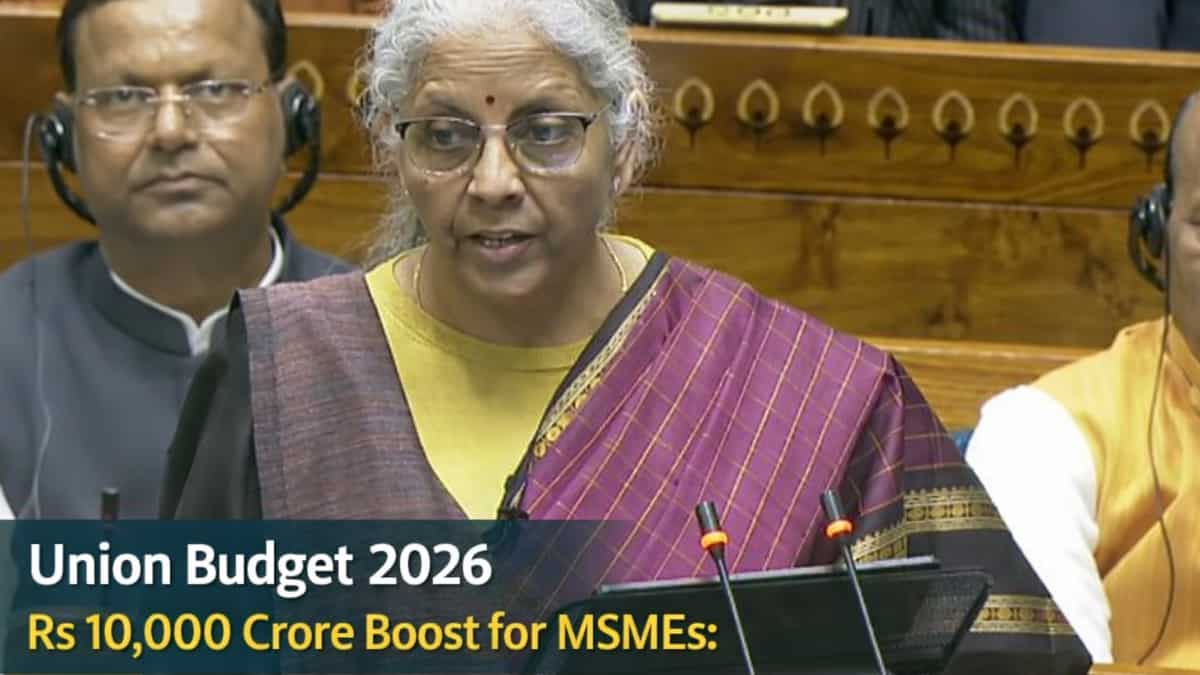
Union Budget 2026: FM Sitharaman unveils Rs 10,000 crore MSME growth fund to boost champion enterprises
Published on 01/02/2026 12:30 PM
Union Budget 2026: Finance Minister Nirmala Sitharaman unveiled a major initiative to support Micro, Small, and Medium Enterprises (MSMEs) as she presented her ninth consecutive record Budget on Sunday, February 1, announcing a Rs 10,000 crore SME Growth Fund along with measures to strengthen liquidity and equity support, as the sector faces headwinds from steep 50 per cent US tariffs.
India’s real GDP growth for 2026-27 is projected in the range of 6.8-7.2 per cent, reflecting sustained medium-term growth amid a challenging global environment.
Speaking on creating champion MSMEs, Sitharaman proposed a three-pronged approach. “This includes equity support via a Rs 10,000 crore SME Growth Fund. Also, I propose to top-up the Self-Reliant India Fund by Rs 2,000 crore. We will also provide liquidity support via the TReDS platform,” she said.
The minister highlighted plans to enhance human capital in the sector. “The government will facilitate professional institutes to design short-term courses and modules to develop a cadre of Corporate Mitras,” she added, aiming to provide skilled support for MSMEs’ growth.
Also Read: Budget 2026: Finance Minister Nirmala Sitharaman proposes to set up 3 new All India Institutes of Ayurveda
The Self-Reliant India Fund, first announced in 2023 with a corpus of Rs 50,000 crore, will see an additional Rs 4,000 crore infusion in 2026-27. Sitharaman noted that more than Rs 7 lakh crore has been made available to MSMEs through liquidity support.
“To leverage its full potential, I propose four measures. One: mandate TREDS as the transaction settlement platform for all purchases from MSMEs by CPSEs. Survey as a benchmark for other corporates. Two: introduce a credit guarantee support mechanism through CGT-MSC for invoice discounting on the TREDS platform. Three: link GEN with TREDS for sharing information with financiers about government purchases from SMEs, encouraging cheaper and quicker financing. Four: introduce TREDS receivables as asset-backed securities, helping develop a secondary market, enhancing liquidity and settlement of transactions,” she said.
The minister also proposed an integrated textile programme with five sub-parts, including a Natural Fibre Scheme, Textile Expansion and Employment Scheme, and National Handloom and Handicraft Programme, to strengthen the sector affected by US tariffs.
The government will continue to focus on infrastructure development in Tier II and Tier III cities, turning them into growth centres. “I propose to revive 200 legacy industrial clusters… introduce a Rs 10,000 crore SME Growth Fund… and top up the Self-Reliant India Fund by Rs 2,000 crore to support micro enterprises,” she said.
Also Read: Union Budget 2026-27: Mega Textile Parks to Boost Khadi, Handicrafts and Jobs under Mahatma Gandhi Swaraj Scheme
Over the years, MSMEs have become a critical driver of India’s economy. The Udyam Registration Portal currently lists over 5.93 crore MSMEs, employing more than 25.18 crore people. Micro-enterprises form the majority, and the sector contributed 30.1 per cent to India’s Gross Value Added (GVA) in the last financial year, up from 27.3 per cent in 2020-21.
The government has introduced several initiatives to boost the sector, including PM Vishwakarma, PMEGP, SFURTI, and the Public Procurement Policy for Micro and Small Enterprises (MSEs), along with enhanced credit guarantees and startup support.
The Economic Survey, tabled ahead of the Budget, indicated that India recorded the lowest inflation rate since the start of the CPI series, with average headline inflation at 1.7 per cent for April-December 2025.