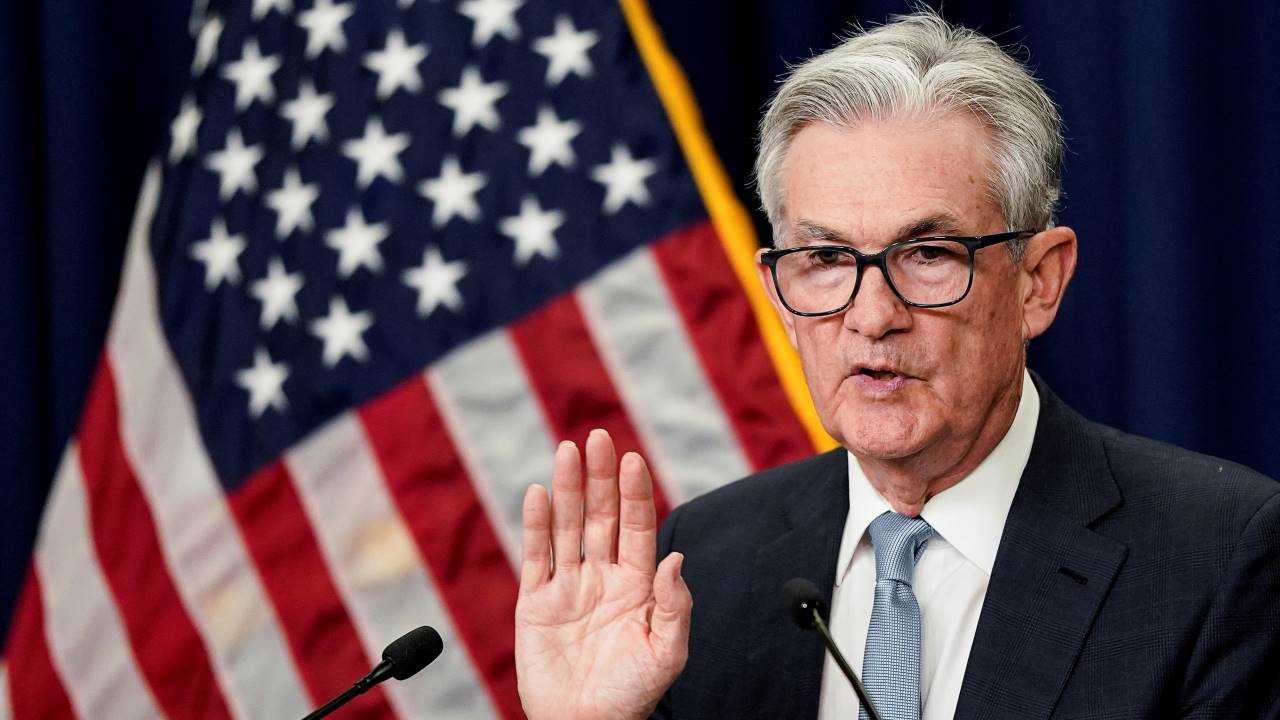
US Fed Meeting LIVE Updates: US central bank cuts rates for the second time this year, will end balance sheet run-off in Dec
Published on 30/10/2025 12:03 AM
The Federal Reserve put policy on autopilot Wednesday thanks to the lack of economic data due to the government shutdown, said Alexandra Wilson-Elizondo, global chief investment officer of multi-asset solutions at Goldman Sachs Asset Management.
“A single soft inflation release, anchored expectations, and anecdotal cooling labour demand support a cautious easing bias,“ she said. “If conditions hold, another 25-basis point cut at the December meeting seems likely.“
Google’s YouTube will use artificial intelligence to improve the visual clarity of many low-resolution videos on its platform when viewed on TV screens.
YouTube will first implement the feature, known as upscaling, for videos that were originally uploaded at resolutions under 1080p, according to a blog post on Wednesday by senior product director Kurt Wilms. The company said it will support upscaling to even higher 4K quality “in the near future.”
Some creators might take issue with the platform making adjustments to their content, but Wilms said that the original files will always be kept intact. YouTube members can opt out of the “super resolution” upscaling feature altogether if they don’t like how it makes their videos look, he said.
Super-resolution videos will be clearly labelled, making it easy for viewers to see any video as it was originally presented, he added.
Here are key takeaways from the Federal Reserve’s interest-rate decision on Wednesday:
Federal Open Market Committee votes, 10-2, to lower the benchmark interest rate by a quarter point to a target range of 3.75%-4%
Fed says it will end the reduction of its securities holdings beginning on December 1, after slowing the pace of runoff earlier this year, and will roll maturing agency debt into Treasury bills.
Fed Governor Stephen Miran voted against the decision in favour of lowering rates by a half point, while Kansas City Fed President Jeff Schmid dissented in favour of holding rates steady.
Statement maintains description of the labour market, noting that “job gains have slowed, and the unemployment rate has edged up but remained low through August,” adding “more recent indicators are consistent with these developments” and “downside risks to employment rose in recent months”
Fed says “available indicators” suggest economic activity has been expanding at a moderate pace, and reiterates that inflation “has moved up since earlier in the year and remains somewhat elevated”
US stocks remained in the green on Wednesday, boosted by tech names, after the latest interest rate decision from the Federal Reserve.
The Nasdaq Composite climbed 0.5%, and the S&P 500 traded up 0.2%. The Dow Jones Industrial Average advanced 146 points, or 0.3%. All three leading US indexes scored new all-time intraday highs on the trading day.
The Federal Reserve on Wednesday (October 29) approved its second straight interest rate cut, a widely expected move that came despite little recent visibility on the economy due to the government shutdown.
By a 10-2 vote, the central bank’s Federal Open Market Committee lowered its benchmark overnight borrowing rate to a range of 3.75%-4%. In addition to the rate move, the Fed announced that it would be ending the reduction of its asset purchases – a process known as quantitative tightening – on December 1.
Governor Stephen Miran again cast a dissenting vote, preferring the Fed move more quickly with a half-point cut. St. Louis Fed President Jeffrey Schmid joined Miran in dissenting but for the opposite reason – he preferred the Fed not cut at all.
US central bank cuts rates for the second time this year, will end balance sheet run-off in December
Prime Minister Keir Starmer refused to rule out raising income tax, national insurance or value-added tax at the upcoming budget, suggesting the government may break its pre-election promises in order to fill a growing hole in the public finances.
Asked by Conservative opposition leader Kemi Badenoch if he’d adhere to the electoral vow on the three key tax rates — one of Labour’s flagship offerings in last year’s campaign — the premier avoided an answer.
The federal government shutdown has already cost the US economy at least $18 billion this year, a figure that “will intensify” in the weeks to come, according to the Congressional Budget Office.
The nonpartisan organisation emphasised that much of the impact will be temporary, with a short-term boost to economic growth in the first quarter of next year. However, they estimate that between $7 billion and $14 billion of the hit to gross domestic product will not be recovered, depending on the ultimate length of the shutdown.
GDP is already poised to be at least one percentage point lower in the fourth quarter due to the government shutdown, according to the CBO report released Wednesday.
Nvidia Corp. has gradually become one of the most important players in the venture capital world, without being a VC firm. The chipmaker said last month that it’s planning to invest $100 billion in OpenAI — a deal that would mark the largest startup investment of all time. It’s part of a growing string of bets on private artificial intelligence companies that Nvidia has made across the world.
At the company’s highly anticipated GTC event in Washington on Tuesday, Nvidia Chief Executive Officer Jensen Huang called out a number of private companies that his company’s taken stakes in by name, including the AI firm Perplexity, the Chinese autonomous vehicle company WeRide and the robotics startup Figure AI. He shouted out to several of their executives sitting in the audience.
Microsoft Corp. said that some users are having issues accessing its suite of business applications and games. “We’re investigating reports of issues accessing Microsoft 365 services and the Microsoft 365 admin center,” the company said in a post on social media network X on Wednesday.
Microsoft has identified portions of internal infrastructure experiencing connectivity issues and is working on recovery, the company said. Issue reports spiked on Downdetector shortly after 11 a.m. in New York.
The UK oil refining industry could eventually disappear completely if the cost of carbon continues to increase, according to Exxon Mobil Corp., which operates the nation’s biggest oil-processing plant.
The company says refining should be included in an initiative known as the carbon border adjustment mechanism, which imposes a charge on imports of goods with weaker environmental standards. Two of the UK’s oil refineries have already closed this year, in part because of elevated costs and competition from plants in Africa and Asia.
Fiserv Inc. stock suffered a record plunge after the fintech slashed its outlook for full-year earnings and unveiled third-quarter results that confounded Wall Street analysts.
Chief Executive Officer Mike Lyons, who took the reins in February, said he discovered that Fiserv wasn’t going to be able to deliver on its previous promises to investors after he undertook a broad-based review of the business in recent months.
Wall Street traders looked past concerns about elevated technology valuations, with the high-profile industry driving stocks toward a fresh record as prospects for another Federal Reserve rate cut bolsters the outlook for corporate earnings.
A renewed tech rally sent the S&P 500 up for a fifth straight day, putting the gauge on track for its longest streak of monthly gains since 2021. While there have been worries about narrowing breadth that could jeopardize the advance in the near term, confidence in the outlook for artificial intelligence kept powering tech megacaps and the broader market.
One options trader is making even the most bullish Wall Street analysts look cautious, placing a huge bet on the S&P 500 Index shooting up more than 30% by the end of next year.
The trader spent $20.9 million in premiums on Tuesday afternoon on call options wagering on the gauge’s rally above 9,000 by December 2026. That kind of rally would dwarf this year’s 17% gain so far, with the S&P 500 around 6,900 ahead of a plethora of technology earnings and a Federal Reserve interest-rate decision.
Donald Trump said he expects to lower tariffs the US has imposed on Chinese goods over the fentanyl crisis and speak with China’s Xi Jinping about Nvidia Corp.’s flagship Blackwell artificial intelligence chip, as leaders of the world’s biggest economies seek to ease tensions in a meeting on Thursday.
“I expect to be lowering that because I believe they’re going to help us with the fentanyl situation,” Trump told reporters on Air Force One as he headed to South Korea on Wednesday, a day before he’s slated to meet with China’s president.
Boeing Co. is laying plans to push production of its 787 Dreamliner to new heights, testing its ability to clear an inventory of parked planes and the strength of its strapped supply chain.
The planemaker is planning to double the South Carolina campus where it manufactures the advanced widebody jet, even as it completes work on the last 10 Dreamliners built prior to 2023. They’re among the last remaining jets in Boeing’s so-called “shadow factory” that at one point encompassed hundreds of undelivered 737 Max and Dreamliners requiring extensive repairs.
General Motors Co. notified about 5,500 employees across three plants that they are being laid off at least temporarily as the carmaker reassesses electric vehicle production in the wake of President Donald Trump’s move to eliminate crucial tax credits.
The total includes 3,400 workers who were furloughed over the summer at its Factory Zero plant in Detroit, where the electric Chevrolet Silverado, GMC Sierra and Hummer EVs are made. The company said Wednesday it will assess how much production it needs and bring back about 1,200 of those employees in January when the plant returns to work on one shift. The remaining 2,200 will be furloughed indefinitely.
Donald Trump and Xi Jinping are set to finalize a détente as they meet Thursday in South Korea, putting the world’s biggest trade fight on hold — at least for now.
Initial signals indicate the leaders are readying a pact that could see a rollback of some tariffs, fees and export restrictions threatened or implemented in recent months. That includes a reduction in US duties linked to fentanyl, approval of the sale of TikTok’s US operations, soybean purchases and a deal to halt measures including China’s sweeping plan to require licenses for goods with even a trace amount of its rare earths.
The moment is a watershed — for the global economy, markets and companies that rely on trade as well as for key sectors, such as semiconductors and shipping, that have become bargaining chips in the broader conflict. Still, the outcome looks more like a temporary pause in hostilities rather than a durable agreement that will alter the trajectory of a managed decoupling of the world’s two leading economies.
An anticipated decision by the US Treasury Department to favor short-term bills to finance the deficit has the potential to drive 10-year note yields lower by more than a quarter point, interest-rate strategists at Bank of America say.
Treasury officials are slated to unveil their financing strategy for November to January on Nov. 5, and Bank of America expects them “to lean more heavily on bill supply.” That would lead to bills accounting for about 25% of the outstanding debt, up from about 20%.
The upshot is relatively less supply of notes and bonds maturing in two to 30 years, which should support their value and allow them to trade at lower yields, strategists led by Meghan Swiber said in a report.
Over the 2026 and 2027 fiscal years, the anticipated increase in the relative bill supply is equivalent to about $1 trillion of 10-year notes, a supply cut they estimate is worth at least 31 basis points and as much as 34 basis points.
Mohamed El-Erian, Allianz’s chief economic advisor, said investors shouldn’t hold their breath for the Federal Reserve to corroborate hopes for future interest rate decreases.
“What we will not get is a a full validation of what the market has priced in in terms of future cuts,” El-Erian said Wednesday on CNBC’s “Squawk on the Street.”
Stocks surged to fresh records ahead of Wednesday afternoon’s Federal Reserve decision. Fed funds futures are pricing in a nearly 98% chance of a rate cut as of late Wednesday morning, per CME’s FedWatch tool.
Caesars Entertainment Inc. shares fell the most since June 2022 after the company, a major operator of resort casinos, reported third-quarter results that fell short of Wall Street estimates.
Sales at the Caesars’ Las Vegas properties declined 9.8% in the quarter, Caesars said Tuesday after markets closed, leaving revenue little changed companywide for the period. Adjusted earnings missed analysts’ estimates.
Shares of Caesars declined nearly 13% Wednesday in New York. Red Rock Resorts Inc., another casino operator with a large presence in Las Vegas, fell as much as 11% after posting sales that fell short of analysts’ estimates.
Caterpillar’s more than 13% rise on Wednesday was single-handedly powering the Dow Jones Industrial Average’s gains.
With Wednesday’s rise, Caterpillar shares were on pace for their best day since Oct. 13, 2008, when it jumped 14.7%. The blue-chip Dow was last up 230 points, or about 0.5%.
Kraft Heinz Co. lowered its sales outlook as its chief executive officer said that the feeling of US shoppers has fallen to historic a low.
“We now have one of the worst consumer sentiments we have seen in decades,” CEO Carlos Abrams-Rivera said on a call with analysts Wednesday.
The company now expects full-year organic net sales to be down 3% to 3.5%. Previously it projected them to be down 1.5% to 3.5%. Kraft Heinz cited slower growth in emerging markets and “pressure” in US retail, while also reducing its profit outlook.
Shares of Kraft Heinz fell as much as 4.3% on Wednesday. The stock had declined 17% this year through Tuesday’s close, compared with a 17% rise in the S&P 500.
Fiserv Inc. stock suffered a record plunge after the fintech slashed its outlook for full-year earnings and unveiled third-quarter results that confounded Wall Street analysts.
Chief Executive Officer Mike Lyons, who took the reins in February, said he discovered that Fiserv wasn’t going to be able to deliver on its previous promises to investors after he undertook a broad-based review of the business in recent months.
Lyons on Wednesday replaced the firm’s longtime chief financial officer and unveiled sweeping changes to the company’s other top leadership and board of directors.
Credit traders are buying protection against Oracle Corp. defaulting on its debt, a trend that Morgan Stanley sees continuing in the near term as the tech giant pours billions into artificial intelligence.
The cost to insure against default on the company debt over the next five years is hovering near its highest since Oct. 2023, according to ICE Data Services. The company’s 4.9% bonds maturing in February 2033 widened 26 basis points to 83 basis points as of 9:23 a.m. New York time, according to Trace.
Boeing Co. announced a $4.9 billion accounting charge and delayed debut for its 777X jetliner, a reminder of the long recovery ahead for the US planemaker even as rising aircraft deliveries bolster its cash.
The non-cash writedown, which was previously reported by Bloomberg News, overshadowed third-quarter earnings, with a $7.47 loss per share that was wider than the $4.44 deficit predicted by analysts. Revenue of $23.3 billion beat estimates.
The planemaker has now recorded almost $16 billion in total charges for the 777X, a strategically important aircraft that is running seven years behind schedule amid tough regulatory scrutiny and is now scheduled to enter service in 2027.
The latest charge shows how Chief Executive Officer Kelly Ortberg still faces multiple challenges to stabilise the company, even as Boeing benefits from surging aircraft orders with support from the Trump administration.
Treasuries edged lower ahead of a widely expected interest-rate cut by the Federal Reserve, with traders focused on comments by Chair Jerome Powell for clues on the central bank’s next move. Yields on 10-year notes rose two basis points to 3.99% after falling the previous two sessions, while monetary policy-sensitive two-year notes held steady around 3.49% Wednesday morning.
Traders have fully priced a quarter-point rate reduction when the Fed announces its decision at 2 pm in Washington, with another likely in December. But they will be focused on Powell’s remarks to determine their next move at a time when US policymakers have grown increasingly divided on the outlook for interest rates.
US stocks rose to record levels on Wednesday, boosted by tech names, ahead of the Federal Reserve’s interest rate decision.
The Nasdaq Composite climbed 0.6%, and the S&P 500 traded up 0.3%. The Dow Jones Industrial Average advanced 281 points, or 0.6%. All three leading U.S. indexes scored new all-time intraday highs on the trading day.
The Bank of Canada cut interest rates as it sees damage from US tariffs persisting, but signaled that borrowing costs are roughly at the right place as long as its forecasts materialize.
Officials led by Governor Tiff Macklem lowered the benchmark overnight rate by 25 basis points for a second consecutive meeting on Wednesday, bringing the policy rate to 2.25%, the lowest since July 2022.
The central bank also slashed growth projections, painting a downbeat picture of the economy. In prepared remarks, Macklem called the trade conflict with the US a “structural transition” that has “diminished Canada’s economic prospects.”
Nvidia Corp.’s shares extended their dramatic ascent to a record after US President Donald Trump said he’ll discuss the chipmaker’s Blackwell artificial intelligence processors with Chinese leader Xi Jinping, putting the company on track to become the first $5 trillion business by market value.
“We’ll be speaking about Blackwells,” Trump said Wednesday, ahead of his highly anticipated meeting with Xi later this week. He touted the chip as “super duper” and said Nvidia Chief Executive Officer Jensen Huang recently brought a version of the accelerator to the Oval Office.NewsLive TVMarketPopular CategoriesCalculatorsTrending NowLet's Connect with CNBCTV 18Network 18 Group :©TV18 Broadcast Limited. All rights reserved.