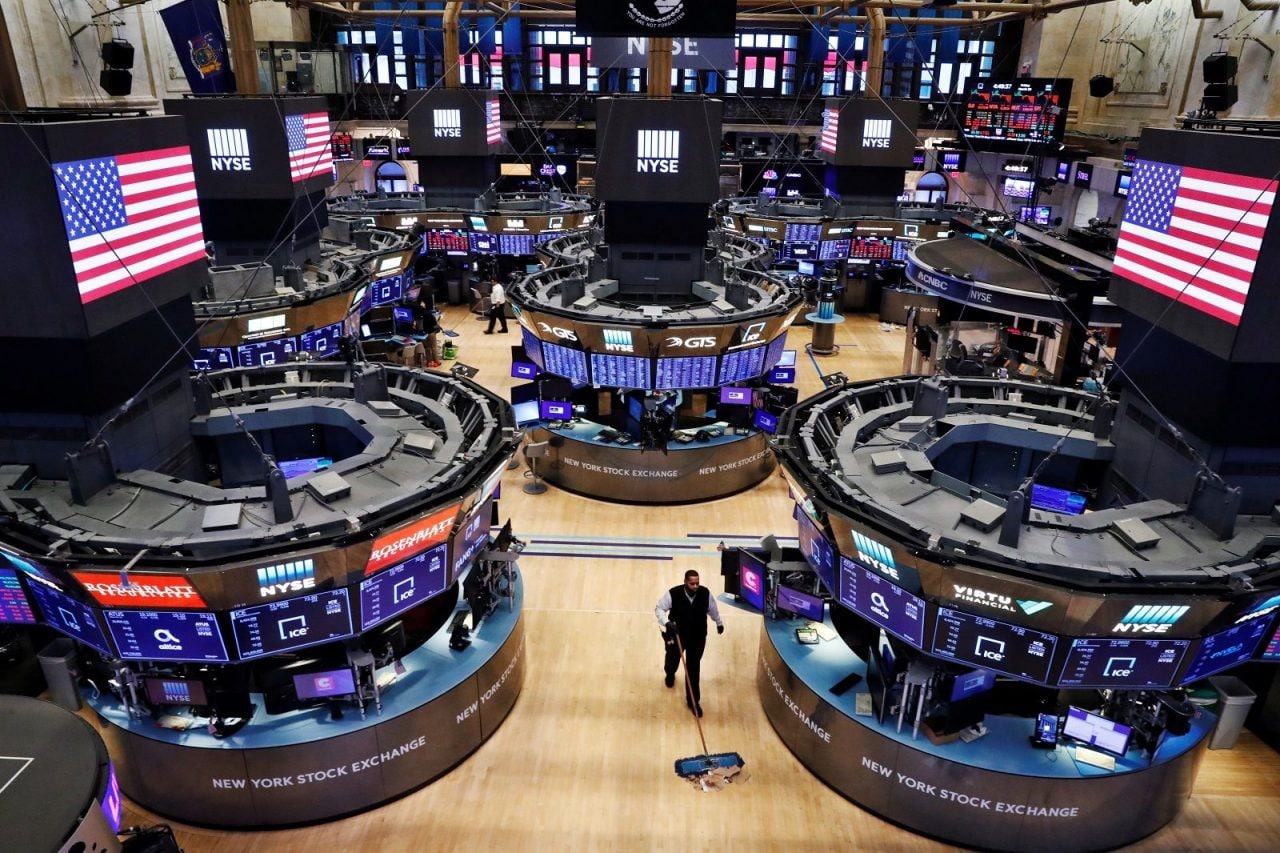
US Stock Market Highlights: Dow adds 200 points, S&P 500 rises in volatile trading as Trump denies he’s firing Powell
Published on 17/07/2025 01:44 AM
We will now wrap up the blog. Bye, folks!
Stocks went on a wild ride Wednesday as a White House official indicated to CNBC that President Donald Trump was moving closer to firing Jerome Powell from his post as Federal Reserve chairman, initially knocking down the S&P 500. The benchmark rebounded as Trump later denied the report, but traders still fear he could follow through.
The S&P 500 added 0.3% after losing as much as 0.68% earlier in the session. The Nasdaq Composite gained 0.2% after briefly dropping as much as 0.83%. The Dow Jones Industrial Average added 231 points, or 0.48%. The 30-stock index had earlier fallen 264.31 points, or 0.6%.
President Donald Trump’s choice to lead the nation’s top car safety regulator pledged to prioritize safety while at the same time making it easier for automakers to deploy-self driving cars.
Jonathan Morrison, who was nominated by Trump on February 11 to be administrator of the National Highway Traffic Safety Administration, told lawmakers in a hearing before the Senate Commerce, Science and Transportation committee Wednesday that the agency he hopes to soon lead should craft self-driving rules that go beyond the current voluntary guidelines that were enacted under previous administrations.
Current rules limit automakers to 2,500 test vehicles that don’t meet federal motor vehicle safety standards, like having steering wheels and brake pedals. Prior Congressional proposals would have allowed carmakers to request as many 100,000 of these exemptions.
The relationship between Argentine leader Javier Milei and his No. 2 reached a breaking point after Vice President Victoria Villarruel imperiled the most important tenet of his economic program, a key lieutenant said.
“That is undoubtedly a crisis — not an institutional one, but a political crisis — within the government,” Cabinet Chief Guillermo Francos told local television channel DNews in a clip aired Wednesday afternoon. “There is a rift between the president of the nation and the vice president.”
Argentina’s Senate, over which Villarruel presides, approved multiple bills last week that threaten the libertarian’s hard-fought fiscal surplus, including a pension hike and increased disability support. Milei called the vice president a “traitor” without naming her a speech before the Buenos Aires stock exchange later that day.
Oil edged lower as signs of a softening crude market undercut broader strength across risk assets. West Texas Intermediate futures dipped 0.2% to settle above $66 a barrel, extending a three-day losing streak.
The commodity followed broader markets off its lows after President Donald Trump denied a plan to fire Fed Chair Jerome Powell. Still, that rebound wasn’t enough to fully undo a slide driven by government data showing falling distillate demand and rising inventories at the key storage hub in Cushing, Oklahoma.
Chipmaker Kioxia Holdings Corp. sold $2.2 billion of US junk bonds in its first corporate debt issuance, becoming the latest Japanese firm to storm overseas credit markets.
The sale involves $1.1 billion each of five- and eight-year notes after initially targeting $1.5 billion of combined issuance, according to a person familiar with the matter. The bonds will respectively yield 6.25% and 6.625%, an eighth-point less than earlier price talk, said the person, who asked not to be identified as they’re not authorised to speak publicly.
Proceeds will go toward repurchasing preferred shares and general corporate purposes, the person added. Morgan Stanley led the transaction.
JPMorgan Chase & Co. is tapping the US investment-grade bond market Wednesday, kicking off what’s expected to be a relatively light season for bank bond sales ahead of expected changes to sector regulations.
The lender is selling $4 billion of 11-year subordinated notes that are fixed-to-floating rate and that can’t be called for 10 years, according to a person familiar with the matter. The bonds may yield 1.13 percentage points above similarly dated Treasuries, said the person, who was not authorised to speak publicly.
Initial price discussions were in the area of 1.4 percentage points above the benchmark.
It’s the first dollar-denominated high-grade offering from a money-center bank this month. Each of the six biggest US banks have reported their financial results for the most recent quarter, a move that typically opens a window for them to sell debt.
Once again, President Donald Trump demonstrated his power to shake up global financial markets. This time, by returning to one of his favourite topics: whether to fire Federal Reserve Chair Jerome Powell.
In an echo of the havoc that Trump unleashed with his trade war in early April, markets were briefly turned upside-down on Wednesday after a White House official said the president was likely to soon remove Powell.
Stocks, the dollar and long-term US government bonds quickly retreated, while short-term Treasuries rallied on speculation that whomever Trump appoints to replace Powell will bend to the president’s will and cut interest rates. Yet in less than an hour, the moves unwound after the president downplayed the possibility, saying he was “not planning” to fire Powell, someone he’s been lobbing almost daily criticisms at for moving too slow.
By most measures, the markets’ reaction was relatively muted, in no small part because of Trump’s penchant for bluffing — not to mention questions about whether a US president has the legal authority to actually remove a Fed chair whose interest-rate policy he dislikes.
Wall Street banks were optimistic Donald Trump’s second term would unleash a dealmaking boom. Instead, it’s delivered a trading bonanza.
First-half trading revenue at the five biggest lenders jumped $10 billion from last year to a record level, with tariffs and tax policy driving a surge of activity across equity, currency and bond markets. Investment-banking revenue, meanwhile, nudged up less than $1 billion, and is still almost 40% below the 2021 peak as that same volatility weighed on merger and IPO volumes.
“Post liberation day we saw a lot of market volatility,” Jim DeMare, Bank of America Corp.’s president of global markets, said in an interview. “There was a lot of client activity and as concerns subsided the market consolidated. That was followed by a re-positioning across equities, rates and foreign exchange.””
US economic activity “increased slightly” between late May and early July, the Federal Reserve said in its Beige Book survey of regional business contacts.
“That represented an improvement over the previous report, in which half of districts reported at least slight declines in activity,” according to the report published Wednesday. “Uncertainty remained elevated, contributing to ongoing caution by businesses.”
All 12 regions of the country reported price increases, with businesses experiencing “modest to pronounced input cost pressures related to tariffs,” the Beige Book said.
“Many firms passed on at least a portion of cost increases to consumers through price hikes or surcharges, although some held off raising prices because of customers’ growing price sensitivity, resulting in compressed profit margins,” according to the report.
Amazon.com Inc.’s carbon emissions rose for the first time in three years in 2024, driven by data center construction and fuel consumption by its delivery providers.
The world’s largest online retailer emitted 68.25 million metric tons of carbon dioxide equivalent last year, up 6% from the prior year, Amazon said in its annual sustainability report, which was published on Wednesday. The company’s emissions last year were up by a third since Amazon pledged in 2019 to eliminate them by 2040.
The company and its high-tech rivals are spending heavily on data centers to power artificial intelligence applications, which require plenty of concrete and steel, two materials that use a lot of energy to produce.
House Republican leaders struggled Wednesday to resolve an impasse with GOP hardliners on crypto legislation backed by President Donald Trump, holding open a key procedural vote as talks dragged on.
The dispute centered on the conservative holdouts’ demands to include a provision prohibiting the Federal Reserve from issuing digital assets in a broader crypto market structure bill.
The president claimed to have convinced the holdouts to move forward with legislation after meeting with a group of them late Tuesday night at the White House.
Preliminary findings of an investigation into a wide-ranging blackout in Spain earlier this year show that European power grids need to improve resilience, according to a report from the European Network of Transmission System Operators for Electricity.
The group, known as ENTSO-E, has assembled a panel of experts to pore over data from Spanish grid operators and power producers to find out what exactly happened in April that suddenly caused millions across the country to lose electricity. Preliminary results show that a cascading series of disconnections of electricity generation and unusual voltage increases were the most likely reason for the blackout, according to an update published Wednesday.
“If confirmed, this high voltage blackout mode will require a thorough analysis and investigation by all power system experts of the ENTSO-E community,” the report found. “The exceptional character of this incident highlights the need to improve the resilience” of the power system in such situations.
Norway is addressing “some real issues” in its trade talks with the US and still aims to prevent increases in tariffs, according to the country’s finance minister.
If a deal doesn’t materialise, Norway will likely do more business with other countries, Jens Stoltenberg said in an interview with Bloomberg Television on Wednesday. He said his country has close contacts on tariffs with both the European Union and the US.
Norway is among about 60 countries seeking to negotiate a deal with the US to avoid higher levies that the US president announced earlier this year.
The country, which is outside the EU, faces a complex challenge negotiating Trump’s moves to reshape global trade. It’s been cosying up to the EU in the hope that it will be exempt from any countermeasures Brussels enacts.
Canada will reduce the amount of foreign steel importers can bring into the country tariff-free, a move to help domestic producers suffering from US President Donald Trump’s levies on the sector.
The government will tighten “tariff rate quota” levels for steel products made in countries that don’t have a free-trade agreement with Canada. Producers from those nations will be able to ship half of last year’s volumes — above that level, a 50% tariff will apply.
Steel-producing countries that have existing trade deals with Canada, such as South Korea, will have more flexibility. They’ll be allowed to ship steel up to 2024 levels before tariffs kick in.
Elon Musk’s artificial intelligence startup, xAI, is in discussions to lease data center capacity in Saudi Arabia, according to people familiar with the matter, part of an effort to expand its infrastructure in regions offering cheap energy and political goodwill.
The company is in early talks with two potential partners: Humain, a Saudi-backed artificial intelligence firm offering xAI several gigawatts of capacity, and another company building a smaller but more immediately available 200-megawatt facility, the people said, asking not to be named discussing private talks.
The Humain proposal, while massive in ambition, remains distant. While the AI company is backed by Saudi’s Public Investment Fund, the firm has yet to break ground on much of the infrastructure it’s pledged to build. Any arrangement with xAI would offer Musk computing resources years down the road instead of being a near-term solution.
Private equity firm Henderson Park Capital Partners UK is selling one of its Irish assets to family office M Core, according to people familiar with the matter.
The Arena Centre in Tallaght, a Dublin suburb, is being bought for just shy of the €35 million ($40.7 million) guide price, the people said. The mixed-used asset, including office and retail, had already been up for sale before, but failed to find a buyer.
In 2023, agents sought €45 million on behalf of Henderson Park. Part of the discount this time round is because a unit leased to Lidl has been sold separately for €7 million. Previous owner Green Reit offered the asset to the market with a guide price in excess of €65 million in 2016, the Irish Times reported then.
Bahrain’s Crown Prince Salman bin Hamad Al Khalifa pledged $17 billion worth of investments in the US as he met with President Donald Trump at the White House. “This is real. These aren’t fake deals,” the crown prince, who also serves as his country’s prime minister, told reporters in the Oval Office on Wednesday.
Trump, in his second term has sought to harness his ties to many foreign leaders to encourage them to boost investments in the US, part of an economic agenda that seeks to rebalance trade flows and create more manufacturing jobs on American shores.
Bahrain’s national carrier, Gulf Air, has been considering purchasing about a dozen of Boeing Co.’s 787 Dreamliner jets in a firm order, with an option to buy additional planes, Bloomberg reported earlier Wednesday, citing people familiar with the plan who asked not to be identified discussing private negotiations.
US President Donald Trump said he would send letters to more than 150 countries notifying them of tariff rates as he pushes ahead with a trade agenda that has sent US partners racing to avoid higher import taxes.
“We’ll have well, over 150 countries that we’re just going to send a notice of payment out, and the notice of payment is going to say what the tariff” rate will be, Trump told reporters on Wednesday at the White House. “It’s all going to be the same for everyone, for that group.”
“They’re not big countries, and they don’t do that much business,” Trump added about the trading partners that would receive upcoming letters.
US President Donald Trump’s administration has barred Nvidia Corp. from selling its H20 chip in China, an escalation of Washington’s tech battle with Beijing that will cost the company billions of dollars and hamstring a product line it explicitly designed to comply with previous US curbs.
The US government informed Nvidia on Monday that the H20 would require a license to export to China “for the indefinite future.” The new rules address Washington’s concerns that “the covered products may be used in, or diverted to, a supercomputer in China,” the company said in a filing. Nvidia warned it will report about $5.5 billion in write-downs during the current quarter, tied to inventory and commitments for the chip.
Stocks were taken on a wild ride Wednesday as a White House official indicated to CNBC that President Donald Trump was moving closer to firing Jerome Powell from his post as Federal Reserve chairman, initially knocking down the S&P 500. The benchmark then rebounded as Trump later denied the report.
The S&P 500 was last down 0.1% after losing as much as 0.6% earlier in the session. The Nasdaq Composite traded 0.2% lower after briefly dropping as much as 0.8%. The Dow Jones Industrial Average hovered near the flatline. The 30-stock index had earlier fallen 264.31 points, or 0.6%.
Oil slipped for a third day on nascent signs of a softening physical market, as traders assess the likelihood of a glut in the second half of the year.
West Texas Intermediate futures fell by as much as 1.7% to trade near $68 a barrel after a weekly report from the US Energy Information Administration showed inventories at the key storage hub in Cushing, Oklahoma, rose to the highest since June, while US distillate demand ticked down. At the same time, crude inventories fell by 3.86 million barrels.
Traders and analysts remain preoccupied with the prospect of an oversupply later this year, as global demand growth cools, the OPEC+ alliance fast—tracks the return of halted supplies and output across the Americas booms. Price gauges indicate that availability is tight for the time being, with a premium of $1.06 cents on the US benchmark’s prompt spread, and US distillate inventories, which include diesel, sitting at the lowest level since the 1996 seasonally.
BNP Paribas SA is betting an army of 500 coders will be able to help it grab more market share in the growing business of prime brokerage.
The French bank has been adding dozens of software engineers to help it develop a new platform that determines how much margin it requires hedge fund clients to keep on hand. Already, the division has amassed more than half a trillion dollars worth of prime balances and has a line of sight to add another $40 billion by year-end.
“We’re not currently constrained,” Ashley Wilson, BNP’s global head of prime services, said in an interview. “We have a lot of capacity to grow.”
President Donald Trump told a room full of Republican lawmakers that he will fire Federal Reserve Chairman Jerome Powell, after receiving approval from them to make the move, a senior White House official told CNBC.
Amid repeated denials from administration officials and high-ranking Republicans, the exchange came Tuesday evening in the Oval Office, following Republicans blocking a vote on cryptocurrency legislation that Trump has favoured.
“The President asked lawmakers how they felt about firing the Fed Chair. They expressed approval for firing him. The President indicated he likely will soon,” the official said.
A rout in chipmakers weighed on stocks, which briefly wiped out gains fueled by a softer-than-estimated inflation reading that reinforced the case for the Federal Reserve to cut rates this year. Bond yields fell. The dollar halted a four-day advance.
The S&P 500 was little changed. A 10% plunge in ASML Holding NV after the company walked back its sales forecast dragged down the semiconductor space. Revenue surprises from US financial giants like Goldman Sachs Group Inc., Bank of America Corp. and Morgan Stanley fueled optimism about their ability to navigate the tariff turmoil.
Treasuries saw mild gains, with the 10-year yield dropping three basis points to 4.45%. Money markets slightly increased bets on Fed cuts this year, with traders still projecting about two reductions before the year is over.
The slowdown at Europe’s cocoa factories is deepening, highlighting how historically high prices are curbing demand and hurting processors’ profits in the top chocolate-consuming region.
The amount of beans ground into butter and powder that’s used in confectionery probably fell almost 5% in Europe in the second quarter from the same period in 2024, the average estimate of seven traders, brokers and processors surveyed by Bloomberg shows. That would mark a fourth straight quarter of year-on-year declines and the lowest grindings for the period since early in the pandemic.
Swiss officials approved the draft of a framework trade deal with the US almost two weeks ago, and are continuing talks while awaiting sign off from President Donald Trump, according to the government.
That twist in the ongoing negotiations was revealed to Bloomberg in an email on Wednesday that suggests Bern remains in suspense over whether the agreement will get over the line before the Aug. 1 deadline set by the White House.
“On July 4, 2025, the Federal Council approved the draft of a joint declaration of intent,” a spokesperson said, adding that this still lacks a nod from the American president. “Switzerland continues to be in touch with the relevant authorities in the US.”
President Donald Trump has dialled down his confrontational tone with China in an effort to secure a summit with counterpart Xi Jinping and a trade deal with the world’s second-largest economy, people familiar with internal deliberations said.
Six months into his second term, Trump has softened his harsh campaign rhetoric that focused on the US’s massive trade deficit with China and resulting job losses. The warmer posture contrasts with his threats against other trading partners to ravage their economies with crushing tariffs.
Trump is now focused on cutting purchase deals with Beijing — similar to one he forged during his first term — and celebrating quick wins instead of addressing the root causes of the trade imbalances. China posted a record trade surplus in the first half of the year amid booming exports.
For a decade, a Chinese tailor toiled in a three-story building on the outskirts of Milan, working 13 hours a day making high-end garments for brands including Italian cashmere label Loro Piana.
The unnamed worker was paid off-the-books, earning roughly €1,500 ($1,742) a month, according to legal documents seen by Bloomberg — about the price of one Loro Piana baby cashmere sweater. He became part of a hidden, underground labor force, employed by third parties, who craft luxury clothing for Italy’s most renowned fashion houses.
His case, which came to light after the tailor’s boss stopped paying wages and allegedly attacked him, became part of an ongoing probe of persistent worker abuses in one of Italy’s most important industries.
For two years, prosecutors have sought to reform an export model where premium brands sell Italian fashion abroad at luxury prices, even as inexpensive workshops proliferate around Milan, flouting labour standards in Italy’s capital of style.
Tesla Inc. is preparing to launch a longer, six-seat version of its Model Y sport utility vehicle in China, where the carmaker has been losing ground to domestic manufacturers with fresher lineups.
The new variant of Tesla’s top-selling model will be about 150 centimeters (5.9 inches) longer than the existing Model Y, according to figures posted Wednesday on the Ministry of Industry and Information Technology’s website. The filing lists LG New Energy as the battery supplier.
Tesla confirmed the upcoming release on the Chinese social media platform Weibo, sharing two images of the SUV along with the caption: “Model Y L, see you in the autumn!”NewsLive TVMarketPopular CategoriesCalculatorsTrending NowLet's Connect with CNBCTV 18Network 18 Group :©TV18 Broadcast Limited. All rights reserved.