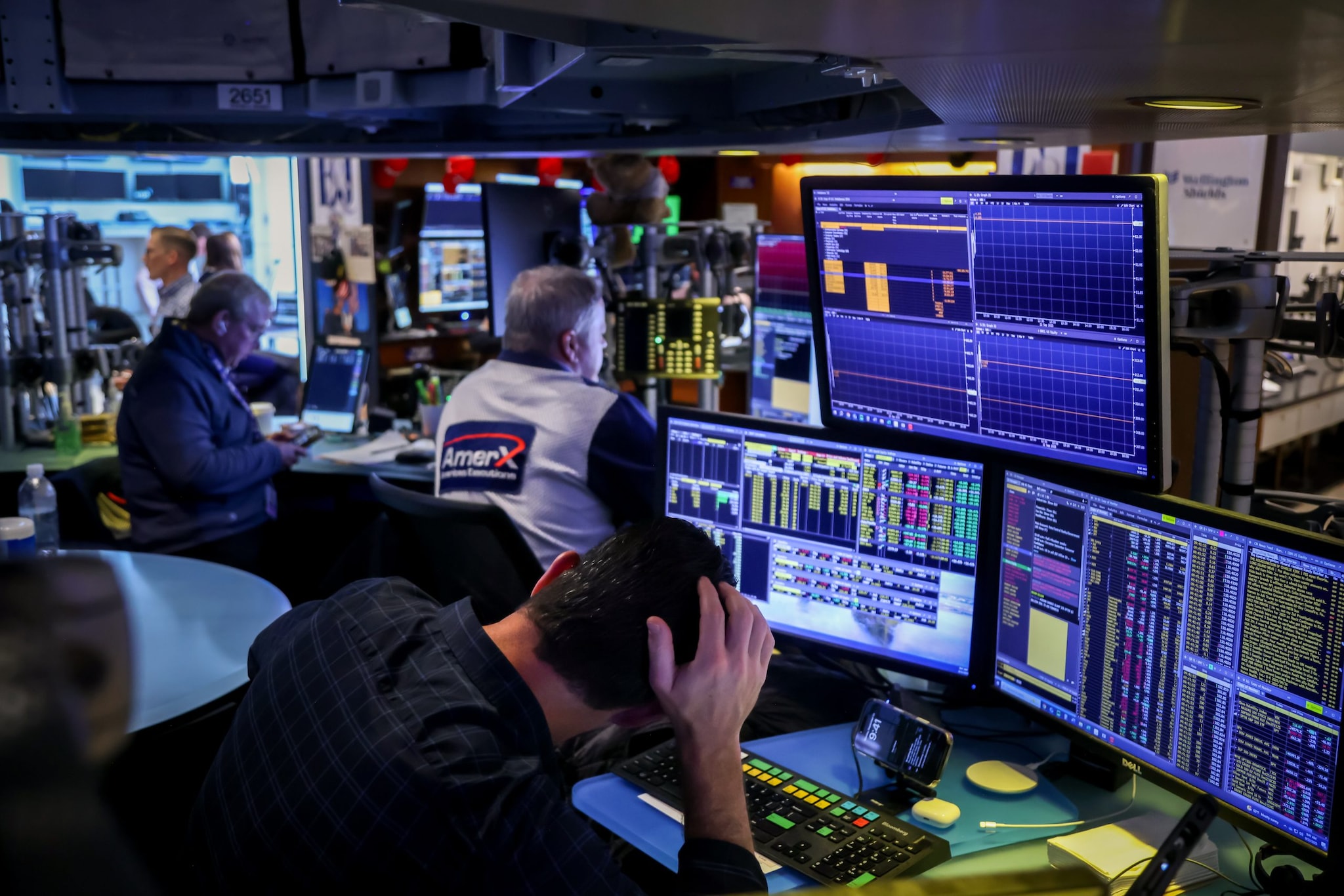
US Stock Market Highlights: Dow closes up 200 points after Supreme Court probes Trump tariff argument, AMD sparks AI rebound
Published on 06/11/2025 03:07 AM
We will now wrap up the blog. Good night, folks!
OpenAI Chief Financial Officer Sarah Friar suggested the market is overly focused on anxiety about a possible bubble in the artificial intelligence sector and should muster more “exuberance” about the technology’s potential.
“I don’t think there’s enough exuberance about AI, when I think about the actual practical implications and what it can do for individuals,” Friar said in an onstage interview at the Wall Street Journal’s Tech Live conference in California on Wednesday. “We should keep running at it.”
There has been mounting scrutiny in recent months on soaring valuations for AI companies as well as the accelerating spending spree from tech firms on data centers and chips to support artificial intelligence development. OpenAI alone has committed to spending more than $1.4 trillion on AI infrastructure, even though the company remains unprofitable.
The crypto lending sector continued its rebound through the third quarter, with the amount of loans delivered setting a fresh record just as digital-asset prices were soaring to all-time highs.
The timing of the recovery is reminiscent of when activity last peaked in the final quarter of 2021, just before a raft of scandals and bankruptcies caused a crypto market crash that nearly wiped out many of the most prominent lenders. After setting a series of record highs through the year, market bellwether Bitcoin has tumbled more than 20% in recent weeks, triggering concerns over a new bear market.
The combined amount of crypto loans reached $73.6 billion in the third quarter that ended in September, surpassing the previous record of $69.4 billion set in the fourth quarter of 2021, according to Galaxy Digital Research, citing data shared by various lending platforms. Galaxy didn’t report activity in the current quarter.
At a time when every dip in stocks is perceived as an opportunity, buyers emerged after a brief pullback led by some of the biggest winners of the artificial-intelligence boom. Bitcoin rallied. Bonds fell.
Equities rebounded, with the S&P 500 up almost 1% following a slide that underscored worries over how stretched the market has become and how sensitive it is to unfavorable news. Chipmakers, which bore the brunt of the recent selling, led gains on Wednesday.
Apple Inc. is planning to use a 1.2 trillion parameter artificial intelligence model developed by Alphabet Inc.’s Google to help power its long-promised overhaul of the Siri voice assistant, according to people with knowledge of the matter.
The iPhone maker is banking on Google’s help to rebuild Siri’s underlying technology, setting the stage for a new slate of features next year. The Google model’s 1.2 trillion parameters — a measure of the AI software’s complexity — would dwarf the level of Apple’s current models.
Apple had previously mulled using other third-party models to handle the task. But after testing Gemini, OpenAI’s ChatGPT and Anthropic’s Claude, Apple zeroed in on Google earlier this year, Bloomberg reported at the time. The hope is to use the technology as an interim solution until Apple’s own models are powerful enough.
The share of US consumer debt in delinquency rose in the third quarter to the highest level in more than five years as unpaid student-loan balances continued to surge.
Around 4.5% of debt was at least 30 days delinquent in the July-to-September period, the most since the first quarter of 2020, the Federal Reserve Bank of New York said Wednesday in its Quarterly Report on Household Debt and Credit. The share of student-loan debt becoming delinquent climbed to 14.4%, the most on record.
The figures suggest US households — especially younger ones — continue to grapple with financial challenges resulting from high interest rates, weak hiring trends and ongoing inflation. Transitions into serious delinquency were most elevated for consumers in their 20s and 30s, the report showed.
Traders slashed odds that the Supreme Court will uphold President Donald Trump’s aggressive tariffs after justices on Wednesday signalled doubts about the legality of the administration’s sweeping trade powers.
On Kalshi, contracts tied to whether the court would rule in favour of Trump’s tariffs slipped to around 30% from nearly 50% before Wednesday’s hearing.
A similar contract on platform Polymarket dropped to about 30% from more than 40% earlier in the week, reflecting traders’ growing belief that the justices may strike down the policy.
The US Federal Aviation Administration issued a ground delay for flights bound for Newark Liberty International Airport on Wednesday due to air traffic control staffing constraints. The delay is scheduled to remain in effect until 11:59 p.m. New York time with planes waiting about 68 minutes on average, according to an FAA advisory.
The disruption is part of the latest string of flight delays and cancellations at airports across the country, including in Washington, Boston, Nashville and the Dallas-Fort Worth area, as the longest US government shutdown in history strains workers essential to safe, efficient air travel.
Oil extended a run of lackluster trading as investors assessed mixed US inventory data and a persistent outlook for oversupply. West Texas Intermediate fell 1.4% to trade below $60, a key level that can trigger accelerated buying when breached, with prices undulating in a band of about $2 since early last week.
The commodity was already under pressure after a US government report on Wednesday showed crude inventories rose 5.2 million barrels in the week ending Oct. 31. That’s the biggest increase since July, but lower than a mostly priced-in forecast by a closely followed industry group. Product inventories fell across the board, indicating resilient demand and limiting potential bearish momentum.
Gold rebounded as investors weighed the outlook for the Federal Reserve’s interest rate path following data that showed some stabilisation in the job market.
Private-sector payrolls increased by 42,000 after two straight months of declines. The ADP report is one of the few monthly snapshots of the labour market, as the longest government shutdown in US history delays the release of official economic data.
While helping to temper concerns of a faster deterioration in the job market, the modest payroll increase last month is consistent with a general softening in labour demand.
Traders should take cover from a protracted selloff in the dollar that could mirror the boom-and-bust cycle of the Internet bubble once the drivers that are supporting the currency turn into headwinds, according to RBC Capital Markets.
The greenback has already been hit hard this year by the uncertainty associated with President Donald Trump’s policies. But it found support from a soaring stock market and US asset allocations from global investors, chief among them mammoth, passive investment funds.
JPMorgan Chase & Co.’s super-rich clients are bolstering investments in sports teams as rising values increasingly attract capital from institutional firms and they mature as an asset class.
Some 20% of 111 billionaire families served by the Wall Street giant now own controlling stakes in sports teams, up from 6% three years ago, JPMorgan said in a report Wednesday.
About a third of the families surveyed this year – who have a combined net worth of more than $500 billion – invested more broadly in sports teams or stadiums, making it their top specialty asset class ahead of art and cars, the bank said in its 2025 Principal Discussions Report.
Oregon Attorney General Dan Rayfield says the Trump administration’s attorney “had the gall to look all of those justices in the eyes and say these are not taxes on the American people, and they’re doing it by abusing an emergency power.”
Rayfield pointed out that the tariffs come “when Americans are facing an affordability crisis.” He spoke to reporters outside the courthouse after the arguments, flanked by attorneys general from Arizona and California.
The Canadian government is set to launch special initiatives to attract top international researchers and H-1B visa holders, while slashing the number of foreign students it plans to bring into the country each year.
Prime Minister Mark Carney’s first budget unveiled a plan to attract international talent, earmarking C$1.7 billion ($1.2 billion) to recruit more than 1,000 highly skilled researchers.
“The expertise of these researchers will help advance our global competitiveness and contribute to the economy of the future,” the budget document said.
The government also said it would launch an accelerated pathway for H-1B visa holders in the coming months. This follows President Donald Trump increasing fees for H-1B visas to $100,000.
Artificial intelligence startup Reevo Inc. has raised $80 million from investors including Khosla Ventures and Kleiner Perkins, the company plans to announce Wednesday — financing that brings the startup’s valuation to $500 million.
The company raised the funding over the course of a seed round in 2024 and a Series A in 2025. Zhu Ventures, Reevo co-founder David Zhu’s venture capital firm, led the $10 million seed deal, and Khosla Ventures and Kleiner Perkins led the $70 million Series A investment.
AI “enables each startup to to more work than it could do,” Vinod Khosla, founder of Khosla Ventures, said in an interview with Bloomberg Television Wednesday. “Twenty engineers can do the work of 60 engineers.”
Treasury Secretary Scott Bessent showed up for the arguments, as promised, along with Commerce Secretary Howard Lutnick and Trade Representative Jamieson Greer. The three sat together in the middle rows of the court room. The trio have largely been responsible for negotiating various trade deals with other nations.
Notable lawmakers who attended the arguments were Republican U.S. Rep. Jason Smith, who heads the House Ways and Means Committee, and Democratic Sen. Amy Klobuchar.
Pinterest shares plummeted 20% on Wednesday after lacklustre third-quarter earnings as advertising took a hit from larger retailers dealing with tariffs.
The company posted a profit of 38 cents per share adj., while analysts polled by LSEG expected earnings of 42 cents per share. However, the platform’s revenue did meet analyst estimates of $1.05 billion.
Alphabet Inc’s Google and cybersecurity company Wiz Inc. cleared a key hurdle to closing their $32 billion deal, with the US government saying it would wrap up its investigation of the acquisition.
After the companies first announced their tie-up in March, the Justice Department opened up an in-depth probe of the deal, Bloomberg reported in June. The decision to close the review, pursuant to so-called early termination, is dated Oct. 24 on the website of the Federal Trade Commission.
Wiz Chief Executive Officer Assaf Rappaport confirmed at a Wall Street Journal event on Tuesday that the DOJ concluded its review, but the deal is still under scrutiny by other antitrust regulators.
Treasuries fell after the US government signalled that larger auction sizes are on the horizon, while signs of economic resilience hurt the odds of a Federal Reserve interest-rate cut in December.
Treasury Department officials, unveiling their plans for financing the US government deficit over the November-to-January period, said they’d begun “to preliminarily consider future increases,” even as they continue to anticipate no changes to note and bond auction sizes “for at least the next several quarters.”
The prospect of cuts to long-maturity auction sizes has been a minority view on Wall Street over the past year.
At a time when every dip in stocks is perceived as an opportunity, buyers emerged after a brief pullback led by some of the biggest winners of the artificial-intelligence boom. Bitcoin rallied. Bonds fell.
While Wall Street didn’t see a buying stampede, equities were able to bounce after a slide that underscored worries over how stretched the market has become and how sensitive it is to unfavourable news. Chipmakers, which bore the brunt of the recent selling, led gains on Wednesday.
Unionised Starbucks baristas are preparing to go on strike next week and disrupt one of the coffee chain’s busiest days — aiming to secure a contract after years of sporadic and unsuccessful talks.
Starbucks Workers United — representing employees at about 550 of the chain’s roughly 10,000 company-run US stores — said members voted to give union leadership the ability to call for a work stoppage at any time if demands aren’t met. It’s now gearing up to launch strikes in more than 25 cities on November 13.
That’s the company’s popular holiday-themed Red Cup Day, which has been a previous union target. The labour actions could expand if there isn’t progress toward finalising a contract and resolving legal disputes, said the union, which accused Starbucks of refusing to fairly negotiate.
The court unanimously ruled for President Gerald Ford in a case about the imposition of tariffs on oil imports, based on a different statute that also doesn’t mention the word tariffs.
“The court 9-0 rejected the argument” that the absence of the word tariff doomed Ford’s action, Kavanaugh said.
Axon Enterprise’s stock plummeted 12% after the Taser maker missed Wall Street’s third-quarter profit expectations as it grapples with tariff constraints. Shares are headed for their worst session since May 2023.
Adjusted earnings totalled $1.17 per share adj., falling short of a $1.52 per share forecast from LSEG. Adjusted gross margins fell 50 basis points from a year ago to 62.7%, which Axon attributed to tariff impacts.
Advanced Micro Devices Inc. failed to impress investors with its revenue outlook, halting a blistering run-up in its shares this year and adding to the concerns over an AI-fueled bubble.
The main contender to Nvidia Corp. in the AI chip market said Tuesday that it expects roughly $9.6 billion in fourth-quarter revenue. While analysts had estimated $9.2 billion on average, some projections ranged as high as $9.9 billion.
AMD’s shares were virtually unchanged in New York on Wednesday. They had slumped in overnight trading, compounding a broader chip selloff amid fears that the global AI boom won’t actually bring about the trillion-dollar chips and data center spending spree that the likes of Nvidia’s Jensen Huang and OpenAI’s Sam Altman have envisioned.
US President Donald Trump conceded that the Democrats’ electoral sweep up and down the ballot across the country on Tuesday night spelled bad news for his Republican Party.
“Last night, it was, you know, not expected to be a victory, it was very Democrat areas, but I don’t think it was good for Republicans,” Trump said during a breakfast meeting with GOP senators at the White House on Wednesday morning.
Attorney Neal Katyal, in response to a question from Thomas, distinguishes between embargos, allowed by the law, and tariffs, which he says are not.
“Embargos stop the shipment, tariffs start the tax bill,” Katyal said. He was solicitor general in the Obama administration, on an acting basis.
At a time when every dip in stocks is perceived as an opportunity, buyers emerged after a brief pullback led by some of the biggest winners of the artificial-intelligence boom. Bitcoin rallied. Bonds fell.
While Wall Street didn’t see a buying stampede, equities were able to bounce after a slide that underscored worries over how stretched the market has become and how sensitive it is to unfavourable news. Chipmakers, which bore the brunt of the recent selling, led gains on Wednesday.
Bonds fell after data showed US services activity expanded in October at the fastest pace in eight months on a swift upturn in the growth of new orders. Meantime, employment at US companies increased, signalling some stabilisation in the job market.
US Supreme Court justices questioned President Donald Trump’s global tariffs, as arguments began in a case that could undercut his signature economic policy.
Justices, including John Roberts and Amy Coney Barrett, pressed US Solicitor General D. John Sauer on his contention that a 1977 law designed for emergency situations gives Trump the authority to collect tens of billions of dollars in tariffs a month.
“The vehicle is imposition of taxes on Americans, and that has always been the core power of Congress,” Roberts said.
The questioning came early on in a session likely to last more than two hours, and it didn’t give a clear indication of how the court will rule. The justices may have equally tough questions when the tariff challengers make their case in the second half of the argument.
Justice Neil Gorsuch, a Trump appointee, has questions about both major questions and nondelegation. He is asking Sauer to provide limits on the broadest reading of the administration’s arguments in favour of tariffs.
Sauer agreed that another, very different president would have the authority to declare climate change an emergency and impose tariffs to deal with it.
McDonald’s Corp reported faster-than-expected US sales growth last quarter as diners prioritised cheap fast food and pulled back from more premium meals at fast-casual chains.
US comparable-store sales, which reflect the results of established locations, increased 2.4% in the third quarter, higher than the average of analyst estimates, with the company attributing the rise mostly to higher per-visit spending.
Overall comparable sales, which add in international markets, were in line with expectations, while adjusted earnings per share fell short of the average of estimates compiled by Bloomberg.NewsLive TVMarketPopular CategoriesCalculatorsTrending NowLet's Connect with CNBCTV 18Network 18 Group :©TV18 Broadcast Limited. All rights reserved.