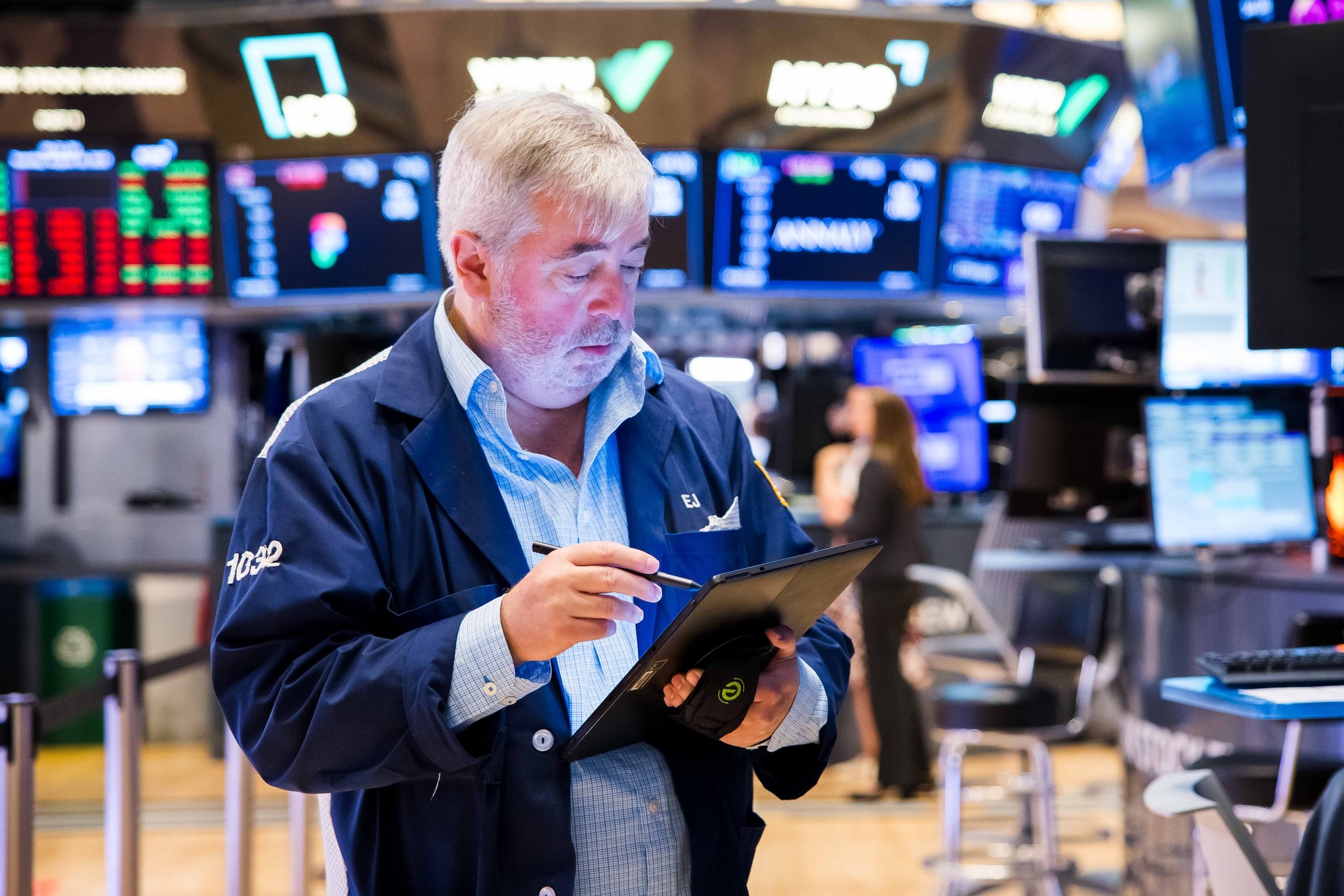
US Stock Market Highlights: Dow dips, S&P 500 and Nasdaq rebound on Strait of Hormuz hopes
Published on 03/04/2026 01:40 AM
The Dow Jones Industrial Average pared back early losses of more than 1% to finish down just 0.1%. The S&P 500 rose 0.1%, while the tech-heavy Nasdaq Composite also gained 0.1%.Energy markets remained volatile, with West Texas Intermediate crude climbing 11% to over $111 a barrel, and Brent crude rising 6% above $108, following Trump’s remarks. The conflict in the Middle East has already pushed Brent prices roughly 50% higher since late February, though a brief pullback earlier this week had provided temporary relief for investors.In other market-moving news, the Trump administration announced tariffs of up to 100% on certain imported medicines, with phased implementation based on company size, aiming to encourage domestic manufacturing.Thursday’s session was the last before the holiday-shortened week ahead of Good Friday. Labor market data offered some relief, with initial jobless claims falling 9,000 to 202,000 for the week ending March 28, ahead of the closely watched March jobs report due Friday.Coinbase received conditional approval from the US Office of the Comptroller of the Currency (OCC) to operate as a trust bank, the crypto exchange announced Thursday. If finalised, the move would allow Coinbase to offer payment products alongside its custody services under federal supervision, Coinbase Chief Legal Officer Paul Grewal told CNBC.“Over the long haul we will be able to explore, with the OCC, offering not just custody products but also other infrastructure products, particularly around payments, that we think will expand and extend crypto payments in all sorts of new and interesting and important directions,” Grewal said.The company clarified it will not become a commercial bank, take retail deposits, or engage in fractional reserve banking. However, a trust charter would give Coinbase legal authority, access to banking infrastructure, and regulatory credibility to move, hold, and settle money more efficiently, potentially positioning it as a competitor to PayPal and Square.Shares of Coinbase were last down more than 1%, amid broader market weakness fueled by uncertainty over the Iran conflict.Tesla shares fell more than 5% after the company reported first-quarter deliveries and production that rose year-on-year but declined from the previous quarter.Wedbush analyst Dan Ives described the numbers as “underwhelming,” though not surprising given the current electric vehicle landscape and Tesla’s increasing focus on its AI strategy. He added that investors will be looking for more clarity during the company’s earnings call on April 22.
Airline stocks fell on Thursday, extending their year-to-date losses, as surging oil and jet fuel prices raised concerns over profitability.
Shares of major US carriers, including American Airlines and United Airlines, dropped more than 3%, while Delta Air Lines slipped nearly 2%. Regional players such as Alaska Air Group and Southwest Airlines also traded lower.
US initial jobless claims declined more than expected last week, reinforcing signs of continued strength in the labour market. According to the US Department of Labor, first-time filings for unemployment benefits came in at a seasonally adjusted 202,000 for the week ended March 28, down 9000 from the previous week and below the Dow Jones estimate of 212,000. Continuing claims, which lag by a week, also moved lower, falling by 25,000 to 1.841 million. The four-week moving average edged down to 1.838 million, marking its lowest level since late September 2024. The data points to a still-tight labour market, with layoffs remaining subdued despite broader economic uncertainty, and will likely factor into expectations ahead of the upcoming monthly jobs report.
Market breadth remained under pressure on Thursday, with 11 S&P 500 stocks hitting fresh 52-week lows even as a handful of defensives and infrastructure-linked names pushed higher. Among the laggards, housing and consumer-linked names led the downside. Lennar fell to levels last seen in December 2022, while Builders FirstSource and Home Depot also slipped to multi-month lows. Discretionary and niche retail exposure remained weak, with Pool Corporation and Tractor Supply declining further. Financial and payments infrastructure stocks extended their downtrend, including Global Payments and Fidelity National Information Services, both trading at multi-year lows. Consumer staples and healthcare names such as McCormick & Company, Nike, and Insulet also featured among the decliners, alongside real estate player Alexandria Real Estate Equities. On the upside, five stocks reached 52-week or all-time highs, pointing to selective strength in defensives and yield-oriented plays. Pfizer climbed to its highest level since late 2024, while utilities Sempra Energy and Entergy extended their rally to record levels. Corteva and data centre giant Equinix also traded at all-time highs.
In an address on Wednesday night, Trump said the US is getting very close to ending the Iran conflict, but warned of intensified military action, stating Washington would hit Tehran extremely hard if needed. The rhetoric pushed the oil markets higher, with West Texas Intermediate crude futures jumping around 8% to trade above $108 per barrel. Global benchmark Brent crude also advanced roughly 5%, crossing the $106 mark.
Artificial intelligence has yet to drive meaningful structural shifts in the labour market, according to Torsten Slok, who said broader economic data does not yet reflect widespread disruption. Speaking on Squawk on the Street, Slok noted that while concerns around AI-led job displacement are rising, particularly in white-collar roles, the impact remains contained for now. “What we are waiting for is to begin to see the impact of AI really broadly in the economy,” he said. Slok acknowledged that the unemployment among younger workers has edged higher, but he also added that the increase is not significantly out of step with broader labour market trends.
Investors are responding positively to emerging clarity around the US-Iran conflict, with equities trimming losses as timelines around the situation begin to take shape. Larry Tentarelli, chief technical strategist at Blue Chip Daily Trend Report, said markets tend to reward any reduction in uncertainty. “What often happens with the stock market is that any certainty is often considered a positive,” he told CNBC, adding that there now appears to be “light at the end of the tunnel.” Tentarelli noted that while remarks from Donald Trump were broadly hawkish, his indication that military action could last two to three weeks may have reassured investors. “A two-to-three week time frame is much better than two to three months,” he said, suggesting that a defined, shorter horizon is helping markets stabilise.
Equities attempted a recovery on Thursday after reports that Iran and Oman are working on a framework to monitor transit through the Strait of Hormuz, but oil prices continued to surge, underscoring a growing divergence between asset classes. West Texas Intermediate crude futures jumped nearly 10% to hover around $110 per barrel, after briefly crossing $113 during the session. Just a day earlier, before remarks from Donald Trump, prices were trading below $100. Meanwhile, equities showed resilience. The S&P 500 and other major indices clawed back earlier losses, even as oil continued to price in elevated geopolitical risk.
Wall Street staged a sharp intraday turnaround on Thursday, with all three major indices moving into positive territory after reports that Iran and Oman are working on a framework to monitor traffic through the Strait of Hormuz. The Dow Jones Industrial Average recovered from a steep loss of 668.5 points, or 1.4%, to trade up 0.4%. The S&P 500 rebounded from a 1.5% decline to gain 0.4% at its peak, while the Nasdaq Composite swung from a 2.2% drop to a 0.3% rise. The reversal followed Iranian state media reports indicating that Tehran and Muscat are drafting a protocol to oversee shipping activity in the key oil transit route, a move seen by markets as a potential step toward reducing immediate supply disruption risks.US stocks rebounded on Thursday, turning positive after a report that Iran and Oman are drafting a protocol to monitor traffic in the Strait of Hormuz.The Dow Jones Industrial Average recovered from a drop of over 660 points to rise about 0.4%. The S&P 500 also reversed earlier losses of 1.5% to gain 0.4%, while the Nasdaq Composite bounced from a 2.2% decline to trade up 0.3% at its peak.Bed Bath & Beyond said it will acquire The Container Store, along with Elfa and Closet Works, in a $150 million deal.Shares of the home essentials retailer fell about 6% following the announcement.Blue Owl has imposed a 5% redemption cap on its private credit funds after witnessing a sharp rise in investor withdrawal requests across key portfolios.The asset manager said redemption demand spiked in two of its flagship funds during the first quarter. Its technology-focused fund, OTIC, saw redemption requests soar to 40.7%, reflecting investor concerns around AI-driven disruption that have weighed on tech-focused strategies.Meanwhile, OCIC, the firm’s largest fund, also faced elevated withdrawal pressure, with redemption requests reaching 21.9% during the period.Following the development, shares of Blue Owl declined nearly 7%, as investors reacted to the heightened redemption activity and potential liquidity pressures.US stocks opened sharply lower on Thursday after President Donald Trump’s latest remarks failed to ease investor concerns over the ongoing West Asia conflict.The S&P 500 fell 1.3% at the open, while the Dow Jones Industrial Average dropped more than 600 points, or 1.4%. The Nasdaq Composite led losses, declining 1.7%.The US trade deficit widened in February but came in lower than expected, according to data from the Commerce Department.The gap in goods and services stood at $57.3 billion, up 4.9% from January, but below the $62 billion estimate.On a broader basis, the deficit has narrowed significantly compared to last year, dropping sharply from levels seen when businesses ramped up imports ahead of tariff announcements. The two-month deficit is down nearly 55% year-on-year, with the overall deficit about 16% lower than 2024 levels.Initial jobless claims in the US fell more than expected last week, pointing to continued strength in the labor market.First-time filings for unemployment benefits came in at a seasonally adjusted 202,000 for the week ended March 28, down 9,000 from the previous week and below the 212,000 estimate, according to the Labor Department.Continuing claims, which are reported with a one-week lag, declined by 25,000 to 1.841 million. The four-week average also edged lower to 1.838 million, marking its lowest level since late September 2024.
Bitcoin declined on Thursday, slipping back toward its yearly lows as broader risk sentiment weakened.
The cryptocurrency fell around 3% to $66,172, pressured by a wider pullback in risk assets following President Donald Trump’s remarks on the Iran conflict, which dampened recent recovery optimism.Crude oil prices moved sharply higher following President Donald Trump’s address, even as recent volatility continues to drive swings in sentiment. US benchmark West Texas Intermediate rose 7% to settle near $107 per barrel, while Brent crude climbed 7% to just above $108.Brent has surged roughly 40% since the conflict began in late February, reflecting concerns over potential supply disruptions. While a brief pullback earlier this week had supported market sentiment, the latest escalation signals have once again pushed oil prices higher.Layoffs at major US companies rose 25% in March, with artificial intelligence emerging as the top reason for job cuts, according to data from Challenger, Gray & Christmas.Employers announced 60,260 job reductions during the month, up from February but still 78% lower than the same period last year. For the first quarter, total layoffs stood at 217,632 — the lowest for the period in four years and down 56% year-on-year.AI-related cuts accounted for 15,341 roles, making up roughly a quarter of all layoffs. Hiring plans, however, picked up sharply, rising 157% month-on-month to 32,826, although year-to-date hiring remains 6% lower.Oil prices spiked sharply on renewed geopolitical concerns, reversing the optimism seen in the previous session. West Texas Intermediate crude futures were last up 7.9% at $107.98 a barrel, while Brent crude futures advanced 7.3% to $108.59.The move comes as markets reassessed expectations of a near-term resolution to the conflict, with sentiment turning cautious after earlier signs of easing tensions.“Markets have reversed the continued positive momentum they’d seen yesterday amid rising hopes that an end to the conflict might be coming into view,” Deutsche Bank strategists said, highlighting the sharp shift in risk sentiment.US stock futures dropped sharply on Thursday after Donald Trump indicated that the conflict with Iran is likely to continue, dampening investor sentiment and lifting oil prices.Futures tied to the Dow Jones Industrial Average fell 541 points, or 1.2%, while S&P 500 futures declined 1.4%. Futures on the Nasdaq-100 dropped 1.7%, reflecting broad-based risk aversion.The move comes as oil prices surged amid concerns that a prolonged conflict could disrupt global energy supplies. Donald Trump’s remarks reinforced fears that geopolitical tensions in West Asia may persist, keeping volatility elevated across markets.
US stock futures declined sharply, reflecting risk-off sentiment after President Donald Trump struck a more hawkish tone on Iran than markets had anticipated. Futures linked to the Dow Jones Industrial Average fell 1.1% versus fair value, while S&P 500 futures dropped 1.25%. Nasdaq 100 futures led losses, sliding 1.6%.
The move came alongside a sharp rebound in crude prices. US crude surged nearly 5% to around $105 per barrel, reversing earlier losses that had briefly pulled prices to about $98 before Trump’s remarks.
Bond yields also edged higher, with the 10-year Treasury yield rising a few basis points to 4.38%, signalling some pressure on fixed income amid the geopolitical uncertainty.
US Futures declined sharply after US President Donald Trump threatened of more attacks on Iran in the coming few weeks.
Dow Futures are down 400 points, Nasdaq futures are down 340 points, while S&P futures have declined 1.1%.
Welcome to CNBC-TV18’s LIVE Blog on US Markets. Check this space for minute-by-minute updates.NewsLive TVMarketPopular CategoriesCalculatorsTrending NowLet's Connect with CNBCTV 18Network 18 Group :©TV18 Broadcast Limited. All rights reserved.