US Stock Market Highlights: Nasdaq snaps three-day slide as tech stocks rebound after sharp sell-off
Published on 15/11/2025 03:06 AM
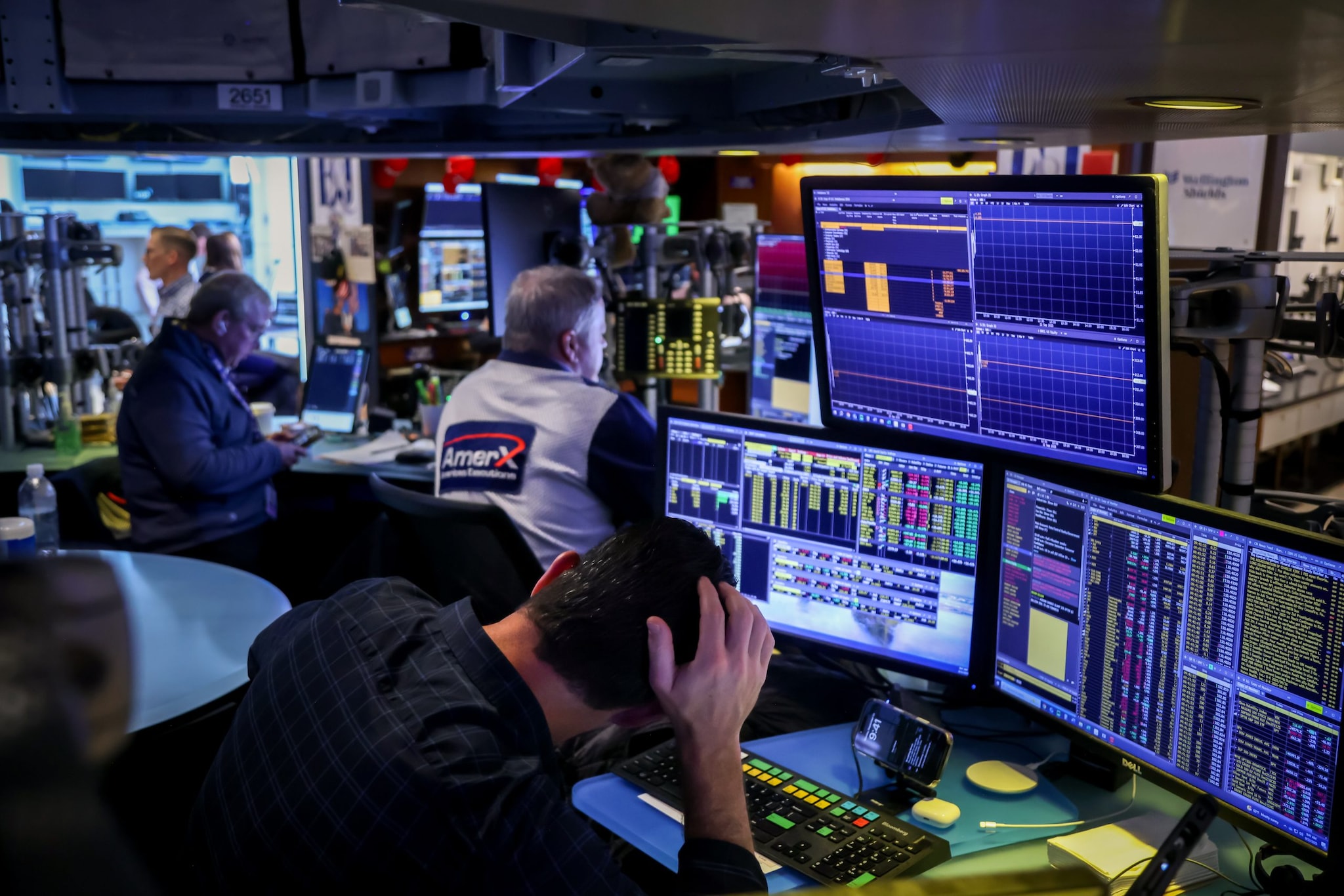
All three indexes clawed back steep early losses, with the Nasdaq and S&P 500 having been down as much as 1.9% and 1.4%, respectively. The Dow had dropped nearly 600 points at its intraday low.Big tech names helped stabilise sentiment after a broad sell-off. AI heavyweights Nvidia and Oracle reversed the previous day’s losses, while Palantir and Tesla also recovered after sharp declines. The Technology Select Sector SPDR Fund rose 0.5%, partly offsetting Thursday’s 2% slide, when major US benchmarks posted their heaviest fall since Oct. 10.
The 30-stock Dow was the laggard during Friday’s session.
The S&P 500 shed 0.05% to close at 6,734.11. The Dow Jones Industrial Average lost 309.74 points, or 0.65%, ending at 47,147.48. The tech-heavy Nasdaq Composite rose 0.13% to settle the session at 22,900.59.
A faction of Federal Reserve policymakers has stepped up warnings that inflation progress could slow or stall, casting doubt over the prospects for another interest-rate cut in December and laying bare a deepening divide at the central bank.
Officials broadly agree the labor market has cooled, but are split over whether the slowdown will intensify. And while one group is sanguine about price pressures, others are warning interest rates at the current level are barely restraining the economy and see further cuts putting progress on inflation at risk.
The public sparring is unusual. It reflects the difficulty of reading the economy right now — and the predicament facing Fed Chair Jerome Powell, who has the task of forging consensus on the direction of monetary policy.
On Friday, eight stocks in the S&P 500
traded at new all-time highs.
Names that hit this milestone included:
Assurant
trading at all-time highs back to its IPO in 2004
Hartford Financial
trading at all-time highs back to its IPO in December 1995
Loews
trading at all-time highs back through our history to 1972
Cardinal Health
trading at all-time highs back to its IPO in 1983
Cencora
trading at all-time highs back to its IPO in April 1995
HCA
trading at all-time high levels back to its IPO in March 2011
Ventas
trading at all-time high levels, back to its spin-off from Vencor in 1998
Welltower
trading at all-time high levels back to its incorporation as Health Care REIT in 1985
Conversely, eight stocks in the benchmark traded at new 52-week lows:
Charter Communications
trading at lows not seen since March 2016
Molina Healthcare
trading at lows not seen since April 2020
Carrier Global
trading at lows not seen since April 2024
Old Dominion Freight Line
trading at lows not seen since November 2022
Motorola Solutions
trading at lows not seen since June 2024
Smurfit Westrock trading at lows not seen since November 2023
Alexandria Real Estate Equities
trading at lows not seen since October 2009
Weyerhaeuser
trading at lows not seen since July 2020
The S&P 500 sector has slipped more than 2% week to date, making it the worst performing of the 11 that comprise the broad index. The group is on track to see its second straight down week.
Williams-Sonoma led the sector down this week with a drop of more than 6%, followed by Aptiv and Tesla’s slides of around 5% each. But Nike
and AutoZone have helped curtail losses, jumping more than 5% and 3%, respectively.
The sector is now down more than 3% for November, on pace to snap a six-month winning streak. If that holds, consumer discretionary would also be the biggest-losing sector for the month.
Kansas City Federal Reserve President Jeffrey Schmid on Friday reiterated that he does not believe additional interest rate cuts are warranted.
After voting against the October cut, Schmid said he hasn’t changed his view that inflation is too high and additional easing won’t help the cooling labor market.
″“I view the current stance of monetary policy as being only modestly restrictive, which is about where I think it should be,” he said, according to Reuters.
Schmid joins a growing chorus of hawks at the Fed who have voiced opposition or hesitation recently to more cuts from the current fed funds target rate of 3.75%-4%. Market pricing Friday morning tilted slightly in favor of a hold at the Dec. 8-9 meeting, down from about 95% odds for a cut a month ago.
A resurgence in tech shares spurred a rebound in stocks, though the advance was limited by concerns over the Federal Reserve’s ability to slash interest rates in December. Bonds fell.
The relief brought by the end of the US shutdown quickly gave way to volatility this week as a host of Fed speakers threw cold water on bets for further policy easing. Hot areas favored by momentum traders such as artificial-intelligence and Bitcoin whipsawed. While the S&P 500 erased a 1.4% slide, most of its shares fell. Nvidia Corp. rallied ahead of its earnings.
The S&P 500 ticked up 0.4% in midday trai ‘.fc ding Friday, led by the information technology and energy sectors.
Information technology was last up 1.3%, clawing back some of its more than 2% loss on Thursday. Energy was higher by 1.1%.
The two S&P 500 sectors were among the six that were positive in the session. In contrast, communication services, materials, health care, financials and consumer staples all suffered losses.
US stocks erased earlier losses Friday with mega-cap tech companies staging a rebound despite mounting concerns the Federal Reserve may not cut rates at its next meeting.
The S&P 500 Index rebounded a sharp drop at the open to climb 0.3% at 11:31 a.m. in New York. The index’s largest sector by weight, technology, bounced from being one of the worst-performing sectors to gaining 0.6%.
The tech-heavy Nasdaq 100 rose 0.6%, while the blue-chip Dow Jones Industrial Average fell 0.4%.
Even if the US Supreme Court strikes down Donald Trump’s sweeping tariffs, there still appear to be significant doubts that trades betting on government refunds will ever pay out.
Several Wall Street heavyweights have struck deals with companies that could be eligible for reimbursement if the levies are found to be unlawful — an outcome that betting markets see as more likely after a hearing last week.
Yet investors are still finding the trade can be had for relatively cheap. Depending on the kind of tariff, the claims were quoted around 10 to 25 cents on the dollar this week, according to people familiar with the matter, who asked not to be identified discussing trades. That’s only a modest increase from before the Nov. 5 hearing, suggesting there are still plenty of questions over whether the gambit will ever deliver.
UK markets were plunged into fresh volatility as speculation about the budget heightened uncertainty over the nation’s finances.
A series of mixed messages about UK tax policy led to wild swings in gilts and the pound on Friday. At the heart of the moves were growing questions over the government’s ability to address the UK’s growing debt pile. It has to balance this against its pre-election promises to voters and a need to keep the support of its rank-and-file lawmakers.
The UK’s 10-year yield was 14 basis points higher at 4.58%, while its 30-year counterpart jumped 16 basis points. The pound was 0.5% lower at $1.3131, after trimming a 0.6% drop.
US President Donald Trump on Friday said that he is asking the Department of Justice to investigate relationships between notorious sex offender Jeffrey Epstein and former President Bill Clinton, JPMorgan Chase, former Treasury Secretary Larry Summers, billionaire tech investor Reid Hoffman and others.
Trump’s statement comes as he faces renewed pressure over his own past friendship with Epstein, who killed himself in August 2019 after being arrested on child sex trafficking charges.
Copper and aluminum trimmed their weekly gains after China’s economic activity cooled more than expected in October, weighing on the demand outlook for the world’s top metal-consuming country.
Easing bets on a December interest rate cut by the Federal Reserve also weighed on industrial metals. Investors were concerned that releases of economic data after the US government reopened may not show enough weakness to justify lower rates.
Slower growth in Chinese industrial production last month and an unprecedented slump in investment added to a drag from sluggish consumption, according to government figures released on Friday. The disappointing data has put both metals on track for their first daily decline this week.
The Trump administration rescinded restrictions on oil drilling in Alaska’s mammoth state petroleum reserve, reversing a move by former President Joe Biden that put limits on an area holding an estimated 8.7 billion barrels.
The policy reversal finalised Thursday applies to a 2024 rule that banned drilling on nearly half of the 23 million-acre National Petroleum Reserve-Alaska, a rugged landscape of tundra and wetlands roughly the size of Indiana that teems with wildlife.
StubHub’s stock plummeted 24% on Friday after the company withheld financial guidance for the current quarter, citing a “long-term” focus.
StubHub CEO Eric Baker told investors on Thursday’s conference call that the timing of when tickets go on sale can shift from quarter to quarter, making it hard to predict consumer demand.
Baker reiterated that demand for live events is “phenomenal,” and added that the company plans to offer an outlook for 2026 when it reports fourth-quarter results.
The US and Switzerland have “essentially” reached a trade agreement to lower tariffs on Swiss goods from 39% to 15%, and the White House plans to reveal details on Friday, US Trade Representative Jamieson Greer said.
The pending deal delivers long-desired relief to Switzerland, which was hit by the highest levy the Trump administration imposed on any developed country. The 15% levy is inclusive of most-favored-nation rates and certain other existing duties, a similar arrangement to the European Union, Greer told reporters.
In exchange, Switzerland has committed to investing $200 billion in the US during President Donald Trump’s term, including $70 billion next year, in industries such as pharmaceuticals and gold smelting, according to Greer. Switzerland has also committed to buying more Boeing Co. commercial planes, Greer said.
Stocks traded solidly in the red on Friday morning. The Nasdaq Composite declined 1.8% just after 9:30 a.m. ET, and the S&P 500 slid 1.3%. The Dow Jones Industrial Average dropped 480 points, or 1%.
The US and Switzerland have “essentially” reached a trade agreement and the White House plans to reveal details on Friday, US Trade Representative Jamieson Greer said.
“Switzerland is probably the next one,” Greer said on CNBC, one day after meeting with a Swiss delegation in Washington. “We’ve essentially reached a deal with Switzerland. So we’ll post details of that today on the White House website.”
Greer said that Switzerland is “going to send a lot of manufacturing here to United States, pharmaceuticals, gold smelting, and railway equipment. So we’re really excited about that deal and what it means for American manufacturing.”
Stock futures dropped on Friday (November 14) after Wall Street logged its worst session in more than a month. Dow Jones Industrial Average futures fell 390 points, or 0.8%. S&P 500 futures were down 1.2%, and Nasdaq 100 futures slid 1.7%.
Selling pressure persisted in major technology names. Nvidia and Advanced Micro Devices were each down 3% in premarket trade, extending Thursday’s losses. Palantir Technologies fell 5%, while Tesla slipped 5% as well. Both stocks are heading for a weak weekly finish, with Palantir down more than 3% so far this week and Tesla lower by more than 6%.
Gold slipped as optimism that the Federal Reserve will cut interest rates next month was shaken by ongoing uncertainty over economic data, following the longest government shutdown in US history.
Bullion dipped below $4,060 an ounce, paring earlier gains and trimming its first weekly advance in a month. Silver also retreated, but was still up by about 5% for the week.
Unsure about the outlook for trade and monetary policy, companies in the US and the UK slashed their currency hedges in the third quarter after boosting them to a record earlier this year.
Treasurers on average protected 46% of their foreign-exchange exposure using financial instruments, down from an all-time high of 57% in the second quarter, according to a survey among 250 businesses by MillTech, a division of currency manager Millennium Global Investments Ltd.
The average length of their hedges, at 5.8 months, was the shortest since MillTech started tracking this data in 2024.
Walmart shares were down nearly 3% in the premarket Friday after the retailer announced that CEO Doug McMillon is going to retire in January.
John Furner will succeed McMillon as the company’s chief executive, effective Feb. 1.
Merck & Co. agreed to acquire Cidara Therapeutics Inc., a biotech company developing a flu treatment, as part of its ongoing efforts to make up for the upcoming patent loss of its blockbuster cancer drug Keytruda.
Merck will pay $221.50 a share in cash for Cidara in a tender offer, more the twice Thursday’s closing price, for a total transaction value of about $9.2 billion, the companies said Friday in a statement.
Cidara’s shares were up 103% in premarket trading in New York, while Merck’s stock was down about 1.4%. As of Thursday’s close, Cidara’s shares had risen 294% this year. Merck shares closed up 1.6% on Thursday, taking its decline this year to 6.6%.
A trade deal between the US and Switzerland is awaiting approval from the White House following talks on Thursday that a senior Trump administration official characterized as positive.
The official, who briefed reporters on condition of anonymity, said Swiss negotiators acknowledged the need to reduce or eliminate Switzerland’s trade deficit with the US, a key concern for the Trump administration. The official added that the Swiss also presented plans for reducing the deficit.
Dow Jone futures slipped 316 points as doubts over the possibility of a Fed rate cut in December triggered the worst day sell-off in the Wall Street in more than a month.
Alphabet Inc.’s Google was ordered to pay €573 million ($666 million) in damages to two German price-comparison websites in the wake of a European Union antitrust crackdown on the search-engine giant’s abuse of market power.
Axel Springer SE-owned Idealo, which initially sought €3.3 billion, was awarded €374 million plus €91 million in interest in a ruling at the Berlin Regional Court. Producto GmbH, another price-comparison service that sought €290 million, was granted €89.7 million plus €17.7 million in interest.
“We are pleased that the court dismissed the majority of these exorbitant claims and require the claimants to bear most of the costs,” Google said in a statement. “However, we disagree with the two rulings overall and will appeal.”
Executives are turning to a novel structure to fund crypto accumulation vehicles as investor appetite thins.
They’re called in-kind contributions, and they now account for a growing share of digital-asset treasury, or DAT, deals. Instead of raising cash to buy tokens in the open market, DAT sponsors contribute large slugs of their own crypto, often unlisted and hard to value.
Digital-asset treasuries are a new breed of public company built to hold concentrated crypto positions. The structure surged in 2025 as small-cap firms, especially in biotech and mining, reinvented themselves as digital-asset proxies. Sponsors provide tokens or raise money to buy them, and the stock then trades as a kind of listed bet on crypto. For insiders, it’s a shortcut to liquidity. For investors, a wager on upside.
Dow futures fell 270 points after Wall Street witnessed its worst day in more than a month.
Futures tied to the Dow Jones Industrial Average lost 276 points, or 0.6%. S&P 500 futures shed 0.8%, while Nasdaq 100 futures dropped 1.3%.
In the span of a few weeks, some of Wall Street’s biggest banks have put down stakes in territory historically controlled by venture capital.
First, Goldman Sachs Group Inc. agreed to buy Industry Ventures, a company with stakes in 800 venture capital funds. Weeks later, Morgan Stanley struck a deal for EquityZen, a trading platform for shares in privately held companies. Charles Schwab Corp. followed, buying EquityZen’s rival, Forge Global Holdings Inc.
The trio of takeovers will provide deal flow, data and relationships with fast-growing startups to institutions that have traditionally focused on companies trading on the public markets. But they’ll also give clients a route to bypassing venture capital firms. Instead of laying out cash to become a limited partner in a VC or investing in a “continuation fund,” where a firm offloads equity and gives partners a chance to exit, investors can use these platforms to make much smaller, targeted bets.
Warner Bros. Discovery Inc. amended the contract of Chief Executive Officer David Zaslav to ensure his stock options remain eligible to vest even if the media company is sold.
The change, announced in a regulatory filing Thursday, follows the company’s decision last month to consider strategic options including a possible sale.
Under the change adopted on Nov. 7, Zaslav’s employment term also would be extended to December 2030 under certain conditions. His agreement previously ran through December 2027.
Warner Bros. had been considering splitting its cable networks from its studios and streaming business. It took the larger step of considering a sale after getting expressions of interest from Paramount Skydance Corp., Comcast Corp. and Netflix Inc.
The company has set a Nov. 20 deadline for bids and plans to make a decision before Christmas, according to a person with knowledge of the matter.NewsLive TVMarketPopular CategoriesCalculatorsTrending NowLet's Connect with CNBCTV 18Network 18 Group :©TV18 Broadcast Limited. All rights reserved.