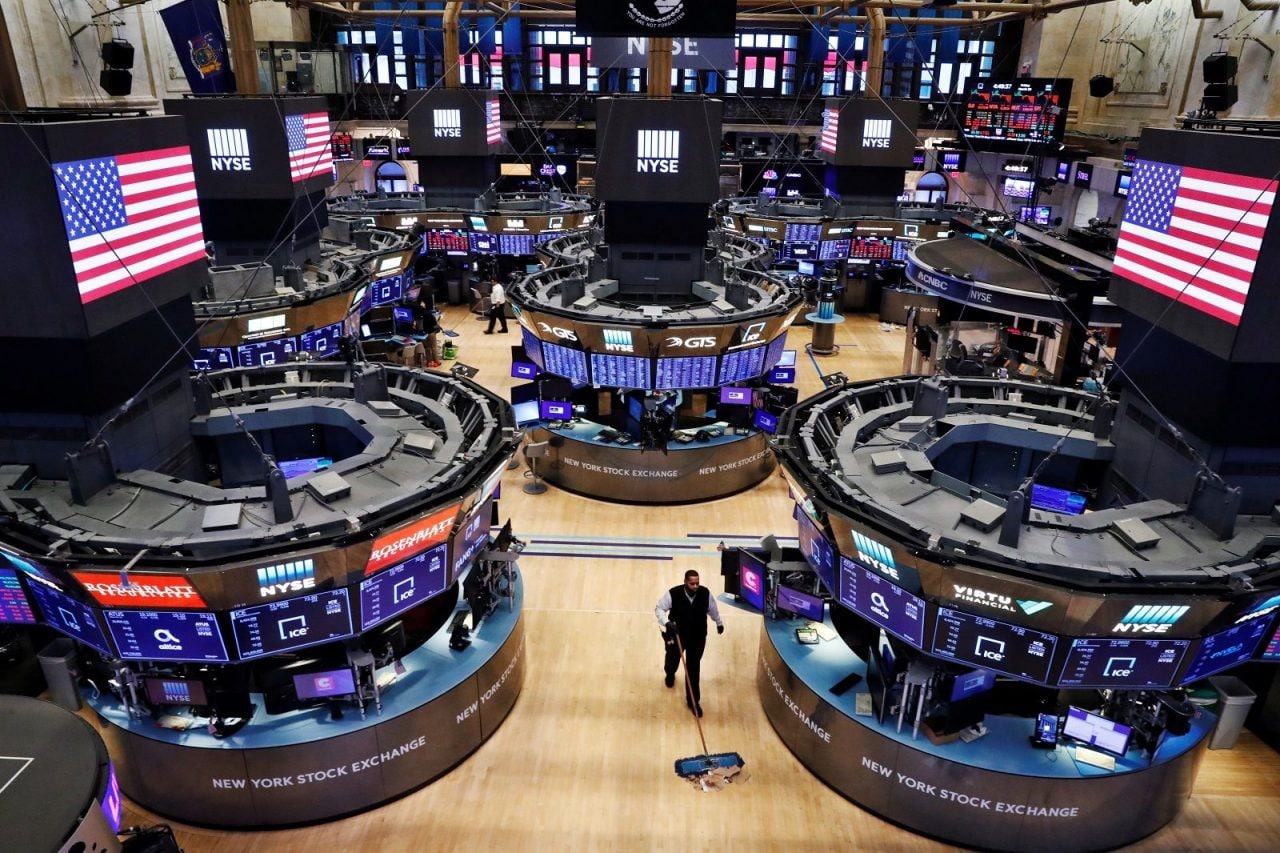
US Stock Market Highlights: S&P 500 posts slim gain Monday as traders hope for lower tariffs before August 1 deadline
Published on 15/07/2025 01:36 AM
We will now wrap up the blog. Bye, folks!
The S&P 500 edged higher on Monday even after President Donald Trump threatened high tariffs on more countries over the weekend. Losses were kept in check as investors bet those duties will eventually be negotiated down and looked ahead to a busy week for the second-quarter earnings season.
The S&P 500 added 0.1%, while the Nasdaq Composite rose 0.3%. The Dow Jones Industrial Average gained 88 points, or 0.2%.
Jersey Mike’s is planning to sell $400 million of asset backed securities to potentially help pay out money to Blackstone Inc., the private equity firm that bought a majority stake in the sandwich restaurant chain earlier this year.
The company is selling a type of debt known as a whole business securitisation bonds, which are backed by Jersey Mike’s assets including fees from franchises and US trademarks. The securities are set to be rated BBB by S&P Global Ratings and Kroll Bond Rating Agency, according to person with knowledge of the transaction.
Jersey Mike’s last sold whole business securitisation debt in December in an $850 million offering that helped fund its buyout. Blackstone agreed in November to buy a majority stake in the chain in a deal valuing it at about $8 billion. The buyout closed in January.
A Milan court placed Italian luxury label Loro Piana SpA under judicial oversight for one year, saying the LVMH-owned label famous for its cashmere clothing failed to stop subcontractors from exploiting migrant workers.
In some Italian factories, working hours largely exceeded the 8-hour legal standard, employees slept on shop floors and were paid a fraction of Italy’s legal minimum, prosecutors said, according to the ruling seen by Bloomberg News. The court also said that Loro Piana omitted due diligence checks.
The order means that a court will appoint a special administrator to oversee the company’s business and will be tasked with cleaning up the production process. Loro Piana isn’t under criminal investigation over the oversight failings, the court said.
The world’s top sovereign wealth fund was a major buyer of Colombian local bonds in June, the month the country got hit by two credit downgrades and fallout from a suspension of fiscal spending limits.
Norway’s central bank, which manages nearly $2 trillion in assets, bought about $420 million of Colombia’s local peso bonds, or TES, last month, according to data from Colombia’s Comptroller’s Office. The Norwegian fund alone has been responsible for half of all net purchases by foreign bondholders in the first half of the year.
For all the hype around stablecoins, they’re a long way from becoming a viable everyday payment tool, according to Mastercard Inc.’s chief product officer, Jorn Lambert.
“While the technology powering stablecoins holds tremendous promise — high speed, 24/7 availability, low costs, programmability, immutability — those attributes alone do not suffice to turn stablecoin into a payment tool,” Lambert said Monday on a call with analysts. “Just as important, or even more so, are other attributes like a seamless and predictable user experience, reach and wide distribution to consumers.”
Mastercard is positioning itself as the bridge between digital assets and the traditional financial system. Lambert said the company can provide the infrastructure needed to make stablecoins usable at scale by lending network attributes like global merchant acceptance, security safeguards and regulatory compliance.
The busiest trade hub in the US saw container traffic rebound last month after a slump in May, as importers grapple with volatility driven by President Donald Trump’s trade war.
The Port of Los Angeles processed some 892,000 twenty-foot-equivalent units or TEUs, according to executive director Gene Seroka. That’s a record for June and up 32% from the previous month. Overall, volumes in the first half of the year were up 5% from 2024.
“While record-setting volume is welcome news, it also highlights the tariff whipsaw effect,” Seroka told reporters on Monday.
US regulators gave fresh guidelines for how banks can offer crypto custody services for clients and not run afoul of their rules, the latest move from Trump-era watchdogs as they weigh how traditional lenders should engage with digital assets.
Banks that contemplate providing safekeeping for crypto-assets should consider the evolving nature of the crypto market, including the technology underlying the cryptoassets, the Federal Reserve, Federal Deposit Insurance Corp. and Office of the Comptroller of the Currency said in a Monday statement, adding that they must implement a risk-governance framework that appropriately adapts to relevant risks.
The head of Lucid Group Inc. warned that President Donald Trump’s tariffs will drive up costs to build automobiles — even in the US.
The industry’s global supply chain means domestic manufacturers still have to import raw materials and some parts from other countries, interim Chief Executive Officer Marc Winterhoff said in an interview with Bloomberg Television on Monday.
“For the American consumers, vehicles are going to be more expensive under the tariff regime. There’s no other way around it,” Winterhoff said. “There’s a reason the supply chain is so global.”
The Newark, California-based manufacturer of electric vehicles is looking for ways to reduce costs by localising more of its supply chain, in particular the raw materials for lithium-ion batteries. Lucid signed a deal in June with Graphite One Inc. to boost its supply of US-processed graphite, a key battery component.
Starbucks Corp. will require its corporate employees to work four days in the office a week, up from three, starting Sept. 29.
The coffee giant also announced that people managers who are currently working remotely will need to relocate to Seattle or Toronto within 12 months. The company announced the move Monday as part of its “Back to Starbucks” plan.
Starbucks Chief Executive Officer Brian Niccol, who initially wasn’t required to relocate when he was hired last year, has a residence and an office in Seattle now, according to the company.
The chain is undergoing a broader turnaround under Niccol, the former Chipotle CEO who joined in September, kicking off an overhaul of its cafes to make them more welcoming and to reverse a sales slump.
Cuba’s crucial and struggling tourism industry was hit with more US sanctions, as President Donald Trump’s administration ratchets up pressure on the communist-run island and its top officials.
The State Department expanded its “restricted list” on Monday with the addition of 11 entities, including the Iberostar Selection La Habana, a new 42-story hotel in the capital. Known as Torre K, the hotel opened this year and is Cuba’s tallest building.
The designation effectively bans US citizens and companies from staying at or doing business with the hotel. The State Department argues that entities on the list, as well as an accompanying annex of prohibited accommodations, “are under the control of, or acting on behalf of, the Cuban military, intelligence or security services.”
Representatives for Iberostar, the Spanish hotel chain that operates Torre K, didn’t immediately return calls and emails seeking comment.
The world’s top sovereign wealth fund was a major buyer of Colombian local bonds in June, the month the country got hit by two credit downgrades and fallout from a suspension of fiscal spending limits.
Norway’s central bank, which manages nearly $2 trillion in assets, bought about $420 million of Colombia’s local peso bonds, or TES, last month, according to data from Colombia’s Comptroller’s Office. The Norwegian fund alone has been responsible for half of all net purchases by foreign bondholders in the first half of the year.
The Scandinavian nation has increased its TES holdings by more than 60% in the year to June and now owns the equivalent of about $2.4 billion of the securities, according to the data, which uses the bonds’ face value to make its calculation. That makes Norway the biggest foreign investor in the $137 billion market, the data show. It also has a small holding in the bonds of the nation’s state oil company, Ecopetrol SA.
President Donald Trump will announce $70 billion in artificial intelligence and energy investments in Pennsylvania on Tuesday, the latest push from the White House to speed up the development of the emerging technology.
Trump is expected to share details of the new initiatives at an event outside Pittsburgh, according to an administration official, who spoke on the condition of anonymity to discuss the planning. Investments from a range of companies will include new data centers, power generation expansion and grid infrastructure upgrades, along with AI training programs and apprenticeships, the official added.
Wall Street traders parsing Donald Trump’s latest tariff threats sent stocks wavering ahead of results from big banks and inflation data. Bond yields and the dollar edged up. Oil fell as the US president’s plan to pressure Russia into a ceasefire with Ukraine didn’t include new measures aimed directly at hindering Moscow’s energy exports.
As investors navigated renewed trade headlines, the S&P 500 hovered near its all-time highs. While Corporate America is bracing for its weakest earnings season since mid-2023, lower estimates could be easier for companies to beat. With financial giants reporting results Tuesday, strategists say subdued expectations are setting the stage for the shares to extend their sizzling run.
Maverick Gaming, a Washington-based casino and card-room operator, filed for bankruptcy on Monday following a debt restructuring last year.
The company filed for Chapter 11 in Texas and listed total liabilities and assets in the range of $100 million to $500 million, according to court papers. It owns and operates a portfolio of 27 properties across Nevada, Washington and Colorado, its website showed.
Maverick Gaming suffered from a weaker local economy as layoffs from the technology industry affected its customer base, according to a June 2024 report by S&P Global Ratings. It also faced high operating costs, including large rent obligations.
Meta Platforms Inc. Chief Executive Officer Mark Zuckerberg said the company is building several massive data centers to power its artificial intelligence efforts with the first one expected to come online next year.
“We’re calling the first one Prometheus and it’s coming online in ‘26,” Zuckerberg said in a post on his social platform Threads on Monday. “We’re building multiple more titan clusters as well,” he said, referring to the large data-center complexes.
Frustrated by the quality of Meta’s past AI efforts, Zuckerberg has been investing heavily in infrastructure and talent. In April, Meta said it could spend as much as $72 billion, with a focus on AI and data centers. And over the last several weeks, the CEO has personally been building a team of experts to achieve artificial general intelligence — or AGI, the notion that machines can perform as well as humans at many tasks.
Venture capital-backed firms in Europe are on track for their worst year of fundraising since 2015, as investors avoid putting money in an industry that’s struggled with returns. Venture funds based in Europe raised €5.2 billion ($6.1 billion) in the first half of 2025, according to data provider PitchBook.
Venture capital funds have seen declining returns from their investments for the past four years, the PitchBook data show. Exit paths for venture capital firms’ investments, such as initial public offerings and acquisitions, have been in decline and overall exit activity in Europe is expected to be 10% lower than last year in 2025.
China’s efforts to ensure power supply through punishing summer heat are getting a boost from a government trade-in program that’s allowed millions of households to upgrade to more efficient air-conditioners, according to a new report.
The combined impact of the swaps could be enough to shave off 4.1% of residential electricity demand this summer, according to research published on Tuesday by climate think tank Ember. That’s enough electricity saved to power Iceland for an entire year.
The initiative, which started last year and will continue at least through December, offers rebates to exchange older cooling units, other household appliances, and even vehicles for newer ones that are more energy efficient.
President Donald Trump said the US will send more weapons to Ukraine, signaling his growing impatience as Russia ignores his demands for a ceasefire and steps up its military campaign.
“We’re not buying it, but we will manufacture it, and they’re going to be paying for it,” Trump said. He said the US was sending “top-of-the-line weapons.”
Trump didn’t say what weapons the US would send to Ukraine but that they would be replacements. Trump also said the US would impose 100% “secondary” tariffs on Russia if there’s no deal in 50 days.
Shares of Volvo Cars plunged 5.5% in late trade after the Swedish automaker said it would face a one-off, non-cash impairment charge of 11.4 billion Swedish kronor ($1.19 billion) in the second quarter related to two models.
The firm said Monday that its upcoming Volvo EX90 electric SUV will have a “reduced lifecycle profitability” due to previous launch delays and additional development costs.
Meanwhile, it is not currently able to sell its new all-electric Volvo ES90 saloon profitably in the U.S. due to import tariffs. Margins on the ES90 are also under pressure in Europe due to the impact of tariffs, it said.
General Motors Co. and LG Energy Solution plan to add more battery production lines at their joint venture plant in Tennessee to make lower-cost cells starting in late 2027, the companies said in a statement Monday. The amount of the investment was not disclosed.
The Ultium Cells LLC plant in Spring Hill, Tennessee, will begin to make lower-cost lithium iron phosphate batteries, or LFP, in addition to more-expensive and longer-range nickel-based batteries. The new LFP batteries will enable GM to make more lower-priced electric vehicles.
The news comes as most automakers are pulling back on electric vehicle investments in the US market. EV sales in the US have slowed and President Donald Trump’s tax bill cuts the $7,500 federal tax incentive for battery-powered models in September.
Saudi Arabia has asked consulting firms to conduct a strategic review of its ambitious plans for building a futuristic city known as The Line, according to several people familiar with the matter, as the kingdom assesses priorities for its project-related expenditures.
A unit of the sovereign wealth fund is asking the firms to review whether current plans for The Line – which is planned to be a 170-kilometer (105-mile) long car-free city that’s part of Saudi Arabia’s Neom development project – are feasible and to suggest possible changes, said the people, who asked not to be named discussing private matters.
The government may decide no changes are needed and the project can continue as planned, the people said. Any changes would need the agreement of executives at the Public Investment Fund and then the government itself, they said.
Betting on Mexico’s currency has paid off for investors even amid Donald Trump’s trade war.
The peso is up more than 11% this year, beating all regional peers, even as it dipped Monday following the latest tariff news — a threat of a 30% levy announced over the weekend. It is also one of the best-performing in emerging markets.
Mexico’s high interest rates and President Claudia Sheinbaum’s tempered approach toward Trump have helped lure in cash from investors reallocating money away from the US. And after months of repeated delays on the implementation of tariffs, money managers have grown more complacent, with reactions to fresh announcements largely contained as they look past Trump’s threats to focus on the medium-term outlook.
Economists have long been warning of a tariff-driven boost to US inflation. The next report on consumer prices will put their conviction to the test.
After four months of overestimating readings on the consumer price index, forecasters are predicting an acceleration in June data from the Bureau of Labour Statistics on Tuesday. Advances in tariff-exposed categories, including furniture, toys and recreational goods, as well as cars, are seen putting an end to the streak of benign figures.
It’s a tough position to be in for the Federal Reserve, which has defended holding interest rates steady this year in anticipation of tariff-driven inflation that hasn’t shown up yet. Another tame number would all but certainly draw more ire from President Donald Trump — who’s repeatedly called for the central bank to lower rates and criticised Chair Jerome Powell personally.
Turkish companies are struggling under a prolonged period of high borrowing costs, a senior official from President Recep Tayyip Erdogan’s government said, adding he’s championing a proposal to facilitate loan restructuring.
Filings for insolvencies have shot up by 70% compared to the previous year, deputy chairman of the Justice and Development Party in charge of economic affairs, Nihat Zeybekci, told Bloomberg in an interview last week. To prevent a further increase, the AKP official and former economy minister said he’s pushing for measures for companies to get debt relief for at least a year — a “preventative measure”.
“Companies need capital and because they can’t meet that need from their equity or profits there’s only one source of capital left and that’s financial institutions and the banking system,” Zeybekci said. But then these companies are met with high interest, he added.
Federal Reserve Bank of Cleveland President Beth Hammack said she wants to see inflation lowered further before she’d support a cut in interest rates.
“We’re not there yet on the inflation side of the mandate,” Hammack said Monday in an interview with Fox Business News. “I think it’s important that we wait and see how all the new policies that have been put forward are going to impact inflation.”
The Fed is widely expected to hold interest rates steady again when it meets July 29-30 in Washington. Two policymakers have suggested they might support a cut at that meeting, but most others have signalled they want more time to assess the impact of tariffs on inflation.
The world’s largest swimming pool maker will likely hike prices for a second time this year as a result of US President Donald Trump’s proposed tariffs.
“I think we’ll have to raise prices somewhat due to tariffs,” Fluidra SA Chief Executive Officer Jaime Ramirez said in an interview. “How much, I can’t tell you right now, because it depends on what they announce about China in the coming weeks.”
Barcelona-based Fluidra is not alone in lifting prices this year in the US, where it’s the second-largest poolmaker. Rival Pentair Plc has done so too, and that’s without taking into account industrywide annual increases that are normally announced in September.
Half of the pool equipment Fluidra sells in the US is manufactured in Mexico, with 15% made in China and other markets such as India, Malaysia and Vietnam, Ramirez said. About 45% of Fluidra’s revenue comes from North America.
Bitcoin breached $120,000 for the first time, with investor enthusiasm showing few signs of dimming as the US House of Representatives prepares to consider key industry legislation during its “Crypto Week” starting Monday.
The cryptocurrency bellwether rose as much as 3.4% to $123,205 before giving up some gains to trade around $121,600 as of 9:19 a.m. in New York. Ether, the second-largest token, also advanced beyond $3,000, along with a host of smaller coins such as XRP and Uniswap.
After surging on the election of Donald Trump to a second US presidential term, Bitcoin had settled into a pattern of fluctuating on either side of $100,000 for several months. Concern about Trump’s political and economic policies had helped to temper optimism over the pro-crypto agenda of his administration. Now, with other risk assets such as US stocks back around record highs, Bitcoin has also resumed its push higher.
Stocks were mostly lower Monday after President Donald Trump threatened high tariffs on more countries over the weekend, but losses were kept in check as investors bet those duties will eventually be negotiated down.
Investors were also optimistic about the second-quarter earnings season, which ramps up this week.
The Dow Jones Industrial Average traded 119 points lower, or 0.3%. The S&P 500 shed 0.1%, while the Nasdaq Composite hovered around the flatline.
Orange juice futures rose to a three-month high in New York on mounting worries that President Donald Trump’s threat to slap a 50% tariff on Brazilian goods will curb supplies to the US.
The most active contract rose as much as 8.7% to $3.1385 a pound, the highest since March 6. Futures of orange juice have rallied since Trump’s announcement last week of the tariff, which risks upending trade in commodities ranging from coffee to beef.
The threat of disruption to supplies of orange juice comes at a time when the US has grown increasingly reliant on Brazilian imports amid a decline in production in Florida, according to Craig Elliott, market analyst at Expana.
Though the impact of the import tariff “remains uncertain, the amount of orange juice trade potentially affected is significant,” said Elliott. That “could potentially further erode Brazil’s competitiveness amid an already challenging market environment.”NewsLive TVMarketPopular CategoriesCalculatorsTrending NowLet's Connect with CNBCTV 18Network 18 Group :©TV18 Broadcast Limited. All rights reserved.