US Stock Market Highlights: Stocks rise, but gains capped thanks to weak jobs data
Published on 05/06/2025 01:43 AM
We will now wrap up the blog. Bye, folks!
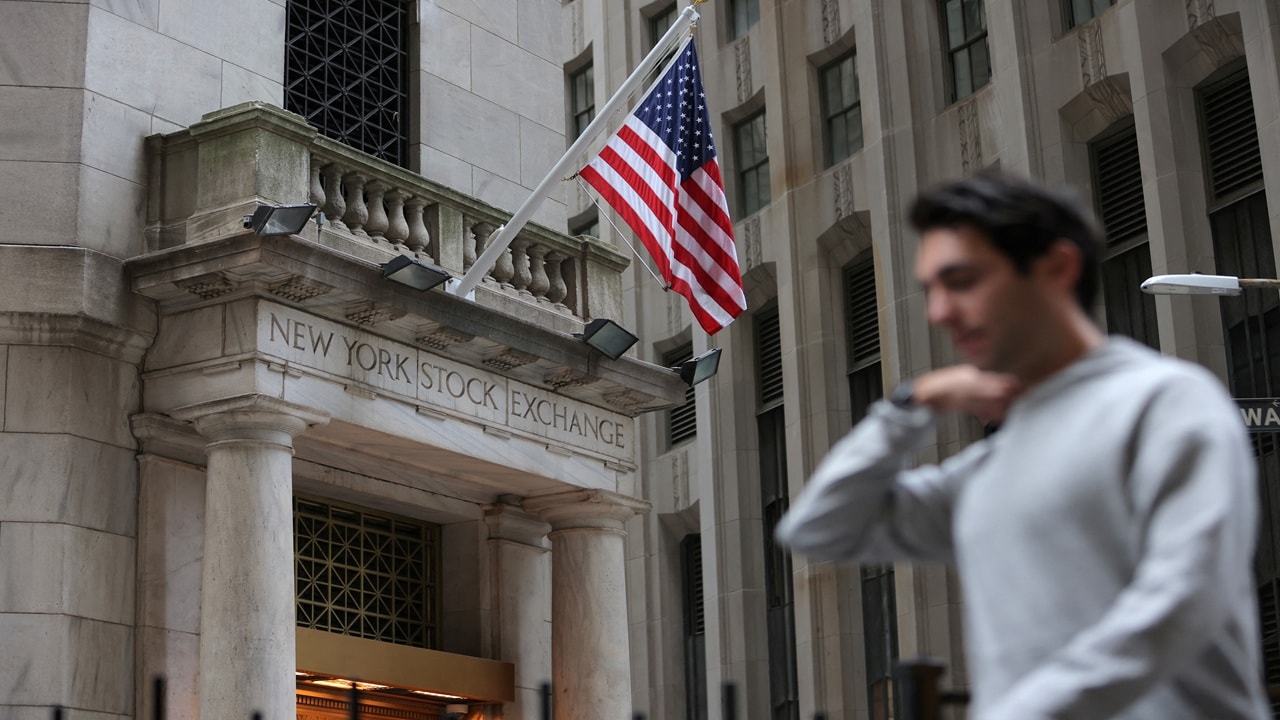
The Dow Jones Industrial Average slipped on Wednesday after private sector hiring hit its lowest level in more than two years, raising concerns that trade policy uncertainty could be weighing on the U.S. economy.
The 30-stock Dow slipped 91.90 points, or 0.22%, ending at 42,427.74. The blue-chip average ended a four-day winning run. The S&P 500 advanced 0.01% and closed at 5,970.81, while the Nasdaq Composite rose 0.32% and settled at 19,460.49.
A report from payrolls processing firm ADP showed that payrolls increased only 37,000 for the month, less than the downwardly revised 60,000 in April and below the consensus forecast of 110,000 that economists polled by Dow Jones were expecting.
Gold rallied after weaker-than-expected US economic data reinforced speculation that the Federal Reserve will cut interest rates at least twice this year.
Bullion jumped near $3,385 an ounce, just $115 short of a record in April. A contraction in US services activity and slower hiring led traders to dial up bets on monetary loosening to avoid a recession. Lower rates are typically a tailwind for gold, which doesn’t bear interest.
Tech titan Elon Musk ratcheted up his offensive against Donald Trump’s signature tax bill on Wednesday, urging that Americans contact their lawmakers to “KILL” the legislation.
“Call your Senator, Call your Congressman,” Musk wrote in a social media post. “Bankrupting America is NOT ok!”
The post came one day after Musk lashed out at the tax bill, describing it as a budget-busting “disgusting abomination” as Republican fiscal hawks stepped up criticism of the massive fiscal package.
Hedge fund founder George Weiss has filed personal bankruptcy months after a federal judge ruled he’s liable for more than $100 million in debt his eponymous firm owes Jefferies Financial Group Inc.
Weiss sought court protection Wednesday in Florida, listing assets and liabilities each of between $100 million to $500 million on a Chapter 11 petition. Besides the Jefferies debt, Weiss’ bankruptcy petition also listed a $180 million claim from the Internal Revenue Service, which he disputes.
The bankruptcy filing immediately halts collection actions Jefferies has brought against Weiss, who follows his hedge fund, Weiss Multi-Strategy Advisers, in filing for Chapter 11.
The US Department of Agriculture is undergoing a review of non-statutory reports including a quarterly forecast on trade that pointed to a record farming deficit.
The agriculture report, which is released on a quarterly basis, was expected to be updated on May 29. It typically shows the USDA’s estimates for exports and imports of several farm product categories as well as an analysis by the agency’s economists. A version of the report showing a trade deficit but stripped from comments and analysis was released on June 2.
“The report was hung up in internal clearance process and was not finalized in time for its typical deadline,” a USDA spokesperson said in an emailed statement. “Given this report is not statutory as with many other reports USDA does, the department is undergoing a review of all of its non-statutory reports, including this one, to determine next steps.”
CrowdStrike Holdings Inc. said US officials have asked for information related to the accounting of deals it’s made with some customers and said the cybersecurity firm is cooperating with the inquiry.
The Austin, Texas-based company said in a filing Wednesday that it has gotten “requests for information” from the US Department of Justice and the Securities and Exchange Commission “relating to the company’s recognition of revenue and reporting of ARR for transactions with certain customers.” ARR refers to annual recurring revenue, a measure of earnings from subscriptions.
The company said the federal officials have also sought information related to a CrowdStrike update last year that crashed Windows operating systems around the world.
Antitrust watchdogs will be more open to approving acquisitions under President Donald Trump, according to the US Justice Department’s head of merger enforcement.
The department will place greater emphasis on negotiation than the Biden administration, seeking asset sales and other measures for companies to complete deals rather than going to court, William Rinner said in prepared remarks he plans to deliver on Wednesday.
“There is no per se rule against mergers,” Rinner will say at an antitrust conference at George Washington University. “Our primary mission is civil merger enforcement against the handful of mergers that are problematic, not civil merger deterrence generally.”
Elon Musk had promised to help reelect the House Republican majority just a day before savaging the party’s centerpiece tax-and-spending package and suggesting he would work to oust lawmakers who supported the legislation, House Speaker Mike Johnson said.
Johnson described the tech billionaire’s pledge to reporters Wednesday as party leaders were still reeling from a social media fusillade Musk launched Tuesday against Trump’s massive fiscal package. The speaker said he had called the Tesla chief executive officer Tuesday evening but Musk didn’t return the call.
Musk lashed out at the measure in a series of posts as a “disgusting abomination” and scolding Republican House members who supported it, telling them “You know you did wrong.”
Joshua Kushner’s Thrive Capital and investment firm Capital Group have in recent months visited China to learn about its AI industry, joining a growing number of US investors rekindling interest in the country after DeepSeek’s advances stunned Silicon Valley.
Senior people at Thrive met with companies and funds in China to discuss AI, people familiar with their visit to the country said. Kushner didn’t join the delegation, one of the people said, asking to remain anonymous discussing a private event. At the same time, Capital Group — one of the world’s largest funds — dispatched senior executives to China to find out more about the AI scene, the people said.
Cobalt Holdings Plc has decided not to proceed with its planned initial public offering in London. The company made the announcement in a statement Wednesday afternoon. The offering had aimed to raise about $230 million to make an initial purchase of cobalt from mining giant Glencore Plc, and to pay for storage costs.
Cobalt Holdings was set up by entrepreneur Jake Greenberg to give investors exposure to cobalt, a key ingredient in battery manufacturing. Greenberg previously founded Yellow Cake Plc, which debuted in London in 2018 and offers investors exposure to uranium.
Oil fell on signs Saudi Arabia wants another major production increase, raising expectations that a glut of crude will form this year.
West Texas Intermediate slid as much as 2% after Bloomberg News reported that the de facto OPEC leader is open to additional significant output hikes in a bid for market share.
The kingdom wants the group to add at least 411,000 barrels a day in August and potentially September, ideally as quickly as possible to take advantage of peak summer demand, according to people familiar with the matter.
Commodity brokerage Snapper Creek Energy has built a power team focused on rising volatility in electricity markets as artificial intelligence and extreme weather upend grids.
Snapper Creek hired seven people to cover PJM Interconnection Inc., the electric system that stretches from New Jersey to Chicago, and the Electric Reliability Council of Texas. The hires include Dennis Bosworth of Greenlight Commodities, who will cover Ercot, and John Olsen of Marex, who will cover PJM.
The chief of Microsoft Corp.’s LinkedIn is taking charge of the teams that build email and productivity apps, in a reorganisation that consolidates more of the company’s workplace software as it seeks to speed up deployment of artificial intelligence tools.
Ryan Roslansky, the professional networking site’s chief executive officer since 2020, will take on responsibility for the teams behind Outlook, Word, Excel and the rest of the Office bundle, Microsoft told employees on Wednesday. He’ll report to Rajesh Jha, a top engineering executive whose organisation includes Windows and business software. In Roslansky’s capacity as LinkedIn CEO, he’ll continue to report to Microsoft CEO Satya Nadella.
A Microsoft spokesperson said the changes don’t signal the end of the relative autonomy LinkedIn has been granted during its nearly nine years as a subsidiary. Microsoft acquired the San Francisco Bay Area-based startup for $26 billion in 2016, outbidding rival Salesforce Inc.
Companies without direct exposure to US tariffs should use this time to be more aggressive as others retreat, according to Carlyle Group Inc.’s Steve Wise.
“It’s also a really good time to find a way to cut costs. It’s hard to cut costs in ebullient times,” Wise, co-head of Americas corporate private equity, said in a Bloomberg TV interview.
Firms in sectors such as health and financial services have been largely spared by Donald Trump’s sweeping tariffs unveiled in April, which focused on cross-border goods. Wise said some companies had responded to tariffs by raising prices in a haphazard way, irking consumers.
Mayfair Equity Partners is considering options for the Luxembourg-based property classified site atHome Group after receiving interest from potential investors, according to people familiar with the matter.
The London-based private equity firm is close to hiring a bank to help with the review, said the people, who asked not to be identified as the information isn’t public. A deal could value the business at about a few hundred million euros, the people said.
Considerations are preliminary and Mayfair could decide to keep the asset for longer, the people said. Representatives for Mayfair and atHome Group declined to comment.
The Bank of Canada held interest rates steady for a second consecutive meeting, but officials said there may be a need to cut borrowing costs if the economy weakens and inflation remains contained as US tariffs make an impact.
Officials led by Governor Tiff Macklem kept the policy rate at 2.75% on Wednesday, matching expectations of markets and the majority of economists in a Bloomberg survey.
Policymakers said they held borrowing costs steady as they gain more information on US President Donald Trump’s trade conflict, which they called “the biggest headwind facing the Canadian economy” as it slams exports and adds to uncertainties for consumers and businesses.
At the same time, officials said the economy held up stronger than expected in the first quarter and flagged a recent surge in core inflation measures.
The European Union’s trade chief, Maros Sefcovic, said he raised industry-wide concerns over Chinese export restrictions on rare earths and magnets with his counterpart Wang Wentao on Tuesday.
“It was one of my priorities to address this issue yesterday and we did,” Sefcovic told reporters Wednesday in Paris, where he’s attending a conference at the Organization for Economic Cooperation and Development.
“I informed my Chinese counterpart about the alarming situation in the European car industry, but I would say industry as such because clearly rare earth and permanent magnets are absolutely essential for the industrial production,” he said.
The EU trade commissioner described the situation as “extremely disruptive.”
The rapid development of data centers connected to the largest US electric grid raised costs by $9.4 billion, an expense that consumers from Illinois to Washington, D.C., will see reflected in their utility bills starting this month.
Overall costs rose by 180%, with the growing energy needs of data centers being the primary cause of tight supply-and-demand conditions, as well as high prices, in the PJM Interconnection capacity market, which serves customers from Illinois to Washington D.C., according to a report Tuesday by Monitoring Analytics, the grid’s independent market monitor.
The analysis from PJM’s watchdog asserts that households and businesses are subsidising the data center boom being carried out by some of the richest tech companies in the world.
The euro zone is set to continue its eastward expansion after Bulgaria was deemed ready to become the currency bloc’s 21st member.
The European Commission recommended on Wednesday that the Black Sea nation of 6.4 million should be allowed to adopt the common currency in 2026. The European Union’s executive arm and the European Central Bank said in separate reports that all the requirements on issues including inflation and public debt had been fulfilled.
“Thanks to the euro, Bulgaria’s economy will become stronger, with more trade with euro area partners, foreign direct investment, access to finance, quality jobs and real incomes,” Commission President Ursula von der Leyen said in a statement. “Bulgaria will take its rightful place in shaping the decisions at the heart of the euro area.”
Treasuries climbed after a soft labour-market reading suggested that high anxiety around President Donald Trump’s ever-changing economic policies weighed on business-staffing decisions.
Bond yields fell across the curve after data showed hiring decelerated to the slowest pace in two years. Swap traders are pricing in two rate cuts before the end of 2025, with the first move seen most likely coming in October. The dollar slipped. The S&P 500 edged up.
Private-sector payrolls increased by 37,000 last month, according to ADP Research, trailing estimates. The report prompted Trump to comment in a social-media post that Fed Chair Jerome Powell should consider lowering rates. The jobs report due Friday is expected to show that growth in nonfarm payrolls slowed and the unemployment rate remained steady.
Mercedes-Benz Group AG and BMW AG are stepping up efforts to avoid potential parts shortages, as China’s export controls on rare earth metals threaten to disrupt global car production.
Mercedes has intensified discussions with key suppliers about the short-term availability of components containing these materials and whether to stockpile certain items, according to Jörg Burzer, who oversees the company’s production.
US stocks were mixed on Wednesday after private sector hiring hit its lowest level in more than two years, raising concerns that trade policy uncertainty could be weighing on the U.S. economy.
The Dow Jones Industrial Average rose just 48 points, or 0.1%. The S&P 500 climbed 0.2%, while the Nasdaq Composite advanced 0.3%.
A report from payrolls processing firm ADP showed that payrolls increased only 37,000 for the month, less than the downwardly revised 60,000 in April and below the consensus forecast of 110,000 that economists polled by Dow Jones were expecting.
Ukrainian President Volodymyr Zelenskiy said that Russia’s maximalist demands mean there’s no point in continuing with lower-level talks aimed at brokering an end to the war.
Calling Russia’s conditions for peace an “ultimatum,” Zelenskiy said that he remains willing to meet directly with President Vladimir Putin. But low-level talks such as those that took place in Istanbul on Monday make no sense unless they lead to a meeting of the two leaders, he said.
“To continue diplomatic meetings in Istanbul at a level that does not resolve anything further is, in my opinion, meaningless,” Zelenskiy told reporters in Kyiv on Wednesday.
Ukrainian President Volodymyr Zelenskiy said that Russia’s maximalist demands mean there’s no point in continuing with lower-level talks aimed at brokering an end to the war.
Calling Russia’s conditions for peace an “ultimatum,” Zelenskiy said that he remains willing to meet directly with President Vladimir Putin. But low-level talks such as those that took place in Istanbul on Monday make no sense unless they lead to a meeting of the two leaders, he said.
“To continue diplomatic meetings in Istanbul at a level that does not resolve anything further is, in my opinion, meaningless,” Zelenskiy told reporters in Kyiv on Wednesday.
A measure in President Donald Trump’s tax and spending bill that’s meant to penalize foreign investors may also raise interest costs for some US borrowers.
The so-called Section 899 provision takes aim at nations such as Canada, the UK and France that have digital services taxes or other corporate tax rules the US deems unfair. Investors and companies from those countries may see gradually higher tax rates on income they earn from US assets, which some analysts have called a “revenge tax.”
But Section 899 would affect loan interest payments in a way that would hurt some US companies, according to legal experts. Many lending agreements require borrowers to cover such tax hikes if they’re enacted after the deal is signed.
Hiring slowed to the slowest pace in two years, pointing to a weakened demand for workers. Private-sector payrolls increased by 37,000 last month, according to ADP Research. That was lower than all estimates in a Bloomberg survey of economists.
“After a strong start to the year, hiring is losing momentum,” Nela Richardson, chief economist at ADP, said Wednesday in a statement.
Wall Street tech analyst Dan Ives is lending his personal brand to power a new ETF riding the artificial-intelligence boom, joining a growing pack of finance names looking to monetize their industry renown with retail-friendly investment funds.
Wedbush Fund Advisers is launching a product tracking the investment picks touted by Ives, whose high-conviction tech calls have earned him a sizable following among the likes of retail investors.
The Dan IVES Wedbush AI Revolution ETF is launching Wednesday with the ticker IVES, and is focused on Ives’ “proprietary research.” It comprises 30 names in AI sectors, including semiconductors, cybersecurities and robotics, among others.
The race to be Bank of Thailand governor is heating up, with bankers and economists leading a list of seven applicants vying for a pivotal role in Southeast Asia’s second-biggest economy.
Candidates include Anusorn Tamajai, who sought the governor’s role in 2020; Vitai Ratanakorn, president of state-owned Government Savings Bank; Bangkok Bank Pcl’s Kobsak Pootrakool; and Somprawin Manprasert, a former economist at Siam Commercial Bank Pcl. Others include a BOT deputy governor and an ex-International Monetary Fund economist, the Thai-language Krungthep Turakij reported.
Apple Inc. shares fell in premarket trading on Wednesday, suggesting the iPhone maker would extend its 2025 weakness as Wall Street remains concerned about its growth prospects and position in the landscape for artificial intelligence.
Needham downgraded the stock to hold from buy, making it the latest firm to turn more cautious. Analyst Laura Martin sees a number of risks, including competition and tepid growth trends, coupled with a valuation that “looks expensive on several metrics.”
Shares fell 0.6% in premarket trading. The stock is down 19% this year as of its last close, making it the weakest of the Magnificent Seven. While much of the selloff reflects political uncertainty, as Apple is seen as especially vulnerable to tariffs and it has repeatedly been singled out by the Trump administration for its global manufacturing footprint, its struggles with AI have been another significant headwind.NewsLive TVMarketPopular CategoriesCalculatorsTrending NowLet's Connect with CNBCTV 18Network 18 Group :©TV18 Broadcast Limited. All rights reserved.