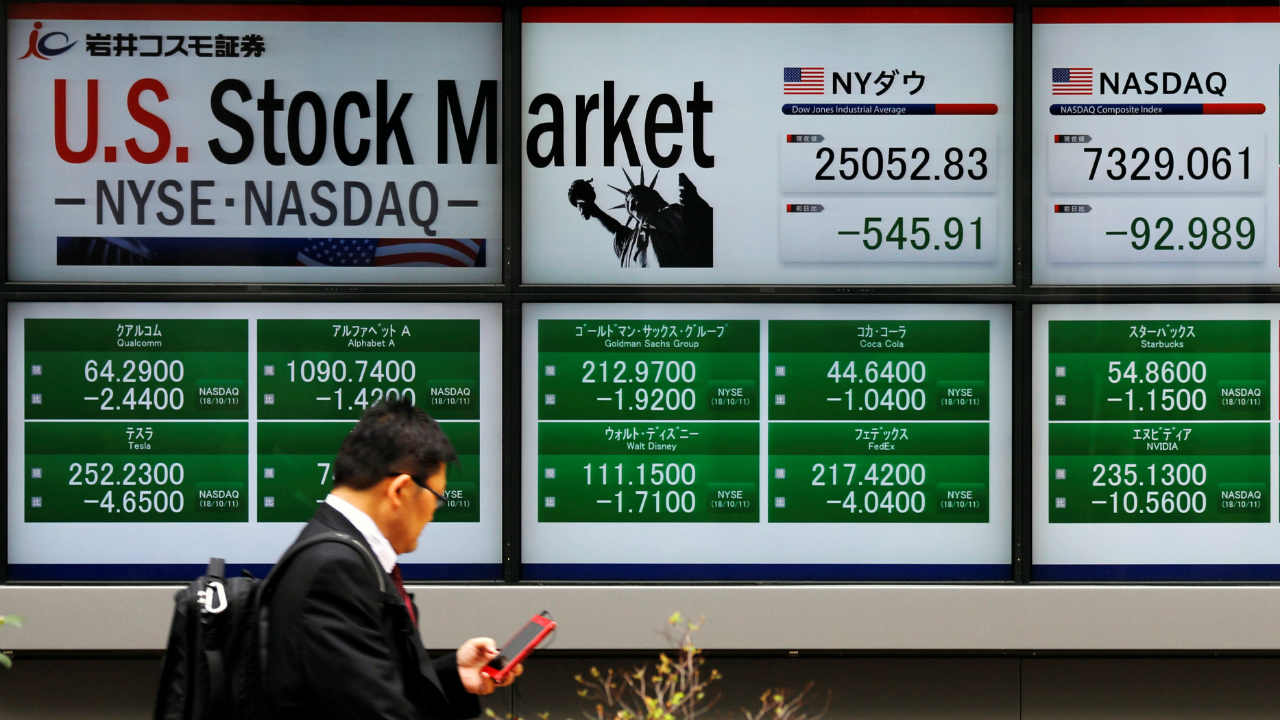
US Stock Market LIVE Updates: Dow futures up 240 points; S&P, Nasdaq at record highs
Published on 30/06/2025 05:38 PM
Moderna Inc. said its experimental flu shot met its goal in a late-stage trial, clearing the path for its broader strategy of selling combination vaccines.
The shot’s efficacy was 27% higher than a licensed influenza vaccine in adults 50 years and older, the company said in a statement Monday. The trial enrolled more than 40,000 adults across 11 countries.
The results set the stage for Moderna to offer a single shot that protects against Covid and flu. US regulators recently told the company that it needed to produce flu vaccine efficacy data — and not just data on the immune response — delaying a potential approval for a combination shot until next year.
Shares rose as much as 7.4% in premarket trading in New York on Monday.
China’s home sales extended their slump in June, putting further strain on the economy and underscoring the impetus for fresh support measures.
The value of new-home sales from the 100 largest property companies stood at 339 billion yuan ($47.3 billion), the latest preliminary data from China Real Estate Information Corp. on Monday showed. That represents a 23% fall from a year ago, according to Bloomberg calculations. June’s sales follows an 8.6% decline in May. On a monthly basis, however, the latest sales were up 14.7% from May, CRIC said.
China’s housing downturn has dragged on for four years, as the effects of a stimulus blitz last September wear off. Premier Li Qiang this month pledged more action to revive the market, which analysts say is necessary to boost consumption and offset the threat to exports from US tariffs.
Ireland should broaden its tax base to ensure its budget protects long-term fiscal stability, the Central Bank of Ireland warned.
“The need to reduce the risks to the public finances from an excessively narrow tax base has become more immediate, given the reliance on corporate tax receipts from an excessively narrow tax base from a small number of multinational enterprises, which may be more vulnerable in light of geoeconomic fragmentation,” Governor Gabriel Makhlouf wrote in a pre-budget letter to the Irish government.
Ireland’s small, open economy has a strong fiscal position for now, with one of Europe’s few budget surpluses thanks to corporation tax receipts from US corporates such as Apple Inc. and Pfizer Inc. However, US President Donald Trump’s tariff war threatens the Irish economic model based on foreign direct investment, which the government has acknowledged will likely slow growth.
Saudi private equity firm Jadwa Investment has committed $45 million to Saudi fuel and fleet management firm PetroApp, with a view toward taking the company public by 2028.
The funding is part of a $50 million round for PetroApp that also includes Abu Dhabi-based Bunat Ventures, according to a statement. Jadwa is investing through its flagship blind pool fund and said it expects to finalise another deal with a healthcare company before the end of 2025.
Jadwa has completed a number of deals in recent weeks as part of a broader strategy to scale regional businesses and capitalise on public offering momentum. It aims to raise another $104 million for its blind pool fund before year-end and is also said to be looking to divest its stake in Saudi firm UniPharma at a valuation of $267 million.
The European Central Bank tweaked the way it uses monetary policy to steer the economy, suggesting it will more carefully weigh risks to the inflation outlook as well as the tools it uses to deliver its 2% goal.
The ECB confirmed Monday that it will take a symmetric approach to keeping price growth at that level over the medium term, and said it will use an “appropriately forceful or persistent policy response” to large and lasting deviations in either direction.
That’s a shift from its findings four years ago, when policymakers committed to taking “especially forceful or persistent” action to avoid too-low inflation becoming entrenched when the economy is “close to the lower bound.”
Turkey’s bid to buy Eurofighter Typhoon jets has won support from all consortium members, the UK said, raising prospects for a deal previously blocked by Germany.
“We are certain all four consortium partners support this sale,” UK Foreign Secretary David Lammy told Hurriyet Daily News, referring to the UK, Germany, Italy and Spain. His comments were published Monday ahead of a meeting with Turkish Foreign Minister Hakan Fidan in Ankara.
Lammy said Turkey’s role as a European security partner is “more crucial than ever” as governments across the continent ramp up defense spending to counter Russia. Turkey, home to NATO’s second-largest military after the US, is seen as key to regional stability.
Nintendo Co. pulled its products from Amazon.com Inc.’s US site after a disagreement over unauthorised sales, meaning the e-commerce company missed out on the recent debut of Nintendo’s Switch 2 — the biggest game console launch of all time.
The Japanese company stopped selling on Amazon after noticing that third-party merchants were offering games for sale in the US at prices that undercut Nintendo’s advertised rates, according to a person familiar with the situation. Enterprising sellers were buying Nintendo products in bulk in Southeast Asia and exporting them to the US, said the person, who requested anonymity to discuss confidential information.
Nintendo product listings started disappearing from Amazon’s US site last year, gaming news outlets reported at the time. The listings had previously appeared as “Sold by Amazon,” which typically denotes merchandise the online retailer buys directly from brands. Some Nintendo products remained on the site, but they were listed by independent merchants who sell their goods on Amazon’s sprawling online marketplace.
Sight deposits at the Swiss National Bank rose sharply after its reduction of borrowing costs to zero, as foreign banks moved cash to the institution to escape negative interest paid in the money market.
Last week, total sight deposits increased by some 18 billion francs ($23 billion) compared to the previous period, according to data published on Monday. This was due to holdings from foreign banks rising by 22 billion francs, while those of domestic lenders dropped by 4 billion francs.
Banks likely moved their money because the average interest rate in the Swiss money market dropped into negative territory after the SNB cut its policy rate to zero. On Friday, the so-called Saron stood at -0.04%.
Gold rose slightly, supported by a dip in the dollar, as Senate negotiations continued over President Donald Trump’s $4.5 trillion tax package and US trade talks progressed ahead of a July 9 deadline.Bullion rose 0.3% on Monday, following two consecutive weekly declines. Republicans are seeking to convince holdouts to support the tax bill for final passage, with a vote set to spill into Monday. The bill’s cost has been a big problem for fiscal conservatives amid concerns that it will further swell the deficit. Meanwhile, with just 10 days to go until Trump’s country-specific tariffs are set to resume, investors were weighing signs of potential progress following recent comments from top White House advisers that indicated the US is nearing trade agreements with several nations.
President Donald Trump said he has identified a buyer for the US operations of TikTok, the social media app owned by Chinese company ByteDance Ltd., without naming the winning bidder. Completing a sale would be contingent on Beijing and President Xi Jinping’s agreement, Trump added in a pre-taped interview on Fox New’s Sunday Morning Futures with Maria Bartiromo. ByteDance and the Chinese government have long opposed such a deal. “We have a buyer for TikTok, by the way. I think I’ll need probably China approval and I think President Xi will probably do it,” the US president said. “It’s a group of very wealthy people.”
Vestas Wind Systems A/S and Orsted A/S slumped on the first day of trading after the latest version of President Donald Trump’s spending package proposed a more aggressive phase-out of tax incentives for US wind and solar projects.The newly released version of the Senate’s tax and spending package, unveiled late Friday, requires wind and solar projects to be fully operational by the end of 2027 to qualify for clean energy incentives. This represents a significant tightening from the earlier proposal, which only required projects to begin construction by the end of 2025.If it becomes law, the change would significantly raise the stakes for the industry, putting pressure on developers to speed up timelines or risk losing critical federal support. The legislation also includes a new tax on wind and solar projects that fail to meet strict restrictions against the use of Chinese materials.
BlackRock Inc. sees European fixed income benefiting from any investor shift away from the US, signaling caution around unpredictable US policy and ballooning government debt.Foreign investors are stepping back from the US and its “special status” in financial markets could be challenged if the country’s government debt is left unchecked, according to BlackRock’s fixed income outlook. The largest US fixed-income allocators are risk averse and see Europe’s stability as more appealing compared with Asian or emerging markets, the report said.“It’s a backdrop of less predictable policy making in the US compared to the predictable nature of Europe and where it’s going,” said James Turner, co-head of European fundamental fixed income investment at BlackRock. “It has made people assess their allocations between Europe and the US.”
Middle East borrowers are ramping up loans that are being syndicated in Asia Pacific as they look to diversify fundraising beyond global bond and domestic markets.More than $2 billion of Middle East deals targeting Asian bank liquidity have launched in recent weeks, including Saudi Electricity’s $1 billion loan, Banque Saudi Fransi’s $750 million facility and a $500 million financing for Al Ahli Bank of Kuwait. The growing need for Middle East borrowers, primarily those from the Gulf States, to look beyond domestic capital markets comes as many regional economies press ahead with expensive diversification plans, in an environment where low oil prices are seen challenging growth and finances.
South Korea sees the need for trade negotiations with the US to continue past next week’s deadline as Seoul continues to seek exemptions from US tariffs including duties affecting the auto and steel industries. A senior South Korean trade official, who asked not to be identified discussing internal matters, said it was unrealistic to expect negotiations to wrap up before across-the-board tariffs are set to rise on July 9.Many countries will likely have to hash out details of their negotiations past the initial deadline, the official said, adding that it’s also uncertain whether South Korea will be able to secure an extension of the grace period due to what the official called a “fluid situation” in the US.
China’s economy surprised with signs of improvement even as deflationary pressures persisted and employment weakened, throwing fresh doubt over the likelihood of further monetary stimulus by Beijing in the face of higher US tariffs.Factory activity and construction had their strongest month of the second quarter in June, according to China’s official purchasing managers’ indexes released on Monday. The official manufacturing PMI remained in contraction but reached 49.7 from 49.5 in May — exceeding forecasts along with a measure of construction and services.Yet behind the headline figures was a more mixed picture of the world’s second-biggest economy that left the market unsure of if and when policymakers might step up stimulus efforts. Traders dialed back bets on further monetary easing after the data release, with futures on 30-year government bonds falling as much as 0.6% — the most in a month.
Novo Nordisk A/S and Eli Lilly & Co, the pharmaceutical giants dominating the global obesity drug market, now face their first serious rival in China. Suzhou-based Innovent Biologics Inc. secured approval last week for its treatment mazdutide, a turning point in China’s efforts to combat rising obesity and diabetes rates with local innovation. With over 600 million Chinese adults projected to be overweight by 2050, the emergence of a viable local alternative to Novo and Lilly’s blockbuster GLP-1 treatments could make weight loss drugs more accessible in the world’s second-largest economy.China’s nascent weight loss drug market is poised for rapid growth, with analysts estimating it could grow to between $5.6 billion and $11.4 billion a year. While China still accounts for just a fraction of the projected $150 billion global pie, a raft of homegrown treatments and cheaper generics could significantly improve the availability — and affordability — of the medication.
Futures on Wall Street have begun trading from where they left off on Friday.
The Dow futures are up 310 points, whereas the S&P 500 and Nasdaq futures are up 30 points and 140 points respectively in trading in the early hours of Monday.
Both S&P 500 and the Nasdaq ended at record high levels on Friday, with the Dow Jones still 1,250 points away from that landmark.
On the face of it, 2025 looks like a banner year for crypto: Bitcoin hitting a record, an industry-boosting US president whose family is venturing headlong into the sector, and key legislation widely expected to be passed by Congress.
But look beyond the bullish headlines and the rally in Bitcoin, and a vastly different landscape comes into view. Most of the so-called altcoins once touted as competitors to the original cryptoasset are nursing steep declines, with more than $300 billion of market value wiped out so far this year.
The sea of red points to a wider malaise that’s forcing parts of the industry to confront existential questions. Crypto was imagined by early enthusiasts as a universe where a host of coins competed for investor money, offering a diverse set of use cases. But as Bitcoin reigns supreme, that’s giving way to predictions that large swathes of the sector will become a digital wasteland.
UK car manufacturers can export to the US under a 10% tariff starting Monday, a reduction from the 25% rate imposed by Donald Trump on other countries, as the first elements of an economic agreement between the US president and Prime Minister Keir Starmer come into effect.
British aerospace companies like Rolls Royce Holdings plc also saw 10% tariffs on goods including engines and aircraft parts slashed to zero as of 5:01 a.m. London time. However, there still remained no sign of progress toward lowering levies on the UK’s beleaguered steel industry, which remain at 25% despite Britain previously announcing an agreement to reduce them to zero.
“From today, our world-class automotive and aerospace industries will see tariffs slashed, safeguarding key industries that are vital to our economy,” Starmer said in a statement.
Overseas investors finally soured on South Korean bonds, trimming holdings after the longest run of inflows in almost two decades, as surging house prices damped bets on central bank interest-rate cuts.
Global funds offloaded a net $1.84 million of the country’s listed bonds on Friday, according to data from the Financial Supervisory Service. That ended a 43-day buying streak, the longest stretch since 2007, based on data compiled by Bloomberg.
The decision to sell came after Bank of Korea Governor Rhee Chang-yong said this month cutting rates too quickly may further stoke housing demand. Apartment prices in the greater Seoul area have climbed for 21 consecutive weeks and posted their biggest advance in nearly seven years earlier in June.
Canada has withdrawn its digital services tax on technology companies such as Meta Platforms Inc. and Alphabet Inc. in a move to restart trade talks with the US.
“Rescinding the DST will allow the negotiations to make vital progress and reinforce our work to create jobs and build prosperity for all Canadians,” Finance Minister Francois-Philippe Champagne said in a social media post late Sunday local time.
On Friday afternoon, US President Donald Trump said he was ending all trade discussions with Canada, one of its largest trading partners, in retaliation for the digital tax. He also threatened to impose a fresh tariff rate within a week.
Senate Majority Leader John Thune is rushing to meet President Donald Trump’s July 4 deadline for pushing through his massive tax and spending bill, but first he has to work through a list of approximately eight Republican senators who have expressed opposition to portions of it. Within the next two days, he needs to find a way to appease most of them. The Senate will kick off a marathon voting session on dozens of amendments Monday morning, a process that can take 12 hours or more, and Thune will be working behind the scenes to quell their concerns. The South Dakota Republican has one of the least enviable jobs in Washington in the coming hours — trying to knit a compromise between factions of his party: one side pushing for more spending cuts in the legislation and senators who are threatening to withhold their support unless there is more funding for health benefits, renewable energy subsidies and other priorities.
China’s factory activity improved for a second month but remained in contraction, as trade rebounds after the ceasefire in the tariff war with the US while weak domestic demand weighs on the economy.
The official manufacturing purchasing managers’ index was 49.7 in June, versus 49.5 in the previous month, slightly exceeding the median estimate in a Bloomberg survey of analysts. A reading below 50 indicates contraction.
The non-manufacturing measure of activity in construction and services rose to 50.5 from 50.3 last month, the National Bureau of Statistics said Monday. That compares with a forecast of 50.3.
– The Latest Senate Draft Bill Will Destroy Millions Of Jobs In America
– Latest Senate Draft Bill Can Cause Immense Strategic Harm To Our Country
– The Latest Senate Draft Bill Is ‘Utterly Insane & Destructive’
– Latest Senate Draft Bill Gives Handouts To Industries Of The Past, Damaging Those Of The Future
Oil fell, following its biggest weekly loss in more than two years, as hedge funds piled into bearish bets after a fragile truce between Iran and Israel, and before a likely OPEC+ supply hike.
Brent dropped to near $67 a barrel after sliding 12% last week, while West Texas Intermediate traded around $65. Iran said it remains skeptical that the US-brokered ceasefire with Israel will last, although President Donald Trump suggested he might back eventual sanctions relief for the Islamic Republic “if they can be peaceful.”
Key members of the Organization of the Petroleum Exporting Countries and its allies are ready to consider another 411,000 barrel-a-day increase for August when they meet on Sunday, according to several delegates. It would be the fourth month in a row the group agreed on such a bumper hike, triple the initially planned volumes.
Gold edged lower after two consecutive weekly declines, with demand impeded by a risk-on mood as the White House aims to finalize trade deals with several nations ahead of a July 9 deadline.
Bullion fell as much as 0.8% in early Asian trading before paring some losses, as investors weighed progress on the trade front.
The European Union and the US believe they can clinch some form of trade agreement in time, Bloomberg News reported Friday, while talks with India, Japan and many others continue. Bloomberg News has also reported that the US is nearing agreements with Mexico and Vietnam.
Japan’s industrial production rose less than expected in May, missing analysts’ estimates as the US tariffs hit the nation’s exports.
Factory output increased 0.5% from the previous month, the Industry Ministry reported Monday. Economists had expected a 3.5% gain. Output fell 1.8% from a year earlier, missing expectations of a 1.6% rise.
Manufacturers anticipate monthly production will gain 0.3% in June and decline 0.7% in July, according to the release.
Asia-Pacific markets rose Monday as investors parsed a slew of data points, including South Korea and Japan’s industrial output figures for May and China’s purchasing managers’ index readings for June.
Japan’s benchmark Nikkei 225 climbed 1.13% in early trade, while the broader Topix index advanced 0.77%.
In South Korea, the Kospi index added 0.63%, while the small-cap Kosdaq was flat.NewsLive TVMarketPopular CategoriesCalculatorsTrending NowLet's Connect with CNBCTV 18Network 18 Group :©TV18 Broadcast Limited. All rights reserved.