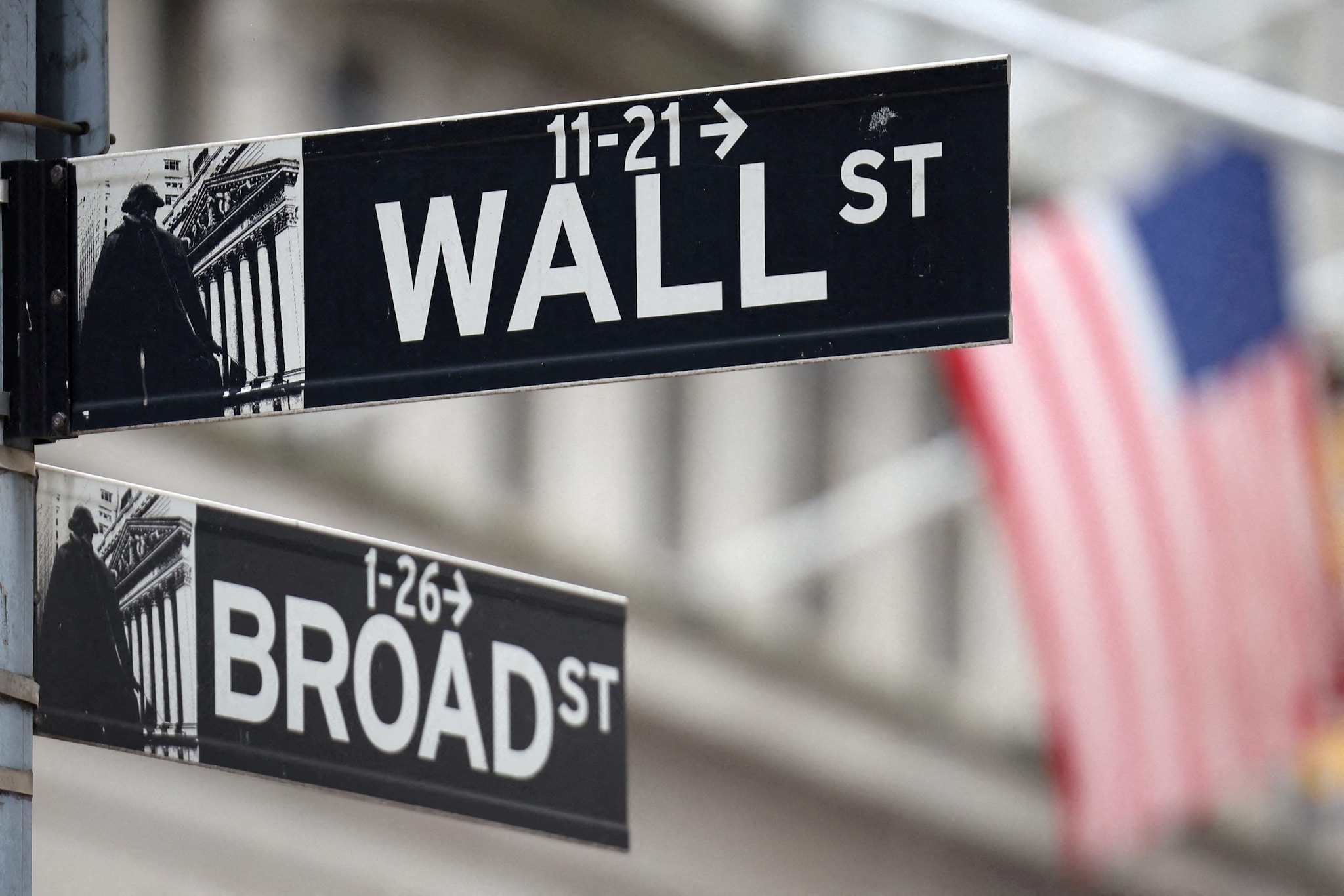
US Stock Market LIVE Updates: Dow Jones falls 160 points as Trump threatens unilateral tariffs
Published on 12/06/2025 07:55 PM
Traders are once again fully pricing in expectations that the Federal Reserve will cut interest rates twice this year as reports on US producer prices and jobless claims support a rally in the bond market.
US Treasuries surged across maturities on Thursday, sending yields down six to seven basis points to the lowest levels in a week and erasing what remained of the moves sparked by strong May employment data. The rally lowered the expected yield for an auction of 30-year bonds later in the session to around 4.84%. It peaked this week at around 4.98%.
After weeks of hand-wringing around demand for long-term US debt, all eyes are on Thursday’s 30-year Treasury auction for a fresh read on whether spiralling deficits are causing investors to shun the maturity.
The $22 billion sale, set for 1 p.m. New York time is part of the government’s regularly scheduled borrowings. Yet it will take place as Congress considers President Donald Trump’s massive tax bill, which by some projections will add trillions of dollars to US budget gaps, potentially requiring more bond issuance to finance the spending.
That backdrop, along with worries that the president’s trade war threatens to reignite inflation and dim global demand for US assets broadly, has punished the longest-maturity Treasuries in particular. Investors have grown more wary of lending to the US government for such a long time, and have demanded higher yields as a result, increasing a cushion known as the term premium.
Initial filings for unemployment insurance were unchanged last week, though an indicator of longer-term unemployment hit its highest in more than 3½ years, the Labour Department reported Thursday.
Jobless claims totalled a seasonally adjusted 248,000 for the week ending June 7, flat from the previous upwardly revised total and near the Dow Jones consensus estimate for 246,000, the Labour Department reported Thursday.
However, continuing claims, which run a week behind, rose 54,000 to 1.96 million, the highest since Nov. 13, 2021.
US producer price inflation remained muted in May across the board, another sign that tariffs have yet to result in higher prices for consumers and businesses.
The producer price index rose 0.1% from a month earlier, according to a Bureau of Labour Statistics report released Thursday. The median forecast in a Bloomberg survey of economists called for a 0.2% increase. Excluding food and energy, the PPI also increased 0.1%.
The PPI report follows May consumer price data that showed a fourth month of tame inflation. While the impact of higher tariffs has so far been modest for Americans, economists see price pressures building in the second half of the year as companies look to guard against further margin weakness.
The dollar fell to the weakest level in three years amid worries over US tariffs and the outlook for the US economy.
The Bloomberg Dollar Spot Index slid as much as 0.8% on Thursday to the lowest level since April 2022. All Group-of-10 currencies rose, with the euro hitting its strongest since 2021.
The latest declines come on the heels of data that showed US producer price inflation remained muted in May, held down by tame goods and services costs. Earlier in the session, the dollar came under pressure as President Donald Trump said he would notify trading partners soon of unilateral levies.
The Pentagon launched a review of a Biden-era pact to develop nuclear-powered submarines with Australia and the UK, as the Trump administration looks to shift the burden to allies and ensure the US’s own supply of warships.
The study would seek to determine whether the Aukus arrangement — signed under President Joe Biden in 2021 — is “aligned with the president’s America First agenda,” the Defense Department said in a statement on Wednesday.
The review would be aimed at making sure that allies contribute more to collective security and that America’s defense industrial base can meet domestic needs, the department said, in remarks that will fuel concerns in Canberra and London that President Donald Trump might withdraw from the deal.
Russia has likely suffered 1 million causalities since the start of its full-scale invasion of Ukraine, the UK Ministry of Defence said, a staggering human cost from the war with no end in sight.
The toll from the conflict includes around 250,000 Russian soldiers who were killed or are missing and presumed dead, and comes largely as a result of President Vladimir Putin’s “desperate tactics,” the ministry said in a post on the X social media platform on Thursday.
Bloomberg was unable to independently verify the figures. Neither Russia nor Ukraine provide official figures for the number of combat casualties. Moscow has said previously that the losses suffered by its troops are far lower than western and Ukrainian estimates since the invasion began in February 2022.
While Donald Trump hailed the outcome of trade talks in London, Xi Jinping walked away with an understated strategic gain: a negotiating process that buys China time and helps defuse the threat of more harmful tariffs and technology curbs.
Shortly after two days of negotiations wrapped, Trump declared on Wednesday on social media that a deal had been “DONE” to restore the flow of critical magnets from China, and pledged to lift curbs on student visas. Hours earlier, US Commerce Secretary Howard Lutnick revealed Washington would unwind its recent tech curbs, if niche metals essential to US auto and defense firms now flowed fast enough.
China’s focus was very different. A People’s Daily commentary on Thursday — Beijing’s most substantial comments so far on the talks — made no mention of export controls. Instead, the Communist Party mouthpiece touted an “institutional guarantee” established in Geneva for the two sides to bridge differences via a “consultation mechanism.” In a long-awaited leaders’ call before the London negotiations, Xi told Trump the importance of using this channel, it added.
Tesla Inc. sued a former engineer with the company’s highly secretive Optimus program, accusing him of stealing confidential information about the humanoid robot and setting up a rival startup in Silicon Valley.
Zhongjie “Jay” Li worked at Tesla between August 2022 and September 2024, according to a complaint filed in a San Francisco Federal Court late on Wednesday. Li worked on “advanced robotic hand sensors—and was entrusted with some of the most sensitive technical data in the program,” Tesla’s lawyers said in the complaint.
The suit, also filed against his company Proception Inc, alleges that in the weeks before his departure, Li downloaded Optimus-related files onto two personal smartphones and then formed his own firm.
Chronos Capital, an early backer of emerging market unicorns Tyme Group and Optasia, is looking to invest in companies deploying artificial intelligence in healthcare as it seeks to capitalise on a technology that’s expected to transform the medical industry.
“AI in healthcare is going to have the biggest impact on humanity,” Roger Grobler, a partner at the investment firm said in an interview. “AI in healthcare is probably where fintech in financial services was 30 years ago. All the upside is still to be made.”
Gold rose as tensions escalated in the Middle East, and President Donald Trump ratcheted up trade uncertainty by saying he intends to impose unilateral tariffs on dozens of US trading partners within two weeks.
Gold climbed as much as 1% following a CBS report overnight that Israel was ready to launch an operation aimed at Iran, prompting the US to move some embassy staff out of Iraq and allowing military families to leave the region. A gauge of the greenback fell 0.6%.
A final warning from Singapore’s regulator has prompted major crypto exchanges operating in the country without a permit to plan for a hasty exit.
Bitget and Bybit — two top-10 exchange operators by volume with a presence in Singapore but no local license — plan to reorganise their teams, according to people familiar with the matter. Bitget will shift staff to jurisdictions including Dubai and Hong Kong, while Bybit is weighing similar moves, said the people, who refused to be identified as the plans are confidential.
Singapore is among Asia’s foremost crypto hubs and a regional base for major global players such as Coinbase and Crypto.com. But it still bears the scars of a string of local blow-ups from the last industry downturn in 2022. Even as it doles out licenses, authorities in the city-state have warned consumers against trading cryptocurrencies and restricted related advertisements.
BioNTech SE agreed to buy former Covid vaccine rival CureVac NV for about $1.25 billion in an all-stock transaction that will boost its growing oncology business.
CureVac investors will get approximately $5.46 in BioNTech shares for each CureVac one, the companies said Thursday. The price represents a 34% premium to CureVac’s closing share price on Wednesday. CureVac shareholders will own between 4% and 6% of BioNTech once the deal closes.
The deal caps decades of rivalry between the two companies that came to a head during the race to develop a Covid vaccine. BioNTech won the race with its partner Pfizer Inc., transforming into one of Europe’s leading biotechs. CureVac’s shot never made it to market after proving less effective in clinical trials.
UK goods exported to the US dropped by £2 billion ($2.71 billion) in April, figures published by the Office for National Statistics on Thursday showed, marking the biggest monthly decrease since records began in 1997.
The value of Britain’s exports stateside was the lowest since February 2022 at £4.1 billion, with the ONS saying the shift was “likely linked to the implementation of tariffs on goods imported to the United States.” Cars, chemicals and metals exports all saw declines, the ONS said.
US imports to the UK dipped by £400 million for the month to £4.7 billion, taking Washington back to a trade surplus in goods with the country for the first time since May 2024.
The European Central Bank’s interest-rate cutting campaign may soon be over, with inflation and the economy both on track, Executive Board member Isabel Schnabel said.
“This monetary-policy cycle is coming to an end as medium-term inflation is stabilizing around target,” the German official said Thursday in Brussels. She described underlying consumer-price growth — projected to be 1.9% in 2026 and 2027 — as “right at target.”
Schnabel stressed that the growth outlook is “broadly stable, despite the trade conflict” and that ECB policy “has been smoothly transmitted to financing conditions, which are no longer restrictive.”
“We are aware of initial reports and are working to gather more information.”
A detailed statement from the company is awaited.
Gold steadied, after rising on escalating tensions in the Middle East, while President Donald Trump ratcheted up trade uncertainty with remarks that he intends to impose unilateral tariffs on dozens of US trading within two weeks.
Gold rose as much as 0.7% during Asian trading hours, after CBS reported that US officials have been informed of Israel’s readiness to launch an operation aimed at Iran, prompting the US to move some embassy staff out of Iraq and allowing military families to leave the region.
Bullion pared gains later Thursday morning as a gauge of the greenback gave up some losses.
Iran said it would build a new uranium-enrichment center in response to a decision by the United Nations atomic watchdog to censure the Islamic Republic over its nuclear program, deepening a crisis that’s also drawn in the US and Israel.
The new site will be at an unspecified secure location, and will be accompanied by the replacement of enrichment devices at an existing site, Fordow, with newer machines, the Atomic Energy Organization Of Iran said in a statement Thursday. Other measures would be announced later, it said, without elaborating.
The International Atomic Energy Agency’s board of governors approved a resolution in Vienna on Thursday that deemed Iran in non-compliance of its international obligations, setting up a potential referral to the UN Security Council for a renewal of sanctions.
Shares of Boeing Company Ltd. are down 7% in pre-market trading on Thursday after an Air India Boeing 787 Dreamliner, heading towards London from Ahmedabad, crashed minutes after take-off.
Follow this blog for all the live updates on the Ahmedabad plane crash.
The US ordered some staff to leave its embassy in Baghdad, officials said, after Iran threatened to strike American assets in the Middle East in the event it’s attacked over its nuclear program.
The decision to reduce staffing in Iraq was “based on our latest analysis,” according to the US State Department. Defense Secretary Pete Hegseth authorized family members of US military stationed across the region to leave, according to a Pentagon statement.
Neither statement cited a specific threat. But they came after the New York Post published an interview with President Donald Trump in which he said he was less confident the US will reach a deal with Iran. The countries are negotiating an agreement that would curb the Islamic Republic’s nuclear activities in return for sanctions relief.
Iran warned it will retaliate following a decision by the United Nations atomic watchdog to censure the Islamic Republic over its nuclear program, deepening a crisis that’s also drawn in the US and Israel.
The International Atomic Energy Agency’s board of governors approved a resolution in Vienna on Thursday that deemed Iran in non-compliance of its international obligations, setting up a potential referral to the UN Security Council for a renewal of sanctions.
Iran will “consider appropriate responses, including initiating the process of withdrawing from the Treaty on the Non-Proliferation of Nuclear Weapons,” Iran’s ambassador to UN, Saeid Iravani, said ahead of the vote, according to the state-run IRNA news agency.
European stock markets have opened sharply lower, with the Stoxx 600 index falling 0.42% and almost all sectors in the red led by travel, down 1.5%.
The FTSE in UK initially dipped after closing at a record high on Wednesday, but was last fractionally above the flatline after figures showed the British economy contracted 0.3% in April as exports to the U.S. dropped by the most on record.
Futures on Wall Street are down even after US President Donald Trump announced that a deal with China is “done” and is only subject to approval from leaders of both countries.
However, Dow futures are currently down 250 points, S&P 500 futures are down 35 points, while the Nasdaq futures are down 150 points.
Japanese borrowers have already sold more corporate bonds than they have for any June in four years, and the month isn’t even halfway through.
It’s a sign that investors are becoming more willing again to take risks, parking their cash in the debt of companies like Nomura Holdings Inc. and Takeda Pharmaceutical Co. rather than staying in the relative safety of sovereign notes.
Those were among the Japanese companies that issued ¥1.55 trillion ($11 billion) of yen bonds through June 12, already making this month of June the busiest since 2021, data compiled by Bloomberg show. Rakuten Group Inc.’s card unit priced a total of ¥110 billion in bonds on Thursday.
Ivanhoe Mines Ltd. slashed output guidance for its Kakula copper mine this year — and withdrew an estimate for 2026 — after restarting parts of the flood-hit operation in the Democratic Republic of Congo.
Seismic activity at the Kakula mine last month caused flooding deep below ground, forcing underground mining to halt and adding to supply uncertainty for the global copper market. Mining in the western part of the project is resuming in a “conservative manner,” Ivanhoe said in an exchange filing on Wednesday.
But another section remains offline, and Ivanhoe cut its expectation for the mine’s output this year by more than a quarter. Production is now targeted at between 370,000 tons and 420,000 tons in 2025, down from 520,000 tons to 580,000 tons. A goal of 600,000 tons for 2026 was withdrawn pending a review.
The UK economy shrank for the first time in six months, calling into question whether Prime Minister Keir Starmer can achieve the growth he is counting on to fund his government’s spending ambitions.
Gross domestic product dropped 0.3% in April after healthy growth in the previous two months, the Office for National Statistics said Thursday. Economists surveyed by Bloomberg had predicted a 0.1% decline. Services and manufacturing shrank, while construction grew.
The figures set the stage for a tepid second quarter as firms and consumers navigate mounting job losses, tax rises and Donald Trump’s tariffs. Economists expect growth of just 0.1%, a reality check for Starmer who has repeatedly hailed Britain outperforming the Group of Seven in the first quarter as evidence that the economy has turned a corner.
Thai exporters and importers risk more than $600 million in added annual logistics costs as congestion worsens at the country’s main deep-sea port, driven by a surge in shipments ahead of potential steep US tariffs.
The Thai National Shippers’ Council has urged the government to address the growing congestion at Laem Chabang Port in Chonburi province. The call comes after the Land Transport Federation of Thailand announced plans to raise trucking fees starting in July, according to a statement Thursday from the council.
A sharp increase in shipment orders — spurred by a 90-day pause in high tariffs proposed by the Trump administration in April — led to a 14% rise in Thai exports during the first four months of the year. The export growth has provided a lift to an economy weakened by declining tourist arrivals and sluggish domestic consumption.
Japanese Prime Minister Shigeru Ishiba said he won’t rush into a trade deal with the US that would hurt the nation’s interests, although he’d welcome any progress made before an expected summit with US President Donald Trump.
“If there’s progress before I meet the president, that’s in and of itself good,” Ishiba told reporters in Tokyo Thursday. “But what’s important is to achieve an agreement that’s beneficial to both Japan and the US. We won’t compromise Japan’s interests by prioritizing a quick deal.”
Ishiba is expected to meet Trump on the sidelines of the Group of Seven leaders gathering in Canada starting Sunday, but Ishiba said the time and date for the bilateral hasn’t been set. The prime minister spoke following a gathering with opposition party leaders to discuss US tariffs. Collaborating beyond party lines is necessary to deal with what can be considered a national crisis, Ishiba said.
President Donald Trump remains open to communications with North Korean leader Kim Jong Un, the White House said in its latest comments expressing willingness to resume dialogue with the nuclear-armed North, despite little signal from Kim seeking engagement.
“The President remains receptive to correspondence with Kim Jong Un and he’d like to see the progress that was made at that summit in Singapore,” White House Press Secretary Karoline Leavitt told reporters on Wednesday when asked about a media report that said Trump tried to send a letter to Kim but was rebuffed.
The renewed call for dialogue comes as US ally South Korea seeks to reduce tensions on the Korean peninsula following the inauguration of new liberal President Lee Jae-myung last week. In one of the first conciliatory steps since Lee’s tenure began, South Korea suspended the broadcast of loudspeakers criticizing the Kim regime near the border this week.
Foreign investors accelerated purchases of South Korean bonds at a record pace in May, highlighting growing appetite for the asset class in the run-up to the presidential election and ahead of the addition to a major global index.
Overseas investors snapped up a net 11.34 trillion won ($8.3 billion) of listed bonds last month, according to a statement from the Financial Supervisory Service. That marks the largest monthly inflow since Bloomberg began compiling the data in 1998, extending April’s strong momentum. Foreign holdings of outstanding listed bonds rose to 300.5 trillion won during the period.
Overseas investors have been net buyers of South Korean bonds for 31 consecutive sessions through June 10, the longest streak since 2023.NewsLive TVMarketPopular CategoriesCalculatorsTrending NowLet's Connect with CNBCTV 18Network 18 Group :©TV18 Broadcast Limited. All rights reserved.