US Stock Market LIVE Updates: Dow Jones tanks 120 points as investors look to recover from Monday's tariff shock
Published on 08/07/2025 07:57 PM
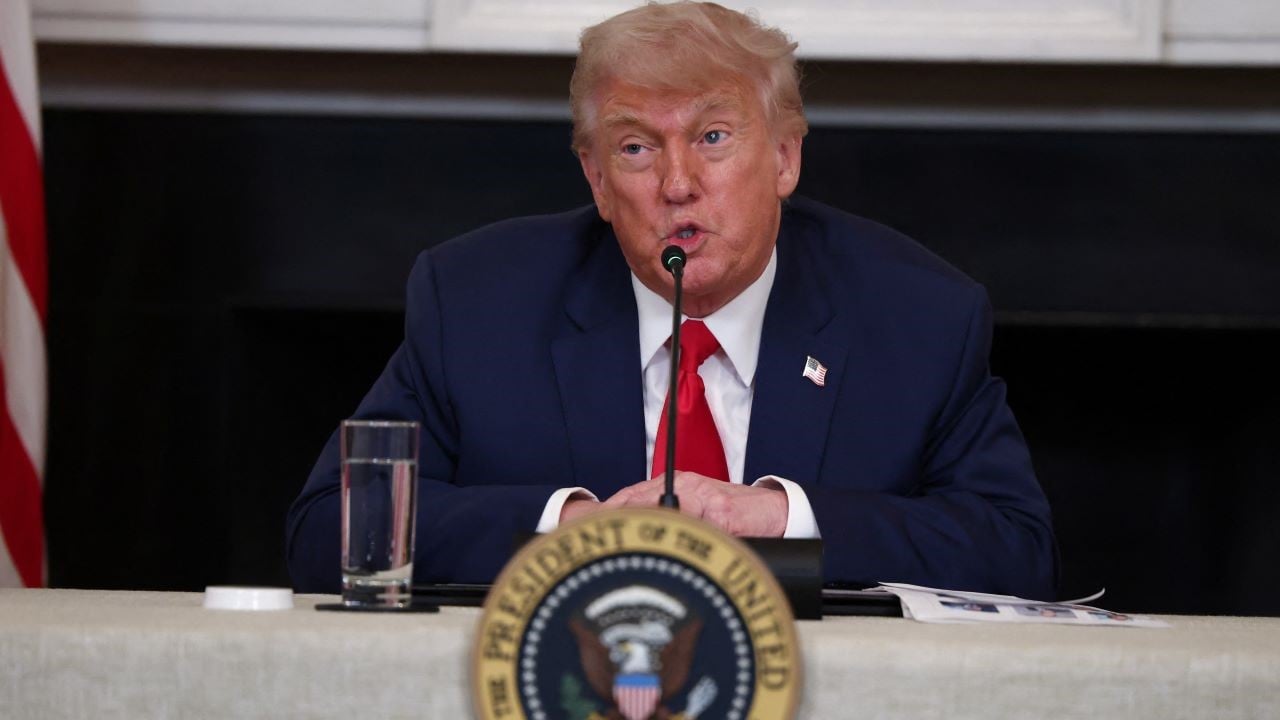
Stocks fluctuated near their record as President Donald Trump’s decision to delay the start of increased duties on several trading partners suggested that he was still open to negotiations. Treasuries joined a global decline of longer-dated bonds. The dollar advanced.
Following a selloff that drove the S&P 500 slightly below overbought levels, the gauge fluctuated around 6,200. Both Goldman Sachs Group Inc. and Bank of America Corp. strategists raised their year-end target for the equity benchmark, highlighting corporate resilience.
Oppenheimer Asset Management remains bullish on US equities at this time, the firm’s chief investment strategist John Stoltzfus wrote in a Monday note.
Specifically, the firm prefers cyclical stocks over their more defensive counterparts. These cyclical sectors include information technology, consumer discretionary, communication services, industrials and financials.
“We anticipate continued positive corporate earnings growth, a key driver of equity valuations,” Stoltzfus wrote. “Our intermediate- and longer-term outlook for the U.S. economy and the stock market remains decidedly bullish.
We believe U.S. economic fundamentals remain on solid footing. As the drag of tight monetary policy eases, job growth and consumption and business fixed investment demand should continue to exhibit resilience. In addition, should the economy appear to falter, the Federal Reserve has the ability to move swiftly to cut rates further to provide economic stimulus and reinvigorate demand.”
HSBC is turning cautious on three of the biggest US bank stocks following a record rally that’s brought the group within shouting distance of an all-time high.
“Downside risks associated with still-elevated macro uncertainty, potentially slowing economic growth and more interest rate cuts through 2025 and 2026 are generally not factored into the stock prices,” analyst Saul Martinez wrote in a note downgrading JPMorgan Chase & Co., Goldman Sachs Group Inc. and Bank of America Corp.
At the same time, “the repricing of fixed-rate assets, benign credit quality, improving investment banking activity, and a favourable regulatory backdrop are well priced in.”
LVMH named Michael Burke to head its Americas operations, bringing back an old-time fixer to take on some of the biggest challenges the group has faced in the region.
Burke, 68, who has worked with Chief Executive Officer Bernard Arnault since the billionaire’s early days in the 1980s, will oversee operations in North and South America, reporting directly to LVMH Group Managing Director Stephane Bianchi, the luxury conglomerate said in an internal memo.
He will also become the non-executive chairman of the US jeweler Tiffany & Co. that LVMH bought in 2021.
Cathie Wood, a longtime backer of Elon Musk, is standing by the Tesla Inc. chief executive after a turbulent start to the week that saw shares in the electric vehicle-maker plunge after the billionaire businessman announced he’s forming a new political party.
The founder of Ark Investment Management LLC pointed instead to what she described as a renewed operational focus after Musk moved to take control of sales in the US and Europe, signalling growing engagement with the company at a critical juncture.
Wood’s continued confidence in Musk is consistent with her long-running bet on Tesla, which has remained a top holding across several Ark funds since 2014.
British energy giants BP Plc and Shell Plc signed agreements with Libya’s National Oil Corp to study new opportunities, joining international majors and accelerating their return to the oil-rich African nation.
BP, which has pivoted away from its failed low-carbon strategy to focus more on fossil fuels, signed a memorandum of understanding to study reviving two huge oil fields in Libya, it said in a statement on Tuesday. The document outlines a framework for how the energy companies might work together and assess a range of technical data.
Separately, a Shell spokesman confirmed the company has signed a MOU with NOC “to study potential opportunities in the country’s oil and gas sector.”
The focus on Libya, a member of the Organization of the Petroleum Exporting Countries, comes as the North African nation tries to bring back oil majors that left. Libya has struggled to quell unrest since the 2011 fall of longtime dictator Moammar Qaddafi. The country, which has the biggest-known crude reserves in Africa, is split between two governments that frequently feud over control of under-invested oil resources.
Goldman Sachs Group Inc. said Rishi Sunak, the former UK prime minister, has rejoined the firm as a senior adviser.
Sunak, who served as prime minister from October 2022 to July 2024, will work with leaders across New York-based Goldman to advise clients globally on a range of topics, “sharing his unique perspectives and insights on the macroeconomic and geopolitical landscape,” Chief Executive Officer David Solomon said in a statement Tuesday.
South Africa’s anti-trust watchdog will not oppose the 13.2 billion rand ($743 million) fiber transaction between Vodacom Group Ltd. and Remgro Ltd. at the Competition Appeal Court, increasing chances that the deal will go ahead.
The Competition Commission reached a deal with Vodacom and Maziv — a wholly owned unit of Remgro’s Community Investment Ventures Holdings Ltd. — on revised conditions that substantially address the anti-trust concerns raised when it initially opposed the transaction, the regulator said in an emailed statement on Tuesday.
Vodacom’s proposed acquisition of 30% of Maziv was blocked by the anti-trust tribunal in October. The telecoms giant and Remgro then turned to the Competition Appeal Court that is scheduled to hear the matter from July 22 to 24. In a rare move, South African Minister of Trade, Industry and Competition Parks Tau also appealed the order that prohibited the deal.
Uber Technologies Inc. investors are brushing aside potential threats from self-driving competition to bet that the company has plenty of room to expand in the near term.
Uber shares have rallied 60% to a record this year as partnerships with robotaxi startups like Alphabet Inc.’s Waymo and growth in new markets have given bulls reasons to cheer after the stock underperformed in 2024. The advance has made Uber the seventh-best S&P 500 performer in 2025.
“They’ve done a great job expanding their addressable markets by adding things like grocery, convenience, alcohol,” said Jamie Meyers, senior equities analyst at Laffer Tengler Investments Inc.
Robinhood Markets Inc. Chief Executive Officer Vlad Tenev said the firm is in talks with regulators over its offering of tokenised equities in Europe after the launch drew rebuke from companies including OpenAI.
The Menlo Park, California-based firm announced last week that retail investors using its app in the European Union could start trading tokens that represent shares of US equities on blockchain. The launch included a giveaway of tokens for closely held companies like OpenAI. The firm led by Sam Altman later cautioned traders that the “tokens” are not equity in the company.
Oil steadied as traders weighed the impact of President Donald Trump’s latest wave of tariff threats and fresh attacks on Red Sea shipping.
Brent was little changed above $69 a barrel, after jumping almost 2% on Monday. The US unveiled a slew of letters warning key trading partners of high tariff rates. Meanwhile, another ship in the Red Sea was under attack.
Hot, dry weather in London and surrounding areas means water usage might have to be restricted for Thames Water’s 16 million customers, according to the supplier.
The UK has already had an unusually warm start to the summer with temperatures set to climb again in the coming days. Met Office forecasts see London reaching 32C (90F) by Friday.
“Unless the situation changes significantly, we will need to put usage restrictions, including a hosepipe ban, in place to ensure taps keep running for customers’ essential use,” a spokesperson for Thames Water said.
A drop in UK homebuilder stocks fanned by last week’s speculation about the future of Chancellor of the Exchequer Rachel Reeves has provided a buying opportunity, according to Bank of America Corp. analysts.
Analysts Allison Sun and Arnaud Lehmann said their base case is that Reeves stays in her position and raises taxes, making Bank of England interest-rate cuts more likely. They upgraded Persimmon Plc to buy on Tuesday, while adding to existing bullish views on Barratt Redrow Plc and Taylor Wimpey Plc.
European Union-backed chipmaker SiPearl has raised €130 million ($152 million) from investors including Taiwan’s Cathay Venture, as Europe pushes for technological sovereignty.
The French startup, which makes high-performance, energy-efficient processors for artificial intelligence and supercomputing, said it would use the Series A financing to invest in research and development and to industrialize its Rhea1 chip, which features 80 cores from chip designer Arm Holdings Plc and more than 61 billion transistors, according to a statement on Tuesday.
The Rhea1 chip will eventually help to power Jupiter, an EU-backed European supercomputer based in Germany and designed for use in strategic fields such as medical research, energy management and defense. SiPearl has recently appointed Taiwan Semiconductor Manufacturing Company Ltd. to start manufacturing the chip, the company said.
The cyberattack that derailed Marks and Spencer Group Plc’s operations for weeks was the result of a “sophisticated impersonation” of one of the retailer’s third-party users, according to Chairman Archie Norman.
The hackers entered M&S’s systems on April 17 and the company detected them two days later, Norman told members of the UK Parliament’s business and trade committee Tuesday. That triggered a “traumatic” period, with the cyber team getting barely any sleep as they grappled with the fallout, he said.
“It’s fair to say that everybody at M&S experienced it,” he said. “We’re still in the rebuild mode and will be for some time to come,” though things would return to normal for customers by the end of this month, Norman added.
JPMorgan Chase & Co. will soon open a new office in Amsterdam after the bank’s stricter return-to-office mandate coupled with an expansion in the region left the biggest Wall Street lender short of desks in the Netherlands.
The move into a larger space in Amsterdam’s World Trade Center became “necessary” after JPMorgan’s push to bring employees back into the office five days a week, said Wendy Hohmann, the newly appointed head of the bank’s Dutch business and one of the few female investment banking leaders in Europe.
“We have a rotation scheme because we simply don’t have enough desks,” Hohmann said in an interview. “It’s also a consequence in terms of the growth we have delivered.”
As businesses around the world start to ditch pandemic-era flexible work policies, they are also confronting a paucity of real estate to accommodate all the staff heading back to office.
Russia’s crude shipments fell to the lowest since February as refinery runs are rising faster than production, eating into exports.
Seaborne crude cargoes averaged 3.12 million barrels a day in the four weeks to July 6, down by 3% from the period to June 29, tanker-tracking data compiled by Bloomberg show.
On this measure, flows have fallen to the lowest since the period ending February 23 and are down by 200,000 barrels a day from March, before eight members of the OPEC+ producer group, including Russia, began easing output cuts they made in 2023.
Over the closest comparable period, production increased by about 60,000 barrels a day, one-third of the headline increase in the country’s OPEC+ output target. Meanwhile, refinery runs rose by 140,000 barrels a day.
On “Liberation Day” on April 2, Donald Trump gushed about how trade was finally going to tilt in America’s favor after decades of its workers and companies being “plundered.” For the president, unfettered tariffs would soon make the US “an entirely different country.”
Spelling out his policy of so-called reciprocity with trading partners, he said, “that means they do it to us and we do it to them, very simple, can’t get any simpler than that.”
Three months later, the transformation is proving harder and slower to execute than advertised.
As Wednesday’s tariff deadline approached with less than a handful of agreements — or mere frameworks of them — ready to announce, the Trump administration is effectively conceding that its self-imposed deadline was too optimistic for a full teardown and rebuilding of the old architecture of the US-led global trading system.
The southern Indian state of Kerala has sued MSC Mediterranean Shipping Co. for the environmental damages caused by a ship capsizing off its coast, according to a court document.
The government is seeking 95.31 billion rupees ($1.1 billion) from the Geneva-based shipping giant, whose Liberian-flagged MSC ELSA 3, which was carrying chemicals and hundreds of tons of fuel, sank due to flooding in May.
The High Court of Kerala, in its Monday order, asked port operator Adani Vizhinjam Port Pvt to seize another container belonging to the Swiss firm until the amount is deposited or initiated by the vessel owner. MSC didn’t immediately reply to an email seeking comment.
Indonesian sovereign wealth fund Danantara appointed four banks to coordinate a multicurrency borrowing of as much as $10 billion, in what could be Southeast Asia’s largest loan, according to people familiar with the matter.
DBS Group Holdings Ltd., HSBC Holdings Plc, Natixis SA and Standard Chartered Plc will be acting as coordinators for the facility, the people said, who asked not to be identified discussing private matters.
Danantara, formally known as Daya Anagata Nusantara, sent a request for proposals to regional and international banks for the loan last month with tenors of around three to five years, Bloomberg reported earlier.
Daimler Truck Holding AG plans to establish an assembly plant in Senegal, with production of Mercedes-Benz trucks scheduled to begin next year.
It will assemble the vehicles in a partnership with the Senegalese government using components supplied from abroad by Daimler, the company said in a statement on its website. The Ministry of Defense, police, fire brigades and private-sector clients will use the trucks.
A joint venture between Senegal and Global Truck Systems will oversee operations, and it’s expected to start producing the first prototypes later this year, with series production in 2026, a spokesman for Daimler said.
The government is providing land, tax incentives and worker training, according to the statement.
German exports sank more than anticipated in May as the value of shipments to the US plunged to their lowest level in more than three years amid President Donald Trump’s tariff threats.
Total exports declined 1.4% from the previous month, the statistics office said Tuesday. That’s worse than the -0.5% median estimate in a Bloomberg survey and followed a revised 1.6% decline in April.
Imports sank 3.8%, including a more than 10% drop in sales from the US. The trade balance increased to €18.4 billion ($21.6 billion) from a revised €15.7 billion.
The European Union is set to rebuke the Italian government for imposing harsh conditions on UniCredit SpA’s takeover of Banco BPM SpA, setting up a power struggle between Brussels and Rome over the fate of the deal.
EU regulators will soon issue formal findings to the Italian government saying it had no right to weigh in on UniCredit’s planned acquisition of Banco BPM, according to people familiar with the matter. The European Commission will say that under the bloc’s merger rules, only Brussels had the legal powers to impose conditions on the deal, which won EU approval last month.
Representatives for the European Commission, UniCredit, Banco BPM and the Italian government all declined to comment.
Billionaire Chris Rokos’ macro hedge fund extended gains in June to cap the first half of the year with double-digit returns.
Rokos Capital Management gained almost 2.6% in June, according to a person familiar with the matter. That boosted the macro hedge fund’s returns for the first six months to 12.3%, the person said, asking not to be identified because the details are private.
A representative for the hedge fund firm, which manages more than $22 billion, declined to comment.
Known for high-conviction macro trades, Rokos made money during what turned out to be a tough stretch for some in the industry in April, when markets convulsed following US President Donald Trump’s unveiling of a roster of tariffs.
June is typically a slow period for car sales in China as the warmer weather kicks in but last month bucked that trend, with buyers seeking to take advantage of a government trade-in subsidy before it was suspended in key cities, pushing transactions to a record.
Retail vehicle sales touched 2.1 million in June, a 7% increase from the previous June peak of 1.9 million in 2022, China’s Passenger Car Association said Tuesday. Wholesale and production figures also hit record highs for the month.
The strong growth during a traditional off-peak season shows that the trade-in subsidy, which provides a 20,000 yuan ($2,800) rebate for newer model cars, made a large contribution to domestic consumption, the PCA said. Some 70% of personal car purchases utilised the sweetener.
European Commission President Ursula von der Leyen accused China of distorting trade and limiting access for European firms two weeks ahead of a summit between the economic powers.
“If our partnership is to move forward, we need a genuine rebalancing: fewer market distortions, less overcapacity exported from China, and fair, reciprocal access for European businesses in China,” von der Leyen told the European Parliament in Strasbourg on Tuesday.
Beijing has imposed export controls on rare earth magnets, hitting European Union industries hard and compounding an increasingly unbalanced trading relationship. The move has dashed signs of a thaw earlier this year between the EU and China because of US President Donald Trump’s tariff policies.
“Broader participation is important,” said Ari Wald, senior analyst at Oppenheimer, who conducted the analysis. “Rallies with most stocks participating, both large and small, are the rallies that typically continue.”
“I thought that off of the lows, with such a ferocious run, you’d find a broader move during that period,” said independent market strategist Jim Paulsen.
Donald Trump’s delay of tariff increases until Aug. 1 may have just softened the price impact for Christmas by pushing it into 2026, according to UBS Group AG Chief Economist Paul Donovan.
Speaking on Bloomberg Television, he said the 10% levy affecting all trade will drive higher inflation numbers in July and August, but extra duties applied to specific countries under the US president’s policies may not now affect shoppers until much later.
“By the time you’ve got the goods shipped to the United States, you’ve got through the supply chain, given that a lot of retailers obviously order early for Christmas,” Donovan said. “That’s obviously something that will lessen some of the damage to US consumers in the second half.”
Taiwan’s exports are on a tear, powered by global demand for artificial intelligence — but the boom is becoming a flashpoint in trade relations with Washington and a growing risk for the economy.
Shipments hit a record $154 billion in the second quarter, according to official data released Tuesday. For June alone, exports hit a new high for any month of $53 billion, topping the previous record set in May.
Although it’s unclear whether the surge could continue through the year as Trump’s tariffs could kick in, Taiwan’s government has previously forecast that net exports will contribute the most to gross domestic product this year since 2021. But the strength is also creating problems, including a rapidly strengthening Taiwan dollar and a widening trade surplus with the US, just as Washington is turning up the pressure on key trading partners.
Nigeria’s currency appears to be decoupling from the price of oil, the nation’s main foreign-exchange earner.
After some initial volatility in the first half, the naira stabilized even as oil prices fell. Analysts from Deutsche Bank AG to Cardinal Stone expect the Nigerian currency to end the year near 1,556 per dollar — its average exchange rate in the first six months of 2025 after it slumped 41% in 2024. It traded around 1,530 on Tuesday, largely flat on a year-to-date basis.
The change in the naira’s fortunes can be attributed to its undervaluation, higher non-oil exports and lower import demand, said Ayo Salami, chief investment officer at Emerging Markets Investment Management Ltd. in London. The currency is trading below its fair value based on purchasing power parity, he said.NewsLive TVMarketPopular CategoriesCalculatorsTrending NowLet's Connect with CNBCTV 18Network 18 Group :©TV18 Broadcast Limited. All rights reserved.