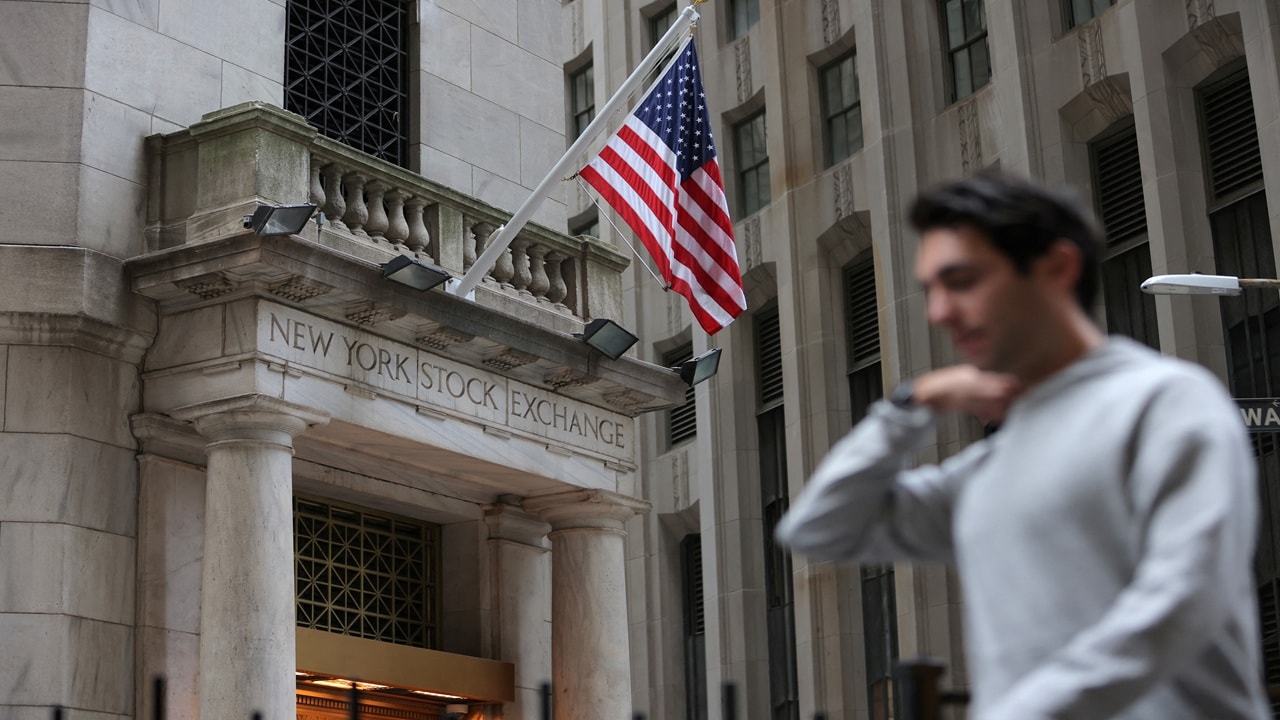
US Stock Market LIVE Updates: Dow opens flat after 4 straight gains as weak jobs data weighs on sentiment
Published on 04/06/2025 07:48 PM
The European Union’s trade chief, Maros Sefcovic, said he raised industry-wide concerns over Chinese export restrictions on rare earths and magnets with his counterpart Wang Wentao on Tuesday.
“It was one of my priorities to address this issue yesterday and we did,” Sefcovic told reporters Wednesday in Paris, where he’s attending a conference at the Organization for Economic Cooperation and Development.
“I informed my Chinese counterpart about the alarming situation in the European car industry, but I would say industry as such because clearly rare earth and permanent magnets are absolutely essential for the industrial production,” he said.
The EU trade commissioner described the situation as “extremely disruptive.”
The rapid development of data centers connected to the largest US electric grid raised costs by $9.4 billion, an expense that consumers from Illinois to Washington, D.C., will see reflected in their utility bills starting this month.
Overall costs rose by 180%, with the growing energy needs of data centers being the primary cause of tight supply-and-demand conditions, as well as high prices, in the PJM Interconnection capacity market, which serves customers from Illinois to Washington D.C., according to a report Tuesday by Monitoring Analytics, the grid’s independent market monitor.
The analysis from PJM’s watchdog asserts that households and businesses are subsidising the data center boom being carried out by some of the richest tech companies in the world.
The euro zone is set to continue its eastward expansion after Bulgaria was deemed ready to become the currency bloc’s 21st member.
The European Commission recommended on Wednesday that the Black Sea nation of 6.4 million should be allowed to adopt the common currency in 2026. The European Union’s executive arm and the European Central Bank said in separate reports that all the requirements on issues including inflation and public debt had been fulfilled.
“Thanks to the euro, Bulgaria’s economy will become stronger, with more trade with euro area partners, foreign direct investment, access to finance, quality jobs and real incomes,” Commission President Ursula von der Leyen said in a statement. “Bulgaria will take its rightful place in shaping the decisions at the heart of the euro area.”
Treasuries climbed after a soft labour-market reading suggested that high anxiety around President Donald Trump’s ever-changing economic policies weighed on business-staffing decisions.
Bond yields fell across the curve after data showed hiring decelerated to the slowest pace in two years. Swap traders are pricing in two rate cuts before the end of 2025, with the first move seen most likely coming in October. The dollar slipped. The S&P 500 edged up.
Private-sector payrolls increased by 37,000 last month, according to ADP Research, trailing estimates. The report prompted Trump to comment in a social-media post that Fed Chair Jerome Powell should consider lowering rates. The jobs report due Friday is expected to show that growth in nonfarm payrolls slowed and the unemployment rate remained steady.
Mercedes-Benz Group AG and BMW AG are stepping up efforts to avoid potential parts shortages, as China’s export controls on rare earth metals threaten to disrupt global car production.
Mercedes has intensified discussions with key suppliers about the short-term availability of components containing these materials and whether to stockpile certain items, according to Jörg Burzer, who oversees the company’s production.
US stocks were mixed on Wednesday after private sector hiring hit its lowest level in more than two years, raising concerns that trade policy uncertainty could be weighing on the U.S. economy.
The Dow Jones Industrial Average rose just 48 points, or 0.1%. The S&P 500 climbed 0.2%, while the Nasdaq Composite advanced 0.3%.
A report from payrolls processing firm ADP showed that payrolls increased only 37,000 for the month, less than the downwardly revised 60,000 in April and below the consensus forecast of 110,000 that economists polled by Dow Jones were expecting.
Ukrainian President Volodymyr Zelenskiy said that Russia’s maximalist demands mean there’s no point in continuing with lower-level talks aimed at brokering an end to the war.
Calling Russia’s conditions for peace an “ultimatum,” Zelenskiy said that he remains willing to meet directly with President Vladimir Putin. But low-level talks such as those that took place in Istanbul on Monday make no sense unless they lead to a meeting of the two leaders, he said.
“To continue diplomatic meetings in Istanbul at a level that does not resolve anything further is, in my opinion, meaningless,” Zelenskiy told reporters in Kyiv on Wednesday.
Ukrainian President Volodymyr Zelenskiy said that Russia’s maximalist demands mean there’s no point in continuing with lower-level talks aimed at brokering an end to the war.
Calling Russia’s conditions for peace an “ultimatum,” Zelenskiy said that he remains willing to meet directly with President Vladimir Putin. But low-level talks such as those that took place in Istanbul on Monday make no sense unless they lead to a meeting of the two leaders, he said.
“To continue diplomatic meetings in Istanbul at a level that does not resolve anything further is, in my opinion, meaningless,” Zelenskiy told reporters in Kyiv on Wednesday.
A measure in President Donald Trump’s tax and spending bill that’s meant to penalize foreign investors may also raise interest costs for some US borrowers.
The so-called Section 899 provision takes aim at nations such as Canada, the UK and France that have digital services taxes or other corporate tax rules the US deems unfair. Investors and companies from those countries may see gradually higher tax rates on income they earn from US assets, which some analysts have called a “revenge tax.”
But Section 899 would affect loan interest payments in a way that would hurt some US companies, according to legal experts. Many lending agreements require borrowers to cover such tax hikes if they’re enacted after the deal is signed.
Hiring slowed to the slowest pace in two years, pointing to a weakened demand for workers. Private-sector payrolls increased by 37,000 last month, according to ADP Research. That was lower than all estimates in a Bloomberg survey of economists.
“After a strong start to the year, hiring is losing momentum,” Nela Richardson, chief economist at ADP, said Wednesday in a statement.
Wall Street tech analyst Dan Ives is lending his personal brand to power a new ETF riding the artificial-intelligence boom, joining a growing pack of finance names looking to monetize their industry renown with retail-friendly investment funds.
Wedbush Fund Advisers is launching a product tracking the investment picks touted by Ives, whose high-conviction tech calls have earned him a sizable following among the likes of retail investors.
The Dan IVES Wedbush AI Revolution ETF is launching Wednesday with the ticker IVES, and is focused on Ives’ “proprietary research.” It comprises 30 names in AI sectors, including semiconductors, cybersecurities and robotics, among others.
The race to be Bank of Thailand governor is heating up, with bankers and economists leading a list of seven applicants vying for a pivotal role in Southeast Asia’s second-biggest economy.
Candidates include Anusorn Tamajai, who sought the governor’s role in 2020; Vitai Ratanakorn, president of state-owned Government Savings Bank; Bangkok Bank Pcl’s Kobsak Pootrakool; and Somprawin Manprasert, a former economist at Siam Commercial Bank Pcl. Others include a BOT deputy governor and an ex-International Monetary Fund economist, the Thai-language Krungthep Turakij reported.
Apple Inc. shares fell in premarket trading on Wednesday, suggesting the iPhone maker would extend its 2025 weakness as Wall Street remains concerned about its growth prospects and position in the landscape for artificial intelligence.
Needham downgraded the stock to hold from buy, making it the latest firm to turn more cautious. Analyst Laura Martin sees a number of risks, including competition and tepid growth trends, coupled with a valuation that “looks expensive on several metrics.”
Shares fell 0.6% in premarket trading. The stock is down 19% this year as of its last close, making it the weakest of the Magnificent Seven. While much of the selloff reflects political uncertainty, as Apple is seen as especially vulnerable to tariffs and it has repeatedly been singled out by the Trump administration for its global manufacturing footprint, its struggles with AI have been another significant headwind.
The euro zone is set to continue its eastward expansion after Bulgaria was deemed ready to become the currency bloc’s 21st member.
The European Commission recommended on Wednesday that the Black Sea nation of 6.4 million should be allowed to adopt the common currency in 2026. The European Union’s executive arm and the European Central Bank said in separate reports that all the requirements on issues including inflation and public debt had been fulfilled.
US stock futures extended gains as investors await further data on the labour market, which has so far held up better than expected amid the Trump administration’s trade war.
S&P 500 contracts rose 0.2% after the US benchmark posted consecutive advances for the first time since mid-May. MSCI’s gauge for global equities hit an all-time high after gains in European and Asian stocks. The dollar and US Treasuries were little changed
Mortgage demand in the US fell 3.9% last week, marking the third consecutive weekly decline, even as average rates on 30-year fixed mortgages edged down to 6.92%. Applications for home purchases dropped 4% but remained 18% higher than a year ago. Refinancing activity also slipped 4% and hit its lowest average loan size since July 2024, as borrowers continue to wait for steeper rate cuts. Despite more housing supply on the market, sales remain subdued, with economists eyeing Friday’s US jobs report for potential rate direction.
Asian markets rose on Wednesday, buoyed by Wall Street’s tech rally, with South Korea leading the advance after opposition leader Lee Jae-myung won the presidential election. The Kospi jumped 2.66% to its highest level since August, while the Kosdaq climbed 1.34%. Gains were more modest elsewhere in the region, as Chinese and Hong Kong markets were muted amid renewed U.S.-China trade tensions. Japan’s Nikkei rose 0.8%, and Australia’s ASX 200 added 0.89% despite weaker-than-expected GDP figures.
Oil steadied after a two-day gain as rains slowed the growth of some blazes that had disrupted Canadian crude production.
Brent traded around $65 a barrel after closing at a three-week high on Tuesday. One Canadian operator restarted a site after shutting down last week, with wildfires halting about 7% of output at one stage in the world’s fourth-largest producer.
Separately, the American Petroleum Institute reported US crude inventories dropped by 3.28 million barrels last week, according to a person familiar with the figures. That would be the biggest draw since March if confirmed by official data later on Wednesday.
Gold edged higher after falling in the previous session, buoyed by Asian bargain-hunters as concerns resurfaced over the impact of US President Donald Trump’s trade war.
The precious metal rose as much as 0.6% to $3,372 an ounce, following a 0.8% decline on Tuesday, after Trump signed a directive to double steel and aluminum tariffs to 50%, while trade relations with China and the European Union again turned sour. That outweighed a rise in US job openings that had boosted positive sentiment about the resilience of the American economy.
Bullion is up around 28% this year, less than $200 below an all-time high reached in April. It’s been bolstered by haven demand as investors have exited assets exposed to an expanding trade war. Central banks are also a major driving force, with their buying spree expected to continue amid geopolitical tensions and concerns about overexposure to the dollar.
Asia-Pacific markets advanced Wednesday after Wall Street rose on the back of a tech rally, led by chipmaker Nvidia, with South Korean stocks leading gains.
South Korean markets rose as opposition party leader Lee Jae-myung won the presidential election. The Kospi index popped 2.66% to end the day at 2,770.84, hitting its highest level since August last year, while the small-cap Kosdaq advanced 1.34% to 750.21.
Lee’s “election pledge has placed considerable weight on enhancing the value of the Korean stock market,” John Cho, Korea equity portfolio manager at J.P. Morgan Asset Management, said in a note.
Futures on Wall Street are pointing towards another positive start for the benchmark indices after the job openings data surprised on the positive side on Tuesday, leading to the indices ending at the day’s high.
The Dow futures are currently up 75 points, while the S&P 500 and Nasdaq futures are up 10 points and 25 points respectively.
Good Afternoon!
Hello and Welcome to CNBC-TV18’s Live coverage on the US markets and other major global developments.
Futures are pointing towards another positive start for Wall Street.
Watch this space for all the lie updates.NewsLive TVMarketPopular CategoriesCalculatorsTrending NowLet's Connect with CNBCTV 18Network 18 Group :©TV18 Broadcast Limited. All rights reserved.