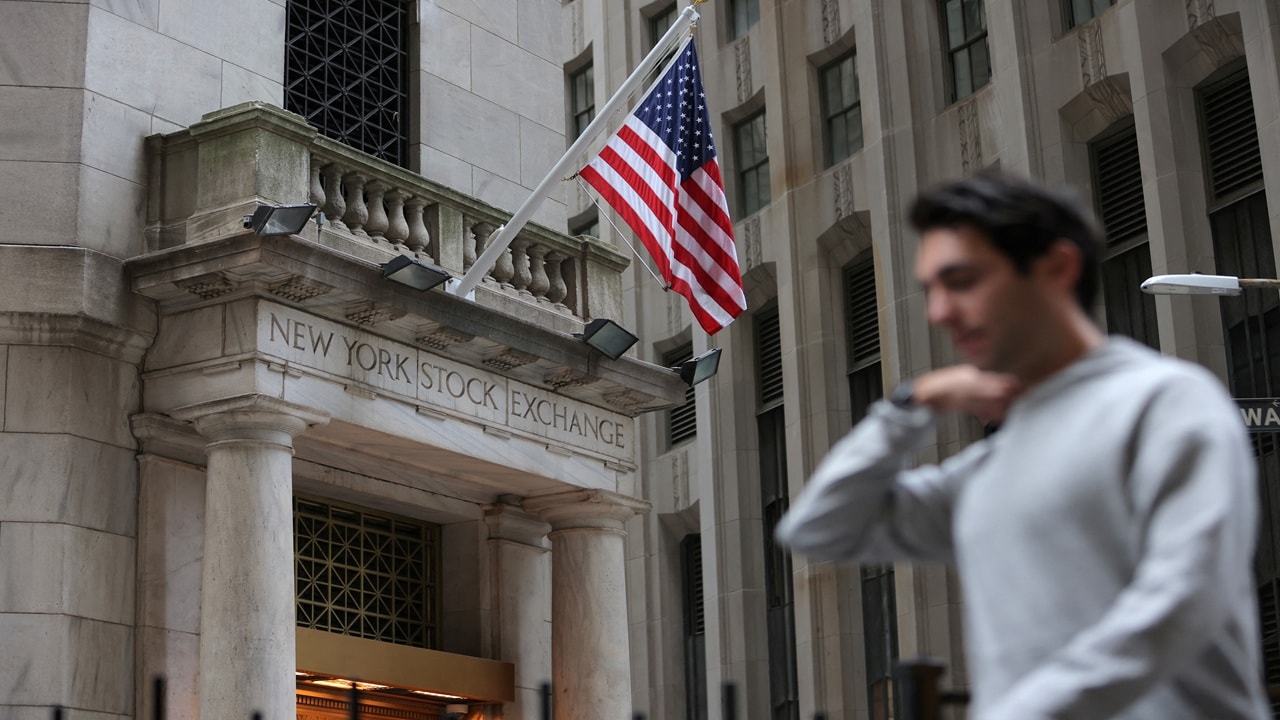
US Stock Market LIVE Updates: S&P 500 rises after Nvidia gains, CPI comes in as expected
Published on 15/07/2025 07:04 PM
Russia’s crude exports hit a one-month high, driven by a surge in weekly flows that coincided with a sharp drop in refinery runs. The increase came before President Donald Trump’s threat of secondary tariffs on buyers of Russian oil if Moscow fails to make a swift peace with Ukraine.
Seaborne crude cargoes averaged 3.23 million barrels a day in the four weeks to July 13, up by 3% from the period to July 6, tanker-tracking data compiled by Bloomberg show. On this measure, flows reversed the previous week’s drop and rose to the highest since the period ending June 15 and are just above their year-to-date average.
Russian refineries processed a little over 5 million barrels a day of crude during the first nine days of July, down by about 300,000 from a month earlier, with several large plants undertaking seasonal maintenance. That’s likely to have freed up more crude for export. The country’s oil production is also edging higher as part of the OPEC+ group’s easing of output cuts. Volumes rose by about 40,000 barrels a day in June.
Air taxi startup Joby Aviation Inc. plans to double aircraft output capacity at its main production site in California, just weeks after completing its first piloted test flights.
The expansion will enable the Marina, California facility to build up to 24 aircraft per year, the company said in a statement Tuesday. It also said “equipment installation is underway” at a new site in Dayton, Ohio, for building and testing aircraft components for a pilot production line.
Earlier this year, the company said in a shareholder letter that it expected parts production to begin in Dayton from mid-2025, marking a delay from initial plans to start output at the site last year.
Joby said Tuesday that engineers from Toyota Motor Corp., which became its largest shareholder in May, are “deeply integrated” into operations in areas such as design, manufacturing and quality control.
UniCredit SpA is ramping up the use of significant risk transfers as it frees up more capital, with the bank a key player in a wave of industry consolidation.
Milan-based UniCredit is on track to issue SRTs tied to as much as €20 billion ($23 billion) of loans this year, said people with knowledge of the matter, who asked not to be named. That would represent an increase of about 30% compared to the bank’s loan portfolios tied to SRT deals last year, they said.
SRTs are a way for financial institutions to insure loans against default by selling credit-linked notes to investors. The transactions allow lenders to boost their solvency ratios and free up capital they’d otherwise use to meet regulatory requirements, increasing their leeway for new lending or acquisitions.
Treasuries were mostly steady after Tuesday’s mixed inflation report for June largely matched economists’ expectations and slightly raised bets on interest-rate cuts by the Federal Reserve.
Longer-term bonds outperformed, with yields on 10-year and 30-year bonds falling more than two basis points, while two-year yields rose about 1 basis point.
Interest-rate swaps showed traders saw a 62% chance of a quarter-point rate cut by September and priced in almost two reductions by year-end.
Chinese quantitative hedge funds are stepping up efforts to hire science and engineering students in the US affected by President Donald Trump’s university funding cuts and tighter visa policies.
Shanghai-based Mingshi Investment Management launched a special program last month to offer full-time jobs to students unable to finish their PhDs due to the recent US policy changes. The initiative also provides internships to graduates from Chinese universities whose overseas study plans may be scuppered, the company said.
Shanghai Goku Technologies, an AI-driven quant, said it will welcome “with open arms” any qualified students hurt by the policies. Another eastern China-based quant fund managing more than 10 billion yuan ($1.4 billion) has hired three AI researchers this year from overseas, including from the US.
US Treasury Secretary Scott Bessent suggested the deadline for a US-China tariff truce slated to end next month is flexible, saying that talks between the world’s largest economies are in a “very good place” ahead of an expected meeting in coming weeks.
“I tell market participants not to worry about Aug. 12,” Bessent said Tuesday on Bloomberg Television, referring to the end of a 90-day reprieve that was announced May 12.
Bessent, who has taken a leading role in Washington’s negotiations with China, said that he hopes to meet with his Chinese counterpart Vice Premier He Lifeng soon, possibly in a third country, either before or after the Chinese leadership hold a meeting early next month.
“We’re still working on it,” he said. “The Chinese leadership has a big conclave at the beginning of August. We’re trying to work out whether that could be in a third country either before or after that conclave.”
Consumer prices rose in June as President Donald Trump’s tariffs began to slowly work their way through the US economy.
The consumer price index, a broad-based measure of goods and services costs, increased 0.3% on the month, putting the 12-month inflation rate at 2.7%, the Bureau of Labour Statistics reported Tuesday. The numbers were right in line with the Dow Jones consensus.
Excluding volatile food and energy prices, core inflation picked up 0.2% on the month, with the annual rate moving to 2.9%, also matching the respective estimates.
Apple Inc. has struck a $500 million deal to buy rare-earth minerals from MP Materials Corp., the US producer that just last week secured backing from the Pentagon.
The two companies will also work together to “establish a cutting-edge rare earth recycling line” in Mountain Pass, California, and develop novel magnet materials and innovative processing technologies to enhance magnet performance,” Apple said Tuesday in a statement.
“American innovation drives everything we do at Apple, and we’re proud to deepen our investment in the U.S. economy,” said Apple Chief Executive Officer Tim Cook. “Rare earth materials are essential for making advanced technology, and this partnership will help strengthen the supply of these vital materials here in the United States.
Wells Fargo & Co. just did something it hasn’t been able to do for more than seven years: Cross the $1.95 trillion asset mark.
The bank’s total assets stood at $1.98 trillion at the end of the second quarter, an increase that followed its long-anticipated freedom from a Federal Reserve cap. The central bank said it lifted the shackle — which restricted it from growing beyond its size at the end of 2017 — in June.
The Fed imposed the sanction as regulators had grown frustrated with the pace of Wells Fargo’s cleanup of a series of scandals that began with fake accounts across its branch network and later multiplied across business lines. The punishment proved costly — by one measure, it caused Wells Fargo to miss out on almost $39 billion of profits.
Bulgaria received more than €9.4 billion ($11 billion) in orders for a planned eurobond sale after credit-rating upgrades spurred by its entry into the euro area next year.
The government is offering a benchmark-sized euro-denominated 10-year note, with guidance at around 100-105 basis points above mid-swaps, tighter than initial price talk, according to a person familiar with the matter who asked not to be identified. The potential sale, which may price on Tuesday, also includes a benchmark 20-year bond at about 150-155 basis points over mid-swaps.
Bulgaria is set to become the 21st country to use the euro in 2026 after European Union finance ministers signed off on its bid last week. The approval helped trigger upgrades at Fitch Ratings and S&P Global Ratings to BBB+, three notches above junk and above existing euro member Greece.
Advanced Micro Devices Inc. said that it plans to restart shipments of its MI308 chips to China after the US said it would approve the sales, following a similar decision on an Nvidia Corp. semiconductor.
The US Commerce Department told AMD that license applications for the MI308 products would move forward for review, an AMD spokesman said Tuesday.
Allowing the products back into China is a reversal for President Donald Trump’s administration, which spent weeks insisting that curbs on chip sales to the Asian country were not up for discussion. The news comes after weeks of thawing ties between the two nations, as well as Nvidia Chief Executive Officer Jensen Huang’s meeting with Trump last week.
Treasury Secretary Scott Bessent tells Bloomberg TV he is involved in the process of picking the next Fed chair. Bessent says he is happy with his current role, but adds he will do what President Trump wants.
US stock futures rose after Nvidia Corp. secured US assurances to resume sales of some artificial intelligence chips to China, lifting sentiment on a busy day that also features inflation data and big bank earnings.
Contracts for the Nasdaq 100 advanced 0.6% while those for the S&P 500 climbed 0.4%. Nvidia strengthened more than 4% in early trading. JPMorgan Chase & Co. fluctuated as the lender’s investment bankers eked out a surprise second-quarter gain.
US government bonds pared modest gains after Treasury Secretary Scott Bessent said it would be confusing for Federal Reserve Chair Jerome Powell to remain at the central bank after his term ends, adding that a “formal process” has already begun to identify a potential successor.
US President Donald Trump’s latest threat of 100% tariffs on Russia would risk complicating relations with two nations crucial to his economic and strategic goals: China and India.
Trump on Monday threatened tariffs of about 100% on Russia unless it reached a peace deal with Ukraine in the next 50 days, saying the levies would come in the form of “secondary tariffs.”
Matt Whitaker, the US ambassador to NATO, later said the planned action effectively represents secondary sanctions on countries buying oil from Russia. “It’s about tariffs on countries like India and China that are buying their oil,” he told reporters.
Global markets — increasingly skeptical of Trump’s near-daily tariff threats — largely shrugged off the news, suggesting there’s little concern around any potential impact to crude flows. Trade analysts said the proposed levies would be difficult to police and, if implemented, could well backfire on the US.
The European Union has finalised a second list of countermeasures to target US goods worth €72 billion ($84 billion), including Boeing Co. aircraft, automobiles and bourbon if it decides to retaliate against Donald Trump’s tariff policy.
Trump on Monday said he is still open to more trade negotiations with the EU after announcing over the weekend a 30% levy on EU imports that will kick in on August 1 if the two sides fail to agree on a better deal. EU trade chief Maros Sefcovic was planning to speak with US Commerce Secretary Howard Lutnick late Monday as he pushes for a settlement that the EU insists must be mutually beneficial to both sides.
“We’re always open to talk,” the US president told reporters at the White House. “We are open to talk, including to Europe. In fact, they’re coming over. They’d like to talk.”
US Treasury Secretary Scott Bessent said a “formal process” is already starting to identify a potential successor to Federal Reserve Chairman Jerome Powell.
“Well, look, there’s a formal process that’s already starting,” Bessent said in an interview on Bloomberg Surveillance on Tuesday morning, when asked if such efforts had already begun.
“There are a lot of great candidates, and we’ll see how rapidly it progresses,” Bessent added. “It’s President Trump’s decision, and it will move at his speed.”
Bessent also said it would be confusing for Powell to remain at the Fed after his term as chair ends.
“Traditionally, the Fed chair also steps down as a governor, and there’s been a lot of talk of a shadow Fed chair causing confusion in advance of his or her nomination,” Bessent added. “And I can tell you, I think it’d be very confusing for the market for a former Fed chair to stay on.”
BlackRock Inc. pulled in $46 billion to its investment funds, and assets hit a record $12.5 trillion as clients rode out the volatility of President Donald Trump’s tariff policies in the second quarter.
Investors added $85 billion to exchange-traded funds and $29 billion to equities overall, New York-based BlackRock said in a statement on Tuesday. Net flows into long-term investments missed the $61 billion average estimate of analysts surveyed by Bloomberg, as a single institutional client redeemed $52 billion from a lower-fee index product.
“Our expanding client relationships are resonating in higher, more diversified organic base fee growth,” Chief Executive Officer Larry Fink said in the statement.
Overall net flows into the company’s funds were $68 billion, including $22 billion to cash-management and money-market funds and $14 billion into digital-asset ETFs.
Russia rejected pressure from Donald Trump after the US president threatened to impose stiff economic penalties on Moscow if it doesn’t end hostilities with Ukraine within 50 days, though the Kremlin indicated it would review his latest stance.
“We first and foremost note that any attempts to make demands — especially ultimatums — are unacceptable for us,” Russian Deputy Foreign Minister Sergei Ryabkov said on Tuesday, according to the state-run Tass news service. Kremlin spokesman Dmitry Peskov said Trump’s statement was “serious,” and Moscow needed time to study it, Tass reported.
Trump said on Monday that he’d apply levies in the form of “secondary tariffs” if the Kremlin didn’t cease fighting. The US president didn’t provide details, but has used the term in the past to describe duties imposed on countries for trading with American adversaries. The threats echo punishment spelled out in a bipartisan bill in Congress that would impose 500% tariffs on countries that buy Russian oil and gas such as China and India.
The UK will not create its own framework for sustainable investments, abandoning years of work to focus on other green policies.
Britain’s government has not found sufficient evidence that a so-called taxonomy would help stop greenwashing and channel investments to more sustainable economic activities, it said in a consultation document published Tuesday. Instead, the UK said it would focus on sustainability reporting standards and corporate transition plans.
Such taxonomies, which classify what a government deems to be “green,” have spread across the globe, though they’ve also faced pushback from companies and investors due to their complexity. The UK’s taxonomy plans were first announced in 2020, but last year it released a consultation on whether it should continue with the project.
Iron ore dropped after data showed China’s crude steel output has plummeted as the nation’s property sector struggles under a prolonged downturn.
Futures of the steel-making ingredient fell as much as 1.6% after traders weighed a slew of key economic prints from the biggest metals-consuming nation on Tuesday. The data showed China’s growth exceeded expectations but other figures painted a picture of weak demand, while uncertainty lingers on whether the resilience of its export market can be maintained.
China’s steel output had its biggest drop in 10 months in June, falling 9.2% from the year before to 83.2 million tons. That left first-half production at its weakest since 2020.
The company reported its second-quarter results on Tuesday. The revenue came in at $45.68 billion.
The shares of the financial services company fell 0.8% in premarket. The company lowered its net income guidance to approximately 2024 levels.
The June consumer price index is expected today. The investors are also eying stock movement following better than expected earnings season.
The shares of NVIDIA are up 4.5% in premarket trade. On the sale of H20 chips to China, the company said in a statement, “The US government has assured NVIDIA that licenses will be granted, and NVIDIA hopes to start deliveries soon.”
Hong Kong’s Hang Seng Index closes 1.6% higher at 24,590.12
China’s CSI 300 index flat at 4,019.06
Japan’s Nikkei 225 benchmark closes 0.55% at 39,678.02
Topix index flat at 2,825.31
South Korea’s Kospi index up 0.41% at 3,215.28
Australia’s S&PASX 200 benchmark ended 0.7% higher at 8,630.30
The dollar hovered near a three-week high versus major peers on Tuesday (July 15) as traders awaited the release of US inflation data later in the day that could provide clues on the path for monetary policy.
here
Fund managers are rushing back into risky assets at a record pace on optimism over economic growth and strong corporate profits, according to a monthly survey by Bank of America Corp.
The risk level in investor portfolios is the highest ever on a three-month basis going back to 2001, the bank’s survey showed. The poll also pointed to strong increases in allocations to US and European stocks, as well as tech shares.
Gold prices inched up on Tuesday, July 15. Investors are waiting for fresh US inflation data to gauge the Federal Reserve’s next move on interest rates.
here
Stocks advanced after Nvidia Corp. secured US assurances to resume sales of some artificial intelligence chips to China, lifting sentiment on a busy day that will also feature inflation data and big bank earnings.
European stocks edged 0.2% higher, with technology shares among the session’s top performers. Futures for the Nasdaq 100 gained 0.5% while those for the S&P 500 climbed 0.3%. Nvidia rose 4.5% in early trading. Bitcoin fell as traders took profit after a record-setting surge.
The yield on 10-year Treasuries declined two basis points to 4.41%, with government bonds rising broadly in positioning-led moves ahead of June’s consumer price index report. The dollar dropped 0.2%.
Japan’s long-term government debt yield touched the highest level since 2008, as a raft of election tax-cut pledges puts investors on edge and risks higher costs all around in the country.
Tuesday’s rise of 2.5 basis points in the 10-year yield — to 1.595% — while modest, is a reminder that it’s not just bonds of 20 to 40 years that are under pressure, even if the most extreme moves have been in these super-long maturities.
The uptick shows the increased vulnerability of Japan’s bond market after its central bank started pulling back from massive purchases that placed a protective cushion around yields for more than a decade. An upper house election on Sunday that could see the ruling coalition lose its majority is further fueling concerns that the government will loosen its grip on its finances even more, adding to pressure on yields.NewsLive TVMarketPopular CategoriesCalculatorsTrending NowLet's Connect with CNBCTV 18Network 18 Group :©TV18 Broadcast Limited. All rights reserved.