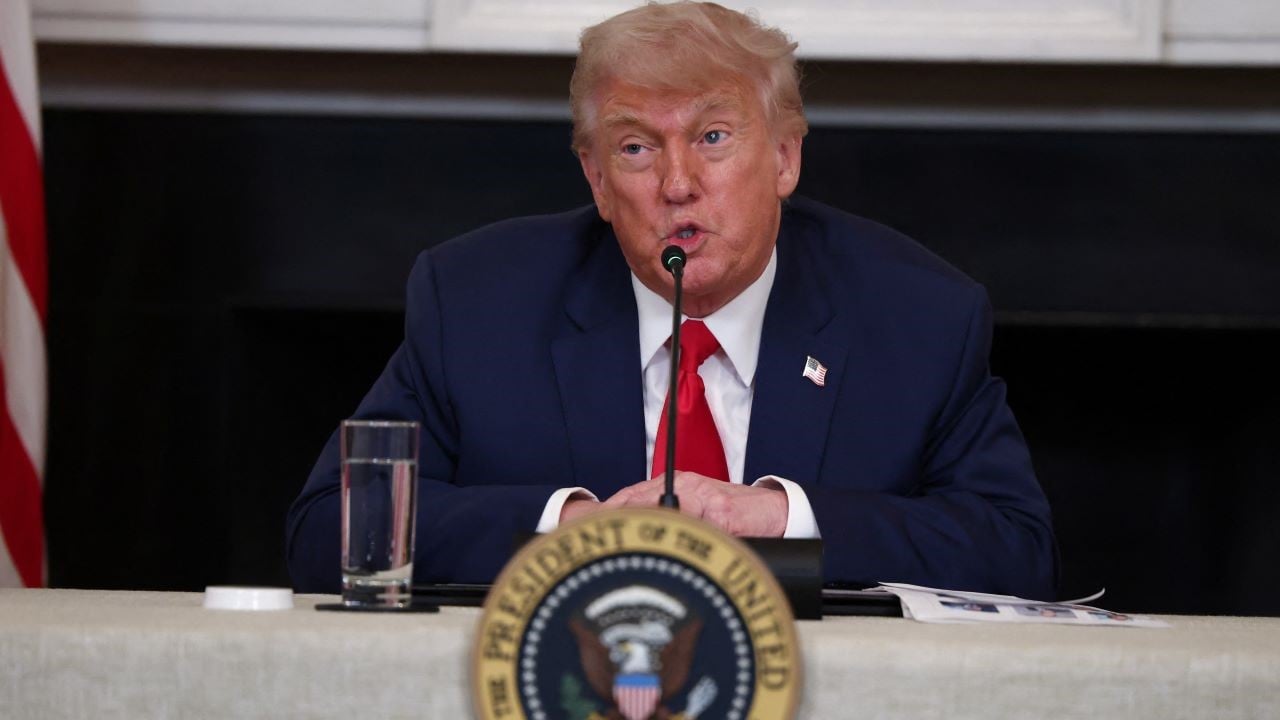
US Stock Market LIVE Updates: S&P 500 struggles for a second day as Trump says no extensions will be granted to August 1 trade deadline
Published on 09/07/2025 01:07 AM
Walt Disney Co. and Hearst Corp. are considering a sale of their A+E Global Media joint venture, which includes cable-TV channels such as History and Lifetime, according to a person familiar with the discussions.
Variety, which reported on the talks earlier Tuesday, said Wells Fargo & Co. had been hired to handle the sale. Spokespeople for Disney and A+E declined to comment, while Hearst didn’t respond.
The A+E business, which operates independently from its two parent companies, began as the Arts & Entertainment channel. It’s best known for reality-TV hits like the A&E show Duck Dynasty and Ice Road Truckers, which ran on the History Channel. It also makes programs for others, like The Lincoln Lawyer on Netflix.
US consumer borrowing increased in May at the slowest pace in three months on a pullback in credit card and other revolving debt outstanding.
Total credit outstanding rose $5.1 billion after a revised $16.9 billion gain in April, according to Federal Reserve data out Tuesday. The median projection in a Bloomberg survey of economists called for a $10.5 billion rise.
Credit-card and other revolving debt outstanding declined $3.5 billion, the first decrease since November. Non-revolving debt, such as loans for vehicle purchases and school tuition, increased by $8.6 billion, a slight deceleration from a month earlier. The report doesn’t include mortgages.
A new COVID-19 variant, officially known as NB.1.8.1 and nicknamed Nimbus, is now the most common strain in the US, according to the US Centers for Disease Control and Prevention.
The CDC said it is “aware of increasing detections” of Nimbus in the US, where it monitors the spread of the virus through nasal and wastewater samples collected via its airport screening program.
Nimbus makes up between 13% and 68% of circulating COVID-19 strains, according to a spokesperson for the Department of Health and Human Services. Estimates from the two-week period ending June 21 show that Nimbus made up 43% of US cases.
Though the symptoms appear to be similar to other COVID strains, some patients have reported intense scratchiness like “razor blades in the throat.”
HHS Secretary Robert F. Kennedy Jr. announced in late May that the government no longer recommends the COVID-19 vaccine for healthy children and pregnant women. Several medical groups sued HHS on Monday for those changes.
Meta Plaforms Inc. bought a minority stake in the world’s largest eye-wear maker EssilorLuxottica SA, a deal that increases the US tech giant’s financial commitment to the fast-growing smart glasses industry, according to people familiar with the matter.
Facebook parent Meta acquired just under 3% of Ray-Ban maker EssilorLuxottica, a stake worth around €3 billion ($3.5 billion) at the current market price, said the people, who asked not to be identified because deliberations are private. Menlo Park, California-based Meta is considering further investment that could build the stake to around 5% over time, the people added, though those plans could still change.
Representatives for Meta and EssilorLuxottica declined to comment.
SpaceX is discussing plans to raise money and sell insider shares in a deal that would value Elon Musk’s rocket and satellite maker around $400 billion, people familiar with the matter said.
The valuation would mark a significant premium to the $350 billion high-mark set during SpaceX’s share buyback in December. It would put the privately held firm on par with the market capitalisations of some of the world’s largest, publicly traded companies, including Home Depot Inc. and Palantir Technologies Inc.
A representative for SpaceX, formally known as Space Exploration Technologies Corp., didn’t immediately respond to a request for comment.
Brazilian President Luiz Inacio Lula da Silva wants to deepen trade ties with India, the world’s most populous nation. The question as he hosts Indian Prime Minister Narendra Modi in Brasilia on Tuesday is how to go about it.
Despite both nations being members of the BRICS grouping of emerging-market economies and natural allies in the fields of poverty reduction and biofuel production, India ranks well down the list of Brazil’s trading partners. Total commerce is dwarfed by that with China, the US, neighbouring Argentina and faraway Germany.
It’s a mismatch that the president known as Lula acknowledged last week when he joked that he’d only just learned that Modi, a devout Hindu, didn’t eat meat. Brazil is the world’s No. 1 beef exporter.
President Donald Trump said his administration is weighing whether to take control of the city of Washington, DC, to help combat crime, in a move that would represent a dramatic upheaval to the capital’s half-century of home rule.
“We could run DC. I mean, we’re looking at DC,” Trump said during a cabinet meeting Tuesday, where he was holding court at length in front of cameras. “We’re thinking about doing it, to be honest with you. We want a capital that’s run flawlessly.”
Trump said that his chief of staff, Susie Wiles, is in touch with the mayor of Washington, Muriel Bowser. He did not specify what he meant by the White House potentially running the city.
Bowser, a Democrat, has cultivated a closer relationship with Trump during his second term, visiting the White House to tout legislative efforts to ensure the city’s National Football League franchise can build a new stadium at the site of its former home near the Anacostia River and removing the Black Lives Matter plaza near the White House. Still, Trump has occasionally criticised the city over its crime rate and homeless encampments.
Currencies across developing economies traded mixed on Tuesday as traders struggled to work out the implications of a series of comments by President Donald Trump over tariffs.
The benchmark currency gauge for emerging markets briefly sank to the day’s low as Trump said he won’t grant extensions to the Aug. 1 deadline for reciprocal tariffs. But currencies from Chile and Peru gained after the president threatened a 50% tariff on copper imports, sending the metal’s price soaring.
Traders are scrambling to pick winners and losers in the developing world this week following a string of trade announcements from the US president. That’s sent the greenback higher and dented a rally in emerging market currencies, with the benchmark gauge slipping — if only marginally — for a second straight day on Tuesday.
The Trump administration is tightening its grip on foreign ownership of farmland amid continuing concerns over Chinese investment in America’s heartland.
The US Department of Agriculture will work with state lawmakers to end farmland purchases “by nationals for countries of concern or other foreign adversaries,” according to a press event Tuesday. The USDA is also partnering with the Treasury Department’s Committee on Foreign Investment in the United States, or CFIUS, to review foreign purchases involving the farming industry.
US farms are “under threat from criminals, from political adversaries and from hostile regimes that understand our way of life as a profound and existential threat to themselves,” Agriculture Secretary Brooke Rollins said at the event. Rollins said she is officially part of CFIUS as of Tuesday.
The European Central Bank mustn’t be too concerned about a temporary undershooting of the 2% inflation target and shouldn’t rush further interest-rate moves, Governing Council member Boris Vujcic told Handelsblatt.
“We should not be worried about smaller deviations we will probably see in the short term,” the Croatian central-bank chief said in an interview published Tuesday. The ECB is projecting 18 months below its goal, before a return to 2% in 2027.
Vujcic, one of the Governing Council’s more hawkish members, said the ECB has the “luxury to wait” and incoming data will “determine what we are going to do, whether we are going to move from here or whether we are going to stay where we are.”
President Donald Trump on Tuesday threatened to impose up to 200% tariffs on pharmaceuticals imported into the US “very soon.” “They’re going to be tariffs at very high rate, like 200%,” Trump said during a Cabinet meeting.
But he suggested that those levies would not go into effect immediately, saying he will “give people about a year, year and a half”
“We’ll give them a certain period of time to get their act together,” Trump said, apparently referring to drugmakers.
The president has repeatedly threatened and then changed course on tariff proposals, so there’s no guarantee he will set pharmaceutical tariffs at that rate. Pharmaceutical stocks were largely unchanged following Trump’s comments.
Copper futures on the Comex surged as much as 17% after US President Donald Trump said he planned to implement a 50% tariff on imports of the metal. Futures rose to $5.8955 a pound as of 1:07 p.m. in New York, a record.
“I believe the tariff on copper we’re going to make it 50%,” Trump said when asked by a reporter what the rate on those products would be.
Trump said he planned to implement the copper levy as part of a set of looming sectoral tariffs. Trump told reporters during a Cabinet meeting on Tuesday he was still planning tariffs on select industries, including drugs, semiconductors, and metals.
President Donald Trump said he planned to implement a 50% rate on copper as part of a set of looming sectoral tariffs, while also indicating he could offer pharmaceutical manufacturers at least a year before implementing levies on their foreign-made products.
Trump told reporters during a Cabinet meeting on Tuesday he was still planning tariffs on select industries, including drugs, semiconductors, and metals.
“I believe the tariff on copper we’re going to make it 50%,” Trump said when asked by a reporter what the rate on those products would be. Copper futures in New York surged as much as 17% after Trump’s comments, the largest intraday gain in data going back to at least 1988.
Trump said he expected to offer pharmaceutical manufacturers some time to bring their operations to the US before implementing the tariffs on their products.
Waymo’s first self-driving taxis arrived in New York City this week to begin collecting data with a human behind the wheel as the company seeks a permit for autonomous testing.
The Alphabet Inc.-owned company plans to gather data as its cars are driven manually in the city, an initial step into one of the largest ride-hailing markets in the US. Waymo applied for a testing permit from the New York City Department of Transportation in June. If approved, it plans to test its vehicles autonomously with a human safety monitor in the vehicle.
US President Donald Trump said he would not offer any extensions for the implementation of increased tariffs on many goods imported into the US, pledging that new rates would hit at the beginning of August.
“TARIFFS WILL START BEING PAID ON AUGUST 1, 2025. There has been no change to this date, and there will be no change,” Trump wrote on his Truth Social platform on Tuesday. “In other words, all money will be due and payable starting AUGUST 1, 2025 — No extensions will be granted.”
Trump began notifying trading partners of the new rates on Monday ahead of what was initially a deadline this week for countries to wrap up trade negotiations with his administration.
JPMorgan Chase CEO Jamie Dimon gave a positive review of the U.S. tax policy changes signed by President Trump last week to CNBC’s Leslie Picker.
“The Administration and Congress took an important step by enacting long-term, internationally competitive tax policy that provides the predictability needed to support business confidence, investment and job growth,” Dimon told Picker.
The “big beautiful bill” extended some of the corporate tax benefits that were implemented during Trump’s first term and set to expire at the end of this year, and the bill also changed some rules around expensing new projects.
Ford Motor Co. no longer believes jobs or investment are at risk at the battery plant it’s building in Michigan after President Donald Trump’s $3.4 trillion fiscal bill passed with fewer restrictions on production tax credits critical to the financial viability of the factory.
The automaker said in a statement Tuesday that the battery facility in Marshall, Michigan, is “on track to qualify for the production tax credit.” A company spokesperson said the $3 billion facility is on schedule to open next year and will ultimately employ 1,700 workers as the company had projected when it downsized the project in late 2023.
Executive Chair Bill Ford warned in May that the battery plant was “imperiled” by language in the bill that would have prevented the automaker from licensing technology from China’s Contemporary Amperex Technology Co. Ltd because it was deemed a “foreign entity of concern.” But when the legislation reached the US Senate, those restrictions were softened and that version of the bill was signed into law by Trump on July 4.
The US sees domestic crude output growth slowing more than expected this year as choppy oil prices limit drilling activity.
US crude output is now expected to grow by 160,000 barrels a day this year to 13.37 million barrels a day and remain flat in 2026, according to the Energy Information Administration’s Short-Term Energy Outlook released Tuesday. The production forecast for this year represents a drop of about 50,000 barrels a day from the agency’s previous projections in June.
Drilling rigs in the US have been declining steadily and are hovering near four-year lows even as oil prices stabilized after plunging to multi-year lows on worries about global demand.
“I am not happy with Vladimir Putin. He is killing a lot of soldiers. He is killing his soldiers and their soldiers. We get a lot of bullshit thrown at us from Putin, if you want to know the truth,” Trump said.
US President Donald Trump said on Tuesday that Federal Reserve Chair Jerome Powell should resign immediately.
“Powell should resign immediately. He is terrible,” he said.
“All members of BRICS, including India, will have to pay an additional 10% tariff. Tariff on BRICS nations is coming very soon,” Trump said.
Boeing Co. said it delivered 60 aircraft in June, its best showing in 18 months that reflects improvements in its factories and the resumption of US jet exports to China.
The US planemaker handed over 42 of its 737 Max models last month, the most since a near-catastrophe plunged it into crisis in early 2024. Eight of Boeing’s deliveries went to China after President Donald Trump and Chinese leader Xi Jinping backed away from a showdown over tariffs.
In all, Boeing delivered 150 aircraft in the second quarter, and 280 commercial planes during the first six months of the year, according to a statement. The manufacturer said it recorded 668 gross jet orders during the first half against 43 cancellations and conversions.
Bank of America Corp. strategists boosted their outlook for US equities, citing the Corporate America’s ability to maintain earnings guidance in the face of President Donald Trump’s chaotic trade policies.
Strategists including Savita Subramanian and Jill Carey Hall raised their year-end target for the S&P 500 Index to 6,300 from 5,600, and established a 12-month target of 6,600. The index traded near 6,222 as of 11:27 a.m. in New York.
While the US is not exceptional, Corporate America might be, they added, noting that profit forecasts remain in place, providing insight for stock investors.
HSBC Holdings Plc is ramping up growth plans for its UK wealth-management operations as Europe’s largest bank seeks to double the assets it oversees for well-heeled individuals in its home nation.
The London-based lender is undertaking a recruitment drive for bankers to cater to affluent, high-income and super-rich individuals, according to a statement and interview on Tuesday. The bank is also opening 50 dedicated spaces this year to bolster its wealth services in flagship branches across Britain.
Building on similar efforts in Asia, HSBC launched its first UK wealth center this week in London’s St. James’s district to boost services for ultra-wealthy individuals at its private banking division and affluent clients in the so-called “Premier” unit, which is hiring about 200 staff this year.
President Donald Trump said he would not offer any extensions to a new August 1 deadline for nations to begin paying so-called reciprocal tariffs.
“TARIFFS WILL START BEING PAID ON AUGUST 1, 2025. There has been no change to this date, and there will be no change,” Trump wrote on his Truth Social platform on Tuesday. “In other words, all money will be due and payable starting AUGUST 1, 2025 – No extensions will be granted.”
Trump began notifying trading partners of the new rates on Monday ahead of what was initially a deadline this week for countries to wrap up trade negotiations with his administration.
But the new letters, unilaterally setting duties on countries that had failed to reach deals, came alongside an executive order delaying the tariff date for three weeks, effectively giving trading partners an extension for talks. Trump also said Monday night that his Aug. 1 deadline was “not 100% firm” when speaking with reporters, indicating then that he could be swayed by offers of additional concessions.
A recent mishap at a century-old copper smelter owned by Codelco is stoking debate over the pros and cons of shutting it down as a global smelting glut puts pressure on old, high-cost plants.
Some at the Chilean state-owned miner are pushing for a permanent closure at the Potrerillos smelter, with a chimney collapse last month underscoring its deficiencies, said people with knowledge of the matter. They asked not to be identified given no decision has been made and it may not even go to the board.
“At this time, there is no formal process in place regarding the closure” of Potrerillos, Codelco said Monday in an emailed response.
Shares of US solar companies fell after President Donald Trump called for new rules that would limit access to tax incentives for renewable energy projects that had already been pared back by a $3.4 trillion budget bill.
Sunrun Inc., the biggest US residential solar company, slid as much as 13%. Solar equipment provider Nextracker Inc. dropped as much 5.6%. First Solar Inc., a domestic solar manufacturer, fell 5.3%.
Amazon.com Inc.’s Prime Day sales fell almost 14% in the first four hours of the event compared with the start of last year’s sale, according to Momentum Commerce, which manages 50 brands in a variety of product categories.
Prime Day stretches over four days this year, up from two in 2024, making year-over-year comparisons tricky. And shoppers could be holding off in the hopes that discounts will deepen as the sale proceeds. But the initial hours are still seen as a key indication of its performance. Momentum, which manages Amazon sales on behalf of brands like Crocs, Beats and Therabody massagers, generates about $7 billion in sales annually on Amazon, giving it a large sample to assess Prime Day.
In 2024, Prime Day sales spiked on the morning and evening of the first day and again on the evening of the second day. This year’s four-day event will spread sales over a longer period.
Mol Nyrt., the Hungarian oil company that’s faced criticism for maintaining strong reliance on Russian energy, sees a pipeline from the Ukrainian port of Odesa as its best bet at diversification.
The company wants to gain access to the Odesa-Brody crude pipeline that runs from Ukraine’s Black Sea port to near the nation’s border with Poland — allowing it to get seaborne supplies from a number of global producers, said Szabolcs Pal Szabo, Mol’s senior vice president for value chain management.
Flows could then be routed to Hungary via the southern Druzhba link, which currently carries Russian oil to the country and connects to the Odesa pipeline close to the Ukrainian-Polish border.
Someone pretending to be Secretary of State Marco Rubio used AI-generated voice technology and a fake Signal account to contact foreign officials and at least one member of Congress, the latest case of impostors mimicking senior US officials.
A State Department cable dated July 3 said an unknown person left voice and text messages for at least five people, including “three foreign ministers, a US governor and a US member of Congress” after creating a Signal account that pretended to be Rubio’s in mid-June.
“The actor likely aimed to manipulate targeted individuals using AI-generated text and voice messages, with the goal of gaining access to information or accounts,” according to the cable, a copy of which was seen by Bloomberg News.NewsLive TVMarketPopular CategoriesCalculatorsTrending NowLet's Connect with CNBCTV 18Network 18 Group :©TV18 Broadcast Limited. All rights reserved.