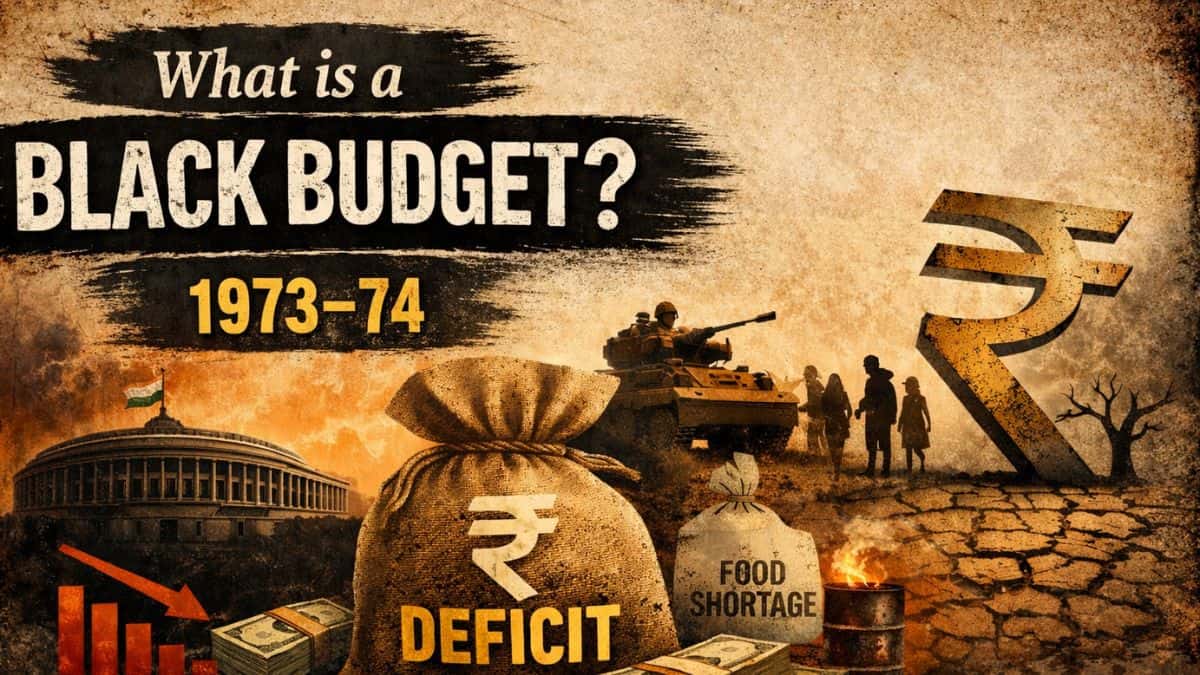
What is a Black Budget and how India faced one in 1973–74
Published on 07/01/2026 02:03 PM
India’s Union Budget has often shaped the country’s economic direction. Over the last four decades, some Budgets stood out for bold reforms. Others are remembered for the stress they revealed.
The 1991 Union Budget marked a turning point. Then finance minister Manmohan Singh introduced liberalisation, privatisation and globalisation.
The Budget dismantled the Licence Raj. It opened Indian markets to foreign investment. It reduced state control over industries.
This Budget changed how India did business with the world. It laid the foundation for modern economic growth.
In 1997, P Chidambaram presented a taxpayer-friendly Budget. He sharply cut personal and corporate tax rates.
The move boosted compliance. It encouraged investment and consumption. The Budget was widely called a “Dream Budget”. It is still cited as a model for tax reform.
Not all Budgets brought cheer. The 1973–74 Budget is remembered as the “Black Budget”.
It was presented by finance minister Yashwantrao B Chavan under Indira Gandhi’s government. The reason was a fiscal deficit of Rs 550 crore. At the time, this was an unprecedented figure.
A fiscal deficit is the gap between government income and spending. A large deficit signals economic stress. In the early 1970s, India was under severe pressure.
Several crises came together. The 1971 India–Pakistan war had drained government finances. India also had to rehabilitate over 10 million refugees.
Defence spending rose to around Rs 1,600 crore. Then came the 1972 drought, the worst in decades. Agriculture collapsed. Food shortages spread across rural India. Cities faced power cuts and rising unemployment.
While presenting the Budget, Chavan said tough decisions were unavoidable.
The government created a Rs 56 crore fund to nationalise coal mines, insurance firms and the Indian Copper Corporation. The aim was to secure resources and meet power demand.
It also allocated Rs 220 crore for drought relief. Another Rs 160 crore was spent to import 2 million tonnes of foodgrains.
These steps were meant to stabilise the economy in crisis.
Finance Minister Nirmala Sitharaman is expected to present her ninth consecutive Budget on February 1, 2026. This will be the second full Budget of the NDA government’s third term.
Like recent years, Budget 2026 will follow a paperless format. Markets will watch closely for growth, fiscal discipline and reform signals.
Abhay Shukla is a Senior Sub-Editor at Zee Business, specializing in the analysis and reporting of stock markets, corporate news, personal finance, technology, and the auto sect