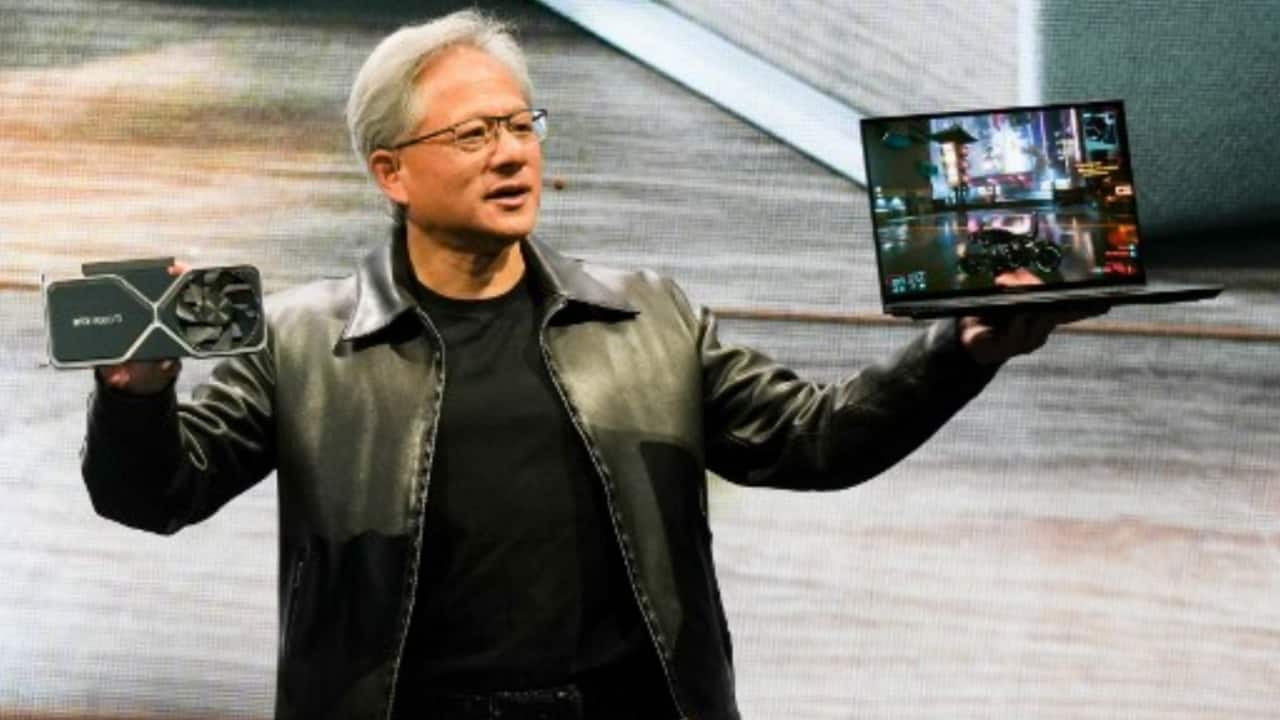
What you need to know about NVIDIA CEO Jensen Huang, biographer Stephen Witt explains
Published on 01/05/2025 06:17 PM
Graphics processing units (GPUs) maker NVIDIA is among the most valuable companies in the world today. How it was formed, and what drives its CEO Jensen Huang are the subjects of a new book, 'The Thinking Machine: Jensen Huang, NVIDIA, and the world's most coveted microchip', by journalist Stephen Witt.
To be sure, much is already known about Jensen Huang and NVIDIA. Huang has given many interviews and speeches, thanks to consistently growing public interest in the company he cofounded in 1993. What 'The Thinking Machine' does, is it compiles a lot of what we know about Huang and NVIDIA, and fills in the gaps in our knowledge and understanding. It also conveys something of what makes Huang—and NVIDIA—tick: How they approach engineering and business problems; why Jensen Huang screams at his employees; why he follows a punishing work ethic himself and drives everyone else hard, too—no, it doesn't quite have to do with his Asian origin; how it took him eight years to complete his master's at Stanford University; how electrical engineering speaks to him, and how NVIDIA is old-school in that it actually works with silicon in Silicon Valley; how NVIDIA worked on parallel computing—an idea that had been around for decades—and made it happen before anyone else; how people outside the company—like Ian Buck, who released the open-source programming language Brook, powered by NVIDIA's GeForce cards—opened up use cases for Nvidia chips that the engineers and managers inside the company hadn't yet thought of; and how neither Huang nor Nvidia engineers had envisaged their role in the AI revolution till a customer in 2012 combined Nvidia's parallel-computing power with a neural net problem. It also sets the context for more recent developments inside Nvidia: for example, Huang's worries about Huawei and why NVIDIA is keen to shift a lot of the actual chip manufacturing from Taiwan to the US.
Cover of 'The Thinking Machine'.
Of course, Huang's eventful life makes for interesting copy. "He's an entertainer," Witt says over a video call from his California office. Huang co-founded NVIDIA—just past his 30th birthday; his self-declared deadline for starting his own venture—with Chris Malachowsky and Curtis Priem in 1993. But even before that, he'd moved to the US as a nine-year-old with just his older brother, excelled at school, made it a habit to do pushups daily, played table tennis competitively, studied electrical engineering in college, had an accident in his two-door Toyota Supra and nearly died, married his college sweetheart Lori Mills in his early 20s, worked at LSI Logic and Advanced Micro Devices (AMD) where he was on the management track before he took the entrepreneurial leap banking on a chip that his co-founders believed in and which their then-employer Sun Microsystems wouldn't put in production.
The semiconductor chips space—perhaps less glamorized than the software and IT services spaces—too is pockmarked with ups and downs, mergers and consolidations, failures and breakthroughs, companies going out of business and others coming up in their place throughout this period. And in his book, Witt gets into the weeds, unpacking the movements and drama, starting from the 1990s to now. For example, he writes how NVIDIA was founded at a QSR called Denny's where the windows had bullet holes. NVIDIA's face-off with chip maker 3dfx—which it would acquire in later years—and the fight for pole position between GeForce made by NVIDIA and ATI's flagship Radeon graphics processors—ATI was later acquired by AMD, now among NVIDIA's chief competitors—Witt captures in a chapter titled "Deathmatch".
At the turn of the 21st century, much before the ChatGPT 3.5 launch that sped up the AI race, Witt writes that gamers like Johnathan Wendel were using NVIDIA chips to gain an all-important if razor-thin advantage over others, and in the process, really helping NVIDIA to move product. Such consumer experiments and uses spilled over from the gaming world to other disciplines, from financial analysis to scientific calculations. Users figured out ways to deploy the processing power of the graphic cards for different purposes. In one place, Witt writes: "The gaming cards were more than just gaming cards now; they were jerry-rigged scientific tools."
Witt suggests that these developments, serendipitous as they may seem, were made possible because of Huang's approach to business. In a video interview to Moneycontrol, Witt says that Huang is an engineer first and businessman later. And this means that's he always concerned himself more with what technology they can build and what else they can do, rather than focusing on whether there's a buyer or market for the product right away. Also, he says, Huang has managed to attract people who have a similar work ethic to his—not just now, when East and South Asians comprise a large part of the workforce, but also in the first decade or so when the employees were largely Americans.
Of course, chatter around NVIDIA—as well as the company's valuation—has grown manyfold since the launch of ChatGPT 3.5 in November 2022. NVIDIA briefly overtook Apple to become the world's most valuable company in June 2024, with a market cap in excess of USD 3.3 trillion. (Soon after, in October 2024, Huang visited India for the AI Summit and talked about Indian engineers and leaders at his company as well as India's potential in the growing artificial-intelligence ecosystem.) Today, Nvidia's market cap is around USD 2.6 trillion. Yet, there's no discounting the part it is currently playing in birthing and enabling AI ecosystems around the world. Witt explains that if NVIDIA was already making chips to power Nobel Prize-winning research as well as Nintendo Switch consoles in the 2000s, in the 2020s, its chips are at the core of AI evolution almost anywhere in the world— except China, where direct sale of NVIDIA chips has been banned by the US government. Edited excerpts from the interview:
Let's start with a basic question: What do you think is the point of the biography?
Oh, good question. What's the point of any biography... Jensen's just such a fascinating person, and he really had just a tremendous impact on technology and society. One of his chief scientists, Bill Dally, he used to be the chairman of the Stanford University computer science department, said that without Jensen, none of this technology would be here. Without Jensen, we'd be 10 years behind. And I think it's true. The more I think about it, I'm not sure anyone (else) out there was building these complex parallel-computing structures with no customers (in sight). No one else was going to do that. That was only Jensen's thing.
Jensen Huang is of course well-known. He's been interviewed so many times and he's talked about himself and about NVIDIA's mission and journey around the world -- he was at the 2024 AI Summit in India. You also did a long profile of him in an international magazine last year. Now, given that so much is already known about Huang and the company he started, did this book present additional challenges?
I like to do a lot of research before I talk to anybody. But in Jensen's case, I did three or four times as much research as I normally do. And I built this giant, kind of, paper dossier, like a timeline of Jensen's life. I also put everything I could find about him, like when he was born, where he went to school, when he got married, if he had any religious beliefs and political beliefs, all of that stuff, and I kind of rolled it into a big document. Then I watched every interview I could find of Jensen on YouTube. And I noticed the journalists often kind of asked him the same questions. There were whole parts of his biography that hadn't been filled in. Like way back in 2009, he had brought up a time he'd almost died in a car accident. But then the journalist didn't follow up on that, and he never brought it up again. So that was actually my first question to him: tell me about this time you almost died in a car accident. It turned out he almost died in a car accident on the same day that he proposed to his wife. I thought that was pretty interesting. So there was still plenty to learn about Jenson. As you say, Jensen's very open and candid, and that's great.
The other thing about Jensen, it's a little tricky, is he's an entertainer and he's kind of always worried that the audience will get bored. And so this causes him sometimes to embellish his anecdotes a little bit, maybe. He has a lot of stories, but the details of those stories change a bit over time.
In the book, you explain how NVIDIA was putting chips into the Nintendo Switch at the same time as it was designing chips for Nobel laureates and scientists to do their experiments. Could you give an overview of the work they are doing, even before the ChatGPT filled up the orderbooks for products like the A100 GPU used in training large language models?
Even before artificial intelligence (AI) showed up, Jensen had a small but dedicated band of scientists who worked on his platform. So basically what was happening at the highest demand computing, was Moore's Law couldn't meet it. Historically, the way that we speed up computers was simply to pack more and more components onto a single microchip, shrinking the components and packing more and more onto the chip. But that was running into the limits of physics. Like the components were like one atom wide. And as they got smaller and smaller, they got compromised and they leaked electricity. And when that happens, you can't just rely on smaller and smaller components. You have to do something else. And so Jensen and his team saw this coming as early as 2003 or 2004. They were sort of saying, well, what we have to do is take a different approach. And that was called parallel computing.
And with parallel computing, what you do is you split the math problems up and you kind of execute them all at the same time. Now, this idea had existed for a long time, in fact going way back to the '60s and '70s, but nobody used it because it was difficult to program. And so the computer programmers had a choice between using these parallel computing structures or just waiting for the components to get smaller. And they always just waited.
Bill Dally again said something like, I can't remember the exact quote, but it was basically like programmers had a choice: They could rewrite 1 million lines of code, or wait two years for the processor to just speed up. And so everybody's waited, but then they hit the limits of physics, and they couldn't do it anymore. They're forced to switch. Jenson saw this coming, and he began to attract all kinds of scientists to his platform.
Now, these are scientists who really need a fast computer, much faster than what the average person needs. They're doing quantum physics simulations. They're doing oil prospecting and then later actually two of the Nobel Prize winning groups ended up using this platform. One was doing Ligo, which is the gravity wave observatory. And then a group with this new technique called cryo electron microscopy (cryo-EM) where they freeze the bacteria and then do a 3D scan of them. And both of these just generate huge amounts of raw scientific data. So, how you going to process it, right? You can't put it on a classical computer; it just takes forever. You can use Jensen's high-performance, super-powered parallel-computing platform.
Now, they didn't know AI was coming. In fact, when they made a list of uses for what this (parallel computing) would be good for, AI was not on that list.
They thought for sure scientists are going to want to use this. Actually, fewer scientists used it than they thought. They had a hard time convincing the scientists to switch their code to use this new platform, but they had a much easier time building a completely new field around it. And that's what AI ended up being. And that's where all the money came from.
You mention early on in your book that there was this one time when you asked Jensen Huang a question and he physically ran away from you—presumably to avoid answering it. What was the question?
We were at a seaside resort where he was giving a lecture, and I asked him a question about his wife -- I think it was. I was like, I guess your wife has been like a big supporter. And he was like, yeah, you know, she has (supported me a lot). And I was like what did she think about these long hours that you work? And he just kind of looked at me, and then he was like, I have to go get on a plane... I thought that was genuinely him trying to avoid the question but in kind of a comic way.
You've written about his work ethic quite a bit in the book, too. In one section you mention that the day after the NVIDIA IPO, he sent out an e-mail to his team asking for an update on the next thing that they're working on. Is this generally attributed to him being Asian? You write that despite this pressure, people tend to stay at NVIDIA and with Huang for years. How do people within the company see this? Is that something that gave you any sort of pause?
It's interesting because that's a complex question, so let me start at the beginning. Jensen works extraordinarily hard. And as far as I can tell, he always has, his entire life. But neither of his brothers works that hard. So it doesn't seem like there was this cultural expectation, at least inside of his family, to work like crazy. In fact, he told me both of his brothers were terrible students, but Jensen had this inside of himself and at NVIDIA it does seem like everyone worked just as hard as Jensen, even though in the early days almost everyone else who worked there was a white American.
I think he just attracts (that kind of work force). I think the cultural expectations of what NVIDIA is and was and the kind of person that Jensen is and the kind of person that his cofounders Chris and Curtis were, just created this culture around him.
How much of it comes from Asia? It's a really tough question to answer. Technically, you would think, well, all of it. Jensen's just a classic hard-working 996 (9 to 9, six days a week) culture Chinese guy. But he's not actually. He moved away from Taiwan when he was nine years old, mostly grew up in the United States and doesn't seem to have that much exposure to 996 culture. It's almost like he independently recreated it inside of NVIDIA.
Of course, then he connected with Morris Chang and those guys, they were totally 996. They were 100 percent Asian cultural values, 100 per cent work hard and do what's best for the company and don't complain. But it was interesting because John Nichols, who was one of the guys who tried to create the Cuda platform inside NVIDIA was also a total 996 guy and he was a white American. So I don't know if it's something in the hardware business. I don't know if it's just something that that can NVIDIA can create. And now what's really complex is like, OK, so for most of its history, for especially the early part, NVIDIA is mostly white guys. You look at a company photo or video from that time (the first decade and a half), everybody looks like me. You go in there now and, like, nobody looks like me. Everyone's from East Asia, everyone's from South Asia. I would say 1/3rd of the company is East Asian and another third is South Asian. And a lot of them are obviously also there on H1Bs or various kinds of visas. And so their incentive to work incredibly hard is just huge. Plus there're these cultural family expectations that you would work this hard. I talk about that a little bit in the book, the shift into that kind of culture.
I think for Jensen at least that was great. He could absorb that completely.
If Jensen was just some white guy from Ohio, could he have done all this? Maybe, maybe not. It's a tough question.
It was relatively rare (to have a Taiwanese American CEO when Jensen started out in that role at Nvidia in the 1990s), and he was working in hardware. So maybe that has something to do with it. I definitely think that Jensen's cultural expectations of what makes him go, he's almost totally motivated by negative emotions. He's motivated by guilt. He says this. He's motivated by fear; fear that NVIDIA will fail, bringing shame to his family. White Americans, we don't really think that way. So that I think is a very Asian cultural quality.
You write in the book that he's an engineer first and a businessperson later. And that the night before he was supposed to give his first big presentation to Sequoia, he didn't actually have a business plan. The investment eventually came through, but that was despite the presentation, not because of it. What's your sense of how Jensen Huang is looking at the business now?
He has been around long enough to understand that business plans might as well be toilet paper. You have to constantly throw everything out the window. So what Jensen is going to do is build fantastic tools and hope that customers show up for them. But he's not going to do a market analysis, determine the total size of the market and then try to determine product-market fit... In fact, he doesn't do this on purpose because everyone else is thinking that way and it won't get him to where he needs to go. If they had done that with a product like CUDA, the parallel computing platform, it never would have gotten off the ground.
Really, they were doing the opposite. They were saying: 'Here's what's possible, here's what we could build, and let's build it. Let's build that platform and see if anybody shows up to it. We think it's important. And we're willing to lose money on it for a long time because we think someday customers will arrive. But if you ask me (Huang) who and when and how much, I don't care.'
That's pretty counterintuitive, but it does seem to be the way that Jensen works now. He's doing this today; in robotics with his platform Omniverse; and he's doing it with a lot of healthcare applications as well.
For the healthcare applications, the market and the customers are more straightforward.
And obviously robotics is going to be huge too. But the way Jensen wants to do it is very unusual. He's not building physical robots very much. He's instead building this kind of digital gymnasium called Omniverse that robots can learn inside of. So if we want to teach a robot to wash the dishes, that's one of the big use cases, a dishwashing robot, we have two choices. We could do it in the real world and the robot would slowly learn to wash dishes through reinforcement learning, and it would probably break about 10 million dishes along its way, which would be very expensive and a huge mess. Or we can simulate the dishwashing environment: We simulate the sink and code and some kind of high-fidelity physics simulator and teach the robot in there. And then once it's done, we download its brain into a real world body. Jensen's taking the second approach, and I think this is the platform he's building. Whether anyone's going to use it is kind of an open question.
I love that you queued in the toilet paper because there's a story in the book about how they almost call themselves Nvision and then found out that that name was already taken by a toilet-paper maker.
Their (NVIDIA's) original business plan was garbage, it turned out. I mean the first product they shipped was crap and so they had to really kind of invent the company on the fly. Jensen is very good at improvisation, and so I think rather than having some rigid plan he's trying to stick to, he's going to launch a lot of boats and see what's taking off.
In India, and perhaps in Silicon Valley too, there is this romanticized idea of startups: around their origins and within that, what they end up naming the business; what problem they set out to solve in the world, what they can achieve, how much funding, etc. Whereas the NVIDIA founders, you write, were sitting down with spreadsheets and dictionaries to come up with names...
Remember they were starting up in the early '90s, so it's kind of a different era. But the other thing is they were all really a hardware designing startup—they weren't manufacturing, but they were designing and commissioning hardware, which functions in a totally different way. I think in some sense they were, in many ways, not just the classic Silicon Valley (startup). There was like a throwback; they were doing silicon literally in Silicon Valley. So, that's kind of old school.
There core, the three cofounders, were probably a little more square than like, say, Steve Jobs. They were probably a little more business-oriented, a little more engineering-oriented. They were hard(core) engineers. They were really builders, computer scientists. And I think, at least initially, they didn't really understand what they were getting into. That's often the case with Silicon Valley founders. The ethos, the work that hardware requires; remember, you have to produce and ship hundreds of thousands of physical products every cycle. It's very demanding. (With) software, we can do whatever, we update it later, and not worry about it. The hardware doesn't have that. It's got to physically work. So that's a much more demanding discipline. You need a lot more operations people. You need a lot more engineers. In this way, I think it looks a little different than, say, your classic Silicon Valley star now.
During the COVID pandemic, we heard about this anxiety around semiconductor availability. Were you in touch with Jensen Huang then? What can you tell us about what he was thinking and doing at the time?
I did not really get in touch with Jensen until 2023, after COVID was kind of dying down. But supply-chain disruptions of that type are on the horizon once again, both with (US) tariffs and the potential invasion of Taiwan.
What's interesting is Jensen—at least when I spoke with them a year ago—they had not done a lot of contingency planning. They were just willing to kind of like let this happen. I was very shocked, honestly, and surprised by that. But I think probably now they're thinking differently. Jensen announced this $500 billion investment in the United States. How that actually manifested, what is it they're actually going to invest in? If Jensen was just saying that to keep Trump happy, I'm not totally sure. But it does seem like they're now thinking about re-shoring at least some production (to the US), just because of the geopolitical risk of having everything go through Taiwan.
I asked their head of operations what happens if Taiwan is invaded, what happens if TSMC goes away? She was like, I don't even have any answer for you... she was like, what I think would happen is we end up going to Samsung. We end up going to other providers and then everybody's technology for a few years would get dumbed down a few clicks.
You know, semiconductors are like oil. If the supply is constrained, it will have ripple effects on the global economy in a really serious way.
They're building a facility in Phoenix?
Yes, TSMC is building that. Yes, that thing is massive. I think they're prototyping stuff there. I think it's up and running. I want to go out and see it. The Phoenix facility, I don't think they can produce the very leading-edge chips yet, the latest production node, but they can backfill a lot of other supply. And I think probably ultimately TSMC will be able to do that. They announced that they're doubling the size of the investment relatively recently. It's already was going to be huge and now it's going to be enormous.
But remember NVIDIA, it's not just TSMC, there's 40 suppliers that they require to make this stuff go. They'll have to not just get TSMC here (to the US), but like half of Taiwan would have to relocate to Phoenix. Maybe that will happen. Maybe they're going to abandon Taiwan and relocate to the desert. It's not a very nice place, but maybe they could do it. Taiwan's much prettier, having been to both places (I can say that).
In 2024, when Jensen Huang was in India, he spoke about NVIDIA's Indian engineers. From the interviews you did with Huang, what's your sense of where India features into NVIDIA's plans?
I'm sure they're in there somewhere. I know Jensen was in Bangalore last year. I just saw that Apple is relocating a lot of production or plans to relocate a lot of the production to India. I'm sure Jensen is paying attention to all of that. And, in some ways, India is a much safer place to build. Good relationship with the United States, we're allies, you're not immediately at threat of being annexed by China in the way that Taiwan is. The technical talent is obviously there as well as a huge global workforce. Silicon Valley now is like 50 percent people from India, including some of the CEOs. And that was certainly not true like a generation or two ago. That has really shifted.
Even inside NVIDIA, it's amazing how many Indians and Indian Americans work there, which was not true at all in the founding days. I don't think there was a single South Asian person working there for the first 10-15 years. And now several of Jensen's chief lieutenants, including Sameer Halepete (vice-president of VLSI engineering) and Jay Puri (executive vice-president of worldwide field operation) are from India. His chief designer, Arjun Prabhu (vice president of CPU ASIC engineering), is one of his chief architects also from there. So it's obvious that India is producing a very high level of technical talent and could probably, you know, run a platform similar to TSMC if such things are in the works.
The question is, has the geopolitical situation gotten so bad that Jensen just has to build in America now? The problem is American costs are way higher than Asia. Maybe robotics will close that gap. Maybe telecommuting will close that gap, but it doesn't seem like it's going to happen overnight.
Speaking of China, is there any anxiety within NVIDIA around DeepSeek -- the stock price of NVIDIA crashed the day after the Chinese AI app launched; around the restrictions that the US government has placed on the sale of NVIDIA's best performing chips to Chinese companies; around the microchip and GPU makers who could come up there while you can't sell in China, which accounted for USD 17 billion in sales for NVIDIA in 2024?
Regarding DeepSeek, there's no anxiety at all. DeepSeek was a good development. He (Jensen) thought the market completely misread it.
There's two or three complicated facets here. So this is going to be a long answer, but I'll start with the beginning.
So DeepSeek, if we take the results at face value, showed that we can train AI much more efficiently on certain kinds of chips. That's actually good in some ways for NVIDIA. The thing to understand is that NVIDIA, their early product was 3D graphics, and what they figured out or intuited quite early was that demand for 3D graphics was infinite. No matter how good you made the video game look, no matter how much processing power you gave it to render graphics, there was a certain kind of customer who was always going to demand better graphics. No matter how much computing power you gave them, they wanted more. And I think that NVIDIA had always looked for another application that had that demand profile. The answer to that was AI: No matter how much, how smart we make the computer, you should just come to it with increasingly complex and sophisticated demands. And that has not been anywhere close to being satiated now. So if we can train AI more easily, this actually just generates more demand for the inference side from people asking the AI increasingly difficult questions. And NVIDIA processes all those questions, so it's actually good for them. So Jensen perceived this to be good for them.
Now the second question is, can we actually believe that DeepSeek really did this (develop its R1 LLM for under-USD 6 million, a fraction of the cost of making ChatGPT, with indigenous design and chips only)? Because over the past year or two, Jensen and NVIDIA have sold a lot of chips to places like Malaysia and Singapore. And there are questions about whether Malaysia is actually the end market for these chips and they're not making their way into China and whether or not making their way to DeepSeek. Specifically Singapore, not that long ago, busted a ring of smugglers who were flipping Jensen's chips; buying them in Singapore and then illegally reselling them into the mainland in violation of like the United States export ban.
So perhaps DeepSeek actually didn't train on such a limited platform. Perhaps their breakthrough was not all it seemed to be. I don't want to accuse DeepSeek of doing anything wrong, but it seems like they want to buy advanced chips for some reason or another. And there's evidence that that stuff is making its way into the country.
The third thing is if Jensen can't sell into China, if his chips don't get into China, that creates the opportunity for domestic competitor, particularly Huawei, the big Chinese chip manufacturer who has been accused in the past of all manner of skullduggery, stealing other people's designs, cloning technology and whatnot. Huawei chips are actually banned in the United States because some people feel that they might spy on us. So Huawei is a big concern for Jensen. He really does not want them to build a competing platform to CUDA, probably because he knows they'll do it for cheaper and just as well. So he's trying to make sure NVIDIA's the player in China so that Huawei doesn't have any room to compete and build its own platform. Because if NVIDIA is banned in China, suddenly that creates a huge opportunity for Huawei to come and replace them with their own AI platform.
So DeepSeek itself is probably not a huge risk to Jensen; it's really this risk that he can't sell. And this was what he was going to Mar-a Lago and giving Trump money for, the ability to try and get around this export ban and sell his chips to China. Trump lifted the export ban and then a few days later, he reversed it and set it back in. So that was bad for NVIDIA. They had to take a charge.
You also mentioned all the research that you did for this book. Tell us one story that you were not able to include in the book, but which you loved?
Almost everything I had about Jensen I included. But something I learned at the end: This is actually in the Taiwanese edition, but it didn't make it into the UK edition. So, Jensen was called upon to throw a baseball at a baseball game, like ceremonial first pitch, totally meaningless. But when he got out there, he's visibly embarrassed. He's like, listen, I'm not very good at pitching. He asked the crowd to please turn away. 'Please don't watch me while I pitch because this is going to be embarrassing.' So he throws the ball and it kind of comes up short and the player has to kind of scoot up to catch it. And he grimaces with embarrassment afterwards. This was meaningless, whether or not he could throw this baseball. But he becomes obsessed with it. This is an irresistible opportunity for self-improvement. So for the next few months, after having $100 billion and running the most valuable company in the world, he comes home with his wife and they go to the backyard and they play catch. They throw a baseball around in their backyard every evening. He gets better at it slowly. And the next time he's asked to do a ceremonial first pitch, it's at a Taiwanese baseball game, and he goes out there and he nails it. Perfect strike. So this is really who Jensen is. It's perfection and everything. It's embarrassment when you don't absolutely perform to the best standards. He was really embarrassed he couldn't throw a baseball. And he was just could not resist this opportunity to get better at it.
Discover the latest Business News, Budget 2025 News, Sensex, and Nifty updates. Obtain Personal Finance insights, tax queries, and expert opinions on Moneycontrol or download the Moneycontrol App to stay updated!
${res.must_watch_article[0].headline}
Stock Market Holiday MI vs RR Live Score Jammu Kashmir News Live GST Collections in April Heatwave in India Q4 Results 2025 Live Hit 3 Review JKBOSE 10th Result 2025 Kolkata News IPL Points Table 2025
Business Markets Stocks India News City News Economy Mutual Funds Personal Finance IPO News Startups
Home Currencies Commodities Pre-Market IPO Global Market Bonds
Home Loans up to 50 Lakhs Credit Cards Lifetime Free Finance TrackerNew Fixed Deposits Fixed Deposit Comparison Fixed Income
Home MC 30 Top Ranked Funds ETFs Mutual Fund Screener
Income Tax Calculator EMI Calculator Retirement Planning Gratuity Calculator
Stock Markets
News18 Firstpost CNBC TV18 News18 Hindi Cricketnext Overdrive Topper Learning
About Us Contact Us Advisory Alert Advertise with Us SupportDisclaimer Privacy Policy Cookie Policy Terms & Conditions Financial Terms (Glossary) Sitemap Investors
You are already a Moneycontrol Pro user.