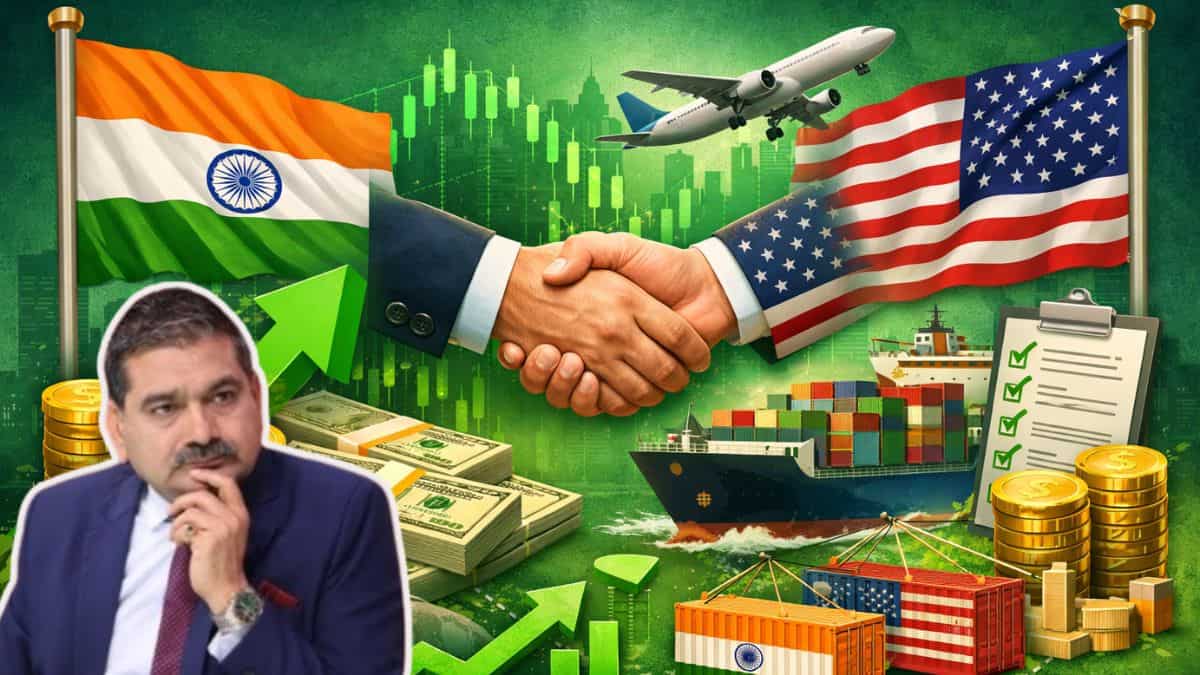
Which sectors and stocks will benefit most from India–US trade deal? Anil Singhvi’s analysis
Published on 03/02/2026 10:49 AM
Indian markets are assessing the impact of the India-US trade deal after the United States reduced tariffs on Indian goods from 50 per cent to 18 per cent, ending nearly a year of uncertainty around bilateral trade, market expert Anil Singhvi said.
Singhvi said the tariff cut followed announcements by Prime Minister Narendra Modi and US President Donald Trump after a phone conversation between the two leaders. The US also removed the additional 25 per cent tariff on imports from India linked to India’s purchase of Russian oil, bringing the total effective tariff down to 18 per cent.
“First and most important, the long period of uncertainty around the trade deal has ended,” Singhvi said.
He said India now faces the lowest tariff among major emerging markets. Countries such as Malaysia, Thailand, Indonesia and the Philippines are facing tariffs of around 19 per cent, while Bangladesh and Vietnam are at 20 per cent. China continues to face tariffs of about 34 per cent.
Singhvi said the deal removes the risk of frequent policy threats and statements from the US administration that had been creating pressure on markets and exporters.
He said the agreement could also help stabilise the rupee at a time when global currency markets remain volatile. “The falling rupee gets some support on the global front,” he said.
On the geopolitical front, Singhvi said the deal reduces the risk of India being sidelined globally and improves India’s position after concluding trade agreements with both the European Union and the United States. He said multiple free trade agreements were concluded more quickly amid global trade pressures.
Singhvi said the deal is expected to support India’s manufacturing and export competitiveness, especially in labour-intensive sectors.
Singhvi said the textiles sector stands to gain the most from the tariff reduction. India now enjoys the lowest tariff among textile-exporting nations supplying to the US.
He said nearly 28 per cent of India’s textile exports go to the US, making it the largest export market for the sector. “Even a 2 per cent tariff advantage matters,” Singhvi said, referring to the gap between India and competing countries such as Bangladesh and Vietnam.
He said stocks such as Gokaldas Exports, SP Apparels, Indo Count Industries, and Welspun Living could benefit as US demand shifts towards Indian suppliers.
Singhvi said electronics manufacturing and consumer durables are also expected to gain. He pointed to rising exports of mobile phones and electronics assembled in India, with exports to the US estimated at $15 billion.
He said the tariff clarity supports companies involved in electronics manufacturing and assembly. He also said jewellery exports could benefit, adding that the sector is labour-intensive and export-oriented.
Singhvi said agro products and seafood exporters are likely to benefit, noting that around 35 per cent of India’s seafood exports go to the US.
He said the US imports a large share of its seafood from India. Companies such as Apex Frozen Foods, Avanti Feeds, KRBL and LT Foods could see benefits due to stable trade conditions.
Singhvi said renewable energy and solar equipment companies had earlier faced pressure due to tariff uncertainty. He said the deal improves sentiment for companies in this space.
He said some companies have built capacity in the US, while others could benefit from improved trade visibility. Stocks such as Waaree Energies, Tata Power and Borosil Renewables were mentioned as potential beneficiaries from a sentiment and business perspective.
Singhvi said companies involved in mechanical engineering, nuclear reactors, boilers and heavy equipment could benefit from better access to the US market.
He said firms such as BHEL, Larsen & Toubro, Thermax and ABB could see improved opportunities as exports become more competitive.
Singhvi said the pharmaceutical sector avoided a major risk as tariffs were neither imposed earlier nor included in the current deal.
“The risk that was hanging over pharma companies has now gone,” he said, adding that higher tariffs on medicines would have made healthcare unaffordable in the US.
Singhvi said auto ancillary companies could benefit even though passenger vehicle exports to the US remain limited. He said component makers supplying global manufacturers may gain from improved export prospects.
He also said furniture and wood product exporters could see steady demand from the US market.
Singhvi said the effective tariff could fall further to around 12–13 per cent after accounting for currency and other trade benefits, improving India’s competitiveness.
He said higher exports, increased foreign direct investment and improved dollar inflows could support India’s balance of payments position, which is already comfortable with reserves of around $700 billion.
Indian equity markets surged sharply in early trade on February 3 after India-US trade deal was announced. The BSE Sensex jumped 2,400.20 points to 84,066.66, while the NSE Nifty 50 climbed 725.20 points to 25,813.60.
Buying was broad-based, led by banks, financials, auto, realty, pharma and metals. Adani Ports, Indigo, Bajaj Finance, Sun Pharma, Bajaj Finserv and Reliance Industries were among the top gainers on the Nifty. Banking heavyweights including ICICI Bank, Axis Bank, HDFC Bank, Kotak Bank and SBI also traded higher.
Sectorally, Nifty Realty rose over 5 per cent, while Nifty Financial Services, Pharma, Consumer Durables, Chemicals and Healthcare gained between 3 and 4 per cent.
Nifty Bank advanced over 2.6 per cent, while IT, Metal and Auto indices also posted solid gains, reflecting positive market sentiment and strong participation across sectors.