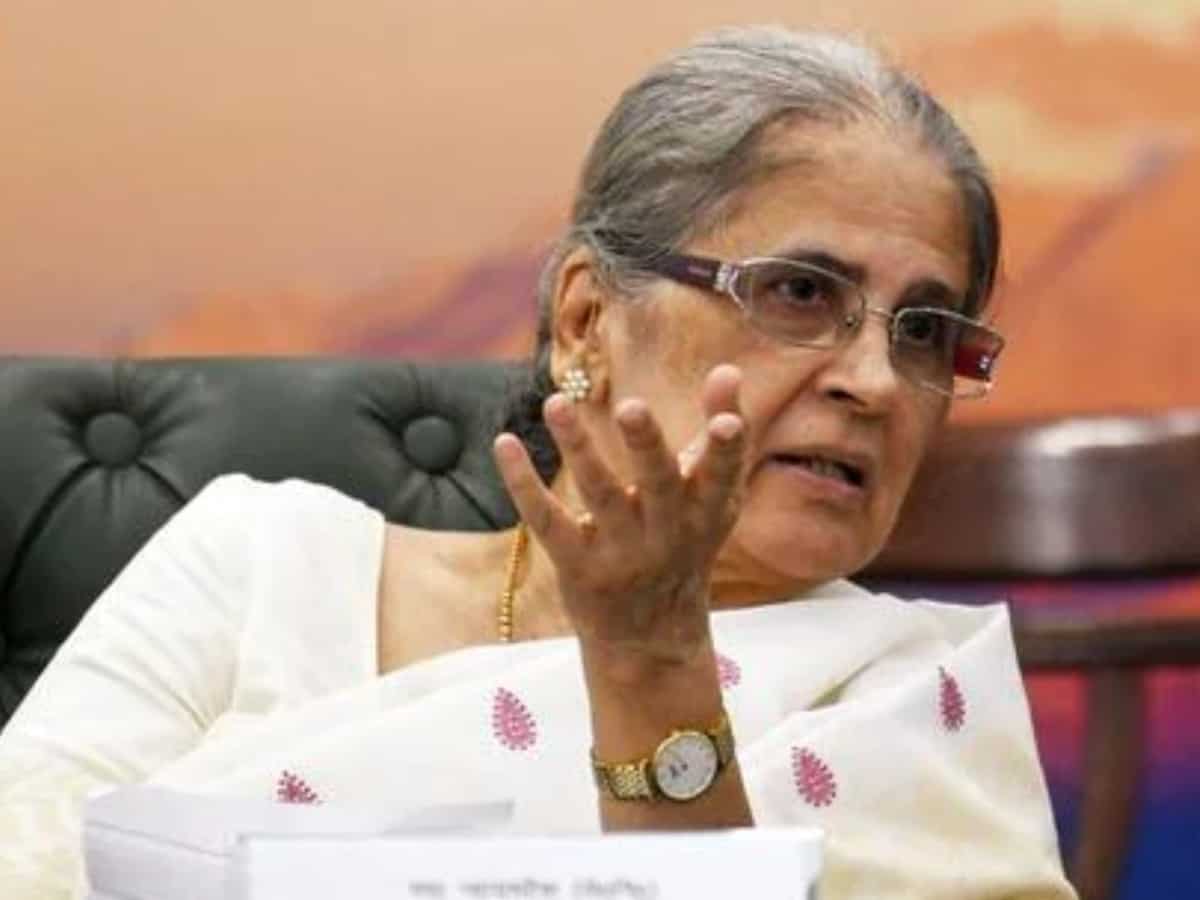
Who is Justice Ranjana Prakash Desai, the new head of India’s 8th Central Pay Commission?
Published on 29/10/2025 04:03 PM
Former Supreme Court judge Justice Ranjana Prakash Desai has been chosen to head the Eighth Central Pay Commission—the body that will recommend revisions to the salaries and service conditions of central government employees.
The appointment follows the Union Cabinet’s approval of the commission’s terms of reference on October 28, in a meeting chaired by Prime Minister Narendra Modi. The commission will function as a temporary body with a Chairperson, one Part-Time Member, and one Member-Secretary, and has been given 18 months to submit its recommendations.
It can also issue interim reports if needed. The panel’s key responsibility will be to strike a balance between improving employee welfare and maintaining fiscal discipline, while also studying pension systems and pay trends across both public and private sectors.
Also Read: 8th Pay Commission Update: Centre approves terms of reference; to submit recommendations in 18 months
Desai brings a legal and judicial experience of quite a scale to one of the most significant reform projects of the government. The main area she was involved in immediately after her retirement from the Supreme Court in 2014 was in Gujarat leading a panel that worked on preparing a draft for the Uniform Civil Code (UCC).
The 30th of October 1949 was the date, and Mumbai was the city for her birth. Arts degree at Elphinstone College was her first degree in 1970, followed by law degree from the Government Law College, Bombay, in 1973. She was still a student when she started her legal career under Justice Pratap and her father SG Samant, who was a famous criminal lawyer.
In a constant and remarkable way, she went up the legal ladder—from the appointment of Government Pleader in 1979, through the position of Special Public Prosecutor for preventive detention matters in 1986, and later, in 1995, the Government Pleader (Appellate Side) of the Bombay High Court. A year later, she was promoted to judge of the Bombay High Court.
Also Read: Will the 8th Pay Commission be implemented by early 2028?
Justice Desai was inextricably linked to the Bombay High Court for more than 15 years, and then in September 2011, she was appointed to the Supreme Court of India. While serving, she gave quite a few important decisions, the influence of which was felt in the legal and democratic framework of the country for a long time.
She was the member of the bench that maintained the death penalty of terrorist Ajmal Kasab, who was involved in the 26/11 attack, by calling it a case of the "rarest of rare" type. Moreover, she was instrumental in getting the NOTA (None of the Above) option being introduced in Electronic Voting Machines (EVMs), which allowed Indian electors to veto all the candidates on the ballot thus marking a tipping point in the electoral process's transparency.
One more of her important judgments led to a huge reduction in the government’s discretionary Haj quota cut down from over 5,000 down to 300 seats.