Why are ONGC, Oil India, GAIL and other oil stocks falling despite Venezuela opening long-term upside?
Published on 05/01/2026 02:02 PM
Oil and gas stocks are trading lower on Monday, with the Nifty Oil & Gas index down 0.54 per cent at 12,273.90 during intraday trade, even as analysts flag potential long-term benefits for select Indian companies from developments in Venezuela. Most heavyweight stocks in the sector are under pressure, dragging the index into negative territory.
ONGC is trading 1.18 per cent lower at Rs 238.62, while Oil India is down 2.11 per cent at Rs 419.80. GAIL is lower by 1.02 per cent, MGL has slipped 1.15 per cent, IGL is down 1.61 per cent, and Adani Total Gas is trading 1.55 per cent lower. IOC is down 0.66 per cent, BPCL has declined 0.35 per cent, and Petronet LNG is trading 0.77 per cent lower. Reliance Industries is also trading in the red, down 0.28 per cent at Rs 1,587.90.
Some stocks are trading higher despite the broader weakness. Aegis Logistics is up 1.66 per cent, Gujarat Gas has gained 1.02 per cent, GSPL is trading 0.48 per cent higher, Hindustan Petroleum is up 0.40 per cent, and Castrol India has risen 0.26 per cent.
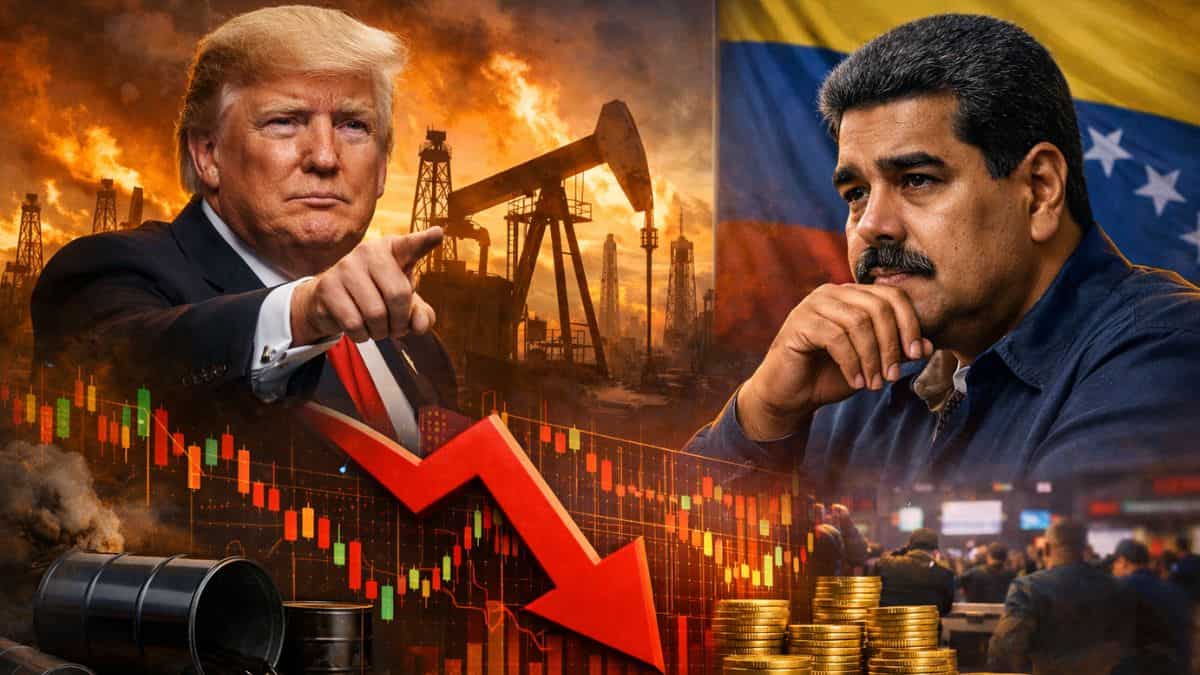
Venezuela has the world’s largest crude oil reserves, at about 303 billion barrels, accounting for nearly 20 per cent of global oil reserves. Oil is the backbone of Venezuela’s economy, which makes its reserves strategically important. Venezuela holds more crude oil reserves than Saudi Arabia, Iran and Iraq, drawing strong interest from the US.
Despite these large reserves, Venezuela’s oil production is very low at around one million barrels per day, or about 0.8 per cent of global output.
Production has fallen sharply from around 3.5 million barrels per day before 2013 due to weak and outdated infrastructure. Most pipelines and refineries are over 50 years old, and restoring production to earlier levels would require investments of about $58 billion.
Venezuela mainly produces heavy crude, which is used to make diesel, industrial fuel and asphalt. Many US refineries are specifically designed to process heavy crude, making Venezuelan oil suitable and relatively cheaper for the US market.
The state-owned company PDVSA lacks capital and technology to revive output on its own. US oil companies are willing to invest billions of dollars to raise production, but experts say it will take five to ten years to see a meaningful impact, as restoring oil output will be complex and time-consuming.
The decline in oil and gas stocks came amid expectations that the Venezuela situation may have a limited near-term impact on global crude prices. Jefferies said Venezuela holds about 18 per cent of the world’s proven oil reserves but currently produces less than 1 per cent of global crude, or under one million barrels per day.
The brokerage said the near-term impact on crude prices is likely to be minimal. However, crude prices could face pressure in the medium term if US oil majors manage to revive Venezuelan production following a possible easing of sanctions. Analysts said additional supply could weigh on crude prices in 2027–28 unless OPEC+ steps in to balance the market.
Jefferies said Reliance Industries could benefit if sanctions are lifted, as it had earlier sourced around 20 per cent of its daily crude requirement from Venezuela’s state-owned oil company PDVSA. Reliance could secure Venezuelan crude at a discount of $5–8 per barrel to Brent, which could support its gross refining margins.
ONGC could also benefit, as it may receive around $500 million in unpaid dividends from the San Cristobal field. ONGC Videsh holds a 40 per cent stake in the field, where output has been curtailed due to US sanctions restricting access to technology and equipment.
Venezuela has failed to pay dividends of $536 million up to 2014, with a similar amount pending for later periods. India was once a major buyer of Venezuelan crude, importing over 4,00,000 barrels per day before sanctions halted purchases in 2020.
Analysts said easing of sanctions could allow Indian refiners such as Reliance, IOC and Oil India to resume purchases of Venezuelan heavy crude, for which Indian refineries are structurally configured.