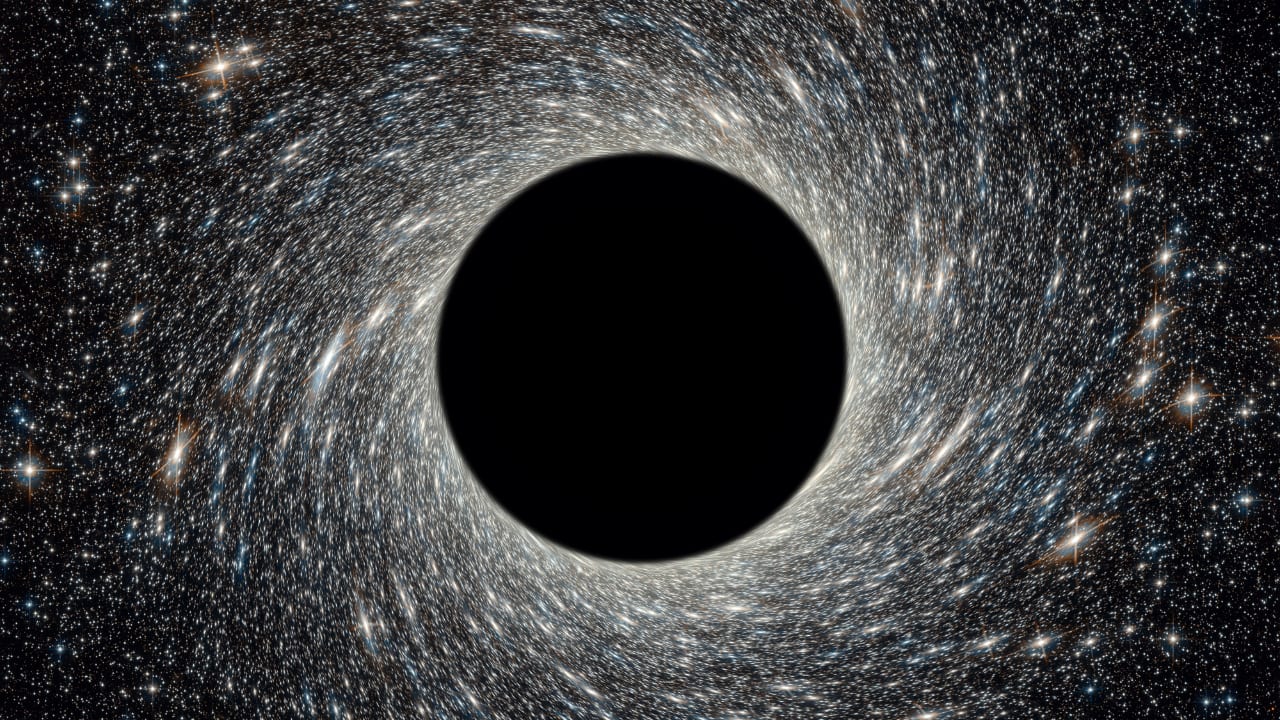
World's first 'black hole bomb' successfully created in a lab by scientists
Published on 02/05/2025 09:46 AM
For decades, physicists dreamed of creating cosmic wonders on Earth. Now, that dream has quietly sparked to life in a lab. Using a spinning aluminium cylinder and clever magnetic fields, scientists have recreated a phenomenon once thought only possible near black holes.
A Black Hole Idea Born in 1969In 1969, Roger Penrose suggested black holes might release energy. He proposed that near a rotating black hole’s outer zone—called the ergosphere—particles could split. One part falls inward with negative energy, reducing the black hole’s mass. The other escapes, boosted with extra energy. Though strange, the idea follows general relativity perfectly.
In 1971, physicist Yakov Zel’dovich took the idea further. He wondered if this effect could be recreated without a black hole. He imagined waves hitting a fast-spinning cylinder and coming back stronger. Energy would be drawn from the cylinder’s motion—no black hole needed.
Zel’dovich also suggested surrounding the cylinder with mirrors. This would bounce the waves back and forth, making them stronger each time. This runaway loop, later called a "black hole bomb," had never been proven—until now.
A Lab Breakthrough Using Aluminium and MagnetismResearchers at the University of Southampton have now achieved this effect. Led by Hendrik Ulbricht and Marion Cromb, the team used a spinning aluminium cylinder. Around it, they placed a three-phase magnetic field and a resonant circuit. This circuit acted like a mirror, feeding waves back into the cylinder.
From mere background noise, the system began producing strong signals. The electromagnetic waves grew louder with each pass. The energy came not from outside, but from the cylinder’s rotation itself.
Ulbricht said, "We’re generating a signal from noise—just like in the black hole bomb idea." The experiment mimicked the original black hole concept, right on a lab bench.
The key lies in what’s called the Zel’dovich effect. If a spinning object moves faster than incoming waves, those waves shift. It’s like the Doppler effect, but for rotation. As a result, waves can flip into negative frequencies—draining energy from the spinning source.
From Sound to Light: Testing Extreme PhysicsIn earlier tests, the team used sound waves on a spinning disc. That worked. But using electromagnetic waves was far harder. This time, they spun the aluminium cylinder fast enough to shift light waves into negative frequency territory. This led to negative absorption—also known as amplification.
Physicist Vitor Cardoso, from the University of Lisbon, praised the result. "You send in a wave and get more back—amazing," he said. The lab model gave the first real evidence that such cosmic energy tricks are possible on Earth.
The team even saw the process become unstable. Noise triggered runaway wave growth. As the cylinder lost rotational energy, the effect faded—exactly what happens near black holes.
A New Tool for Cosmic MysteriesThis success could help in dark matter research. Superradiance—the name for this energy-drawing process—might help find unknown particles. Cardoso explained that spinning black holes could act as natural particle detectors. They might do better than giant machines like CERN when it comes to certain dark matter types.
If these particles exist, they might cluster near black holes. Over time, they would drain energy, slowing black holes down. This loss might show up in gravitational wave signals.
The Southampton team’s findings confirm a long-theorised effect. By mimicking black hole physics in the lab, they have opened a new path to explore the universe’s secrets.
In a paper posted on arXiv, they described how the cylinder acted like a self-powered engine. Once triggered, wave strength grew on its own. When the spin dropped too low, the growth stopped—just as expected.
Now, the team hopes to push further. They want to see if quantum vacuum fluctuations could start wave generation. That will require technical upgrades—but seems within reach.
"From what we’ve shown," the team wrote, "it’s now just a tough technical task."
With just metal, magnets and noise, physicists have taken a big step. They’ve turned ideas born in space into something we can study on Earth.
Discover the latest Business News, Budget 2025 News, Sensex, and Nifty updates. Obtain Personal Finance insights, tax queries, and expert opinions on Moneycontrol or download the Moneycontrol App to stay updated!
${res.must_watch_article[0].headline}
Stock Market Holiday Jammu Kashmir News Live Tim Cook Delhi Rain Heatwave in India Q4 Results 2025 Live WB Madhyamik Result SSLC Result 2025 Kolkata News IPL Points Table 2025
Business Markets Stocks India News City News Economy Mutual Funds Personal Finance IPO News Startups
Home Currencies Commodities Pre-Market IPO Global Market Bonds
Home Loans up to 50 Lakhs Credit Cards Lifetime Free Finance TrackerNew Fixed Deposits Fixed Deposit Comparison Fixed Income
Home MC 30 Top Ranked Funds ETFs Mutual Fund Screener
Income Tax Calculator EMI Calculator Retirement Planning Gratuity Calculator
Stock Markets
News18 Firstpost CNBC TV18 News18 Hindi Cricketnext Overdrive Topper Learning
About Us Contact Us Advisory Alert Advertise with Us SupportDisclaimer Privacy Policy Cookie Policy Terms & Conditions Financial Terms (Glossary) Sitemap Investors
You are already a Moneycontrol Pro user.