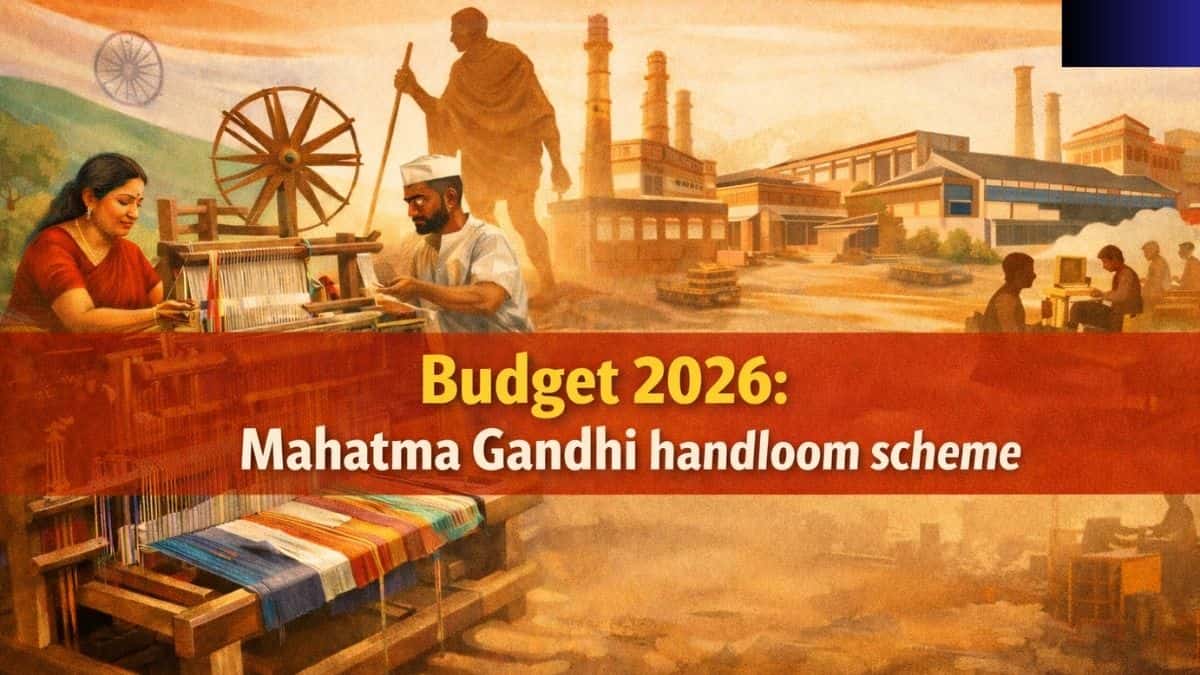
Budget 2026: From Khadi to mega parks—FM Nirmala Sitharaman announces Mahatma Gandhi handloom scheme
Published on 01/02/2026 01:00 PM
Union Budget 2026: The government created an extensive program to boost its labour-intensive textile industry through funding from Finance Minister Nirmala Sitharaman. The program generates employment opportunities while building domestic manufacturing capabilities through advanced technology, which will enhance international market access for Indian textile products.
Sitharaman presented her ninth Union Budget to Parliament while stating that the government intends to achieve three main objectives through its commitment to reform and economic development. She explained that textiles serve as a vital employment sector that particularly benefits rural communities through its opportunities for women weavers and artisans.
The Finance Minister proposed an integrated programme, which includes multiple components that will help improve production and reduce costs while making Indian textiles competitive in international markets. The Budget established a comprehensive plan which included all aspects of the industry, from fibres and factories to skills development and mega park establishment.
One of the most important announcements for the textile sector is the National Fibre Scheme, which forms the first pillar of the government’s plan.
Sitharaman stated that the program aims to accomplish self-sufficient production of all types of fibers including natural and synthetic fibres. The fibre list includes silk, wool, jute, and all artificial and contemporary industrial fibres.
The government plans to achieve its objective of complete fibre independence through their domestic production initiatives, which will decrease its reliance on imports while securing continuous access to essential raw materials needed for textile manufacturing.
The program establishes a path toward developing textiles that meet future performance standards because industrial-grade fibres currently dominate use in technical materials and high-value industrial products. Healthcare facilities, automotive manufacturers, and infrastructure builders require these essential fibres.
The second major component announced in Budget 2026 is the Textile Expansion and Employment Scheme.
This scheme is focused on modernising traditional textile clusters across the country. Many of these clusters still depend on old machinery and outdated methods, which limit productivity and earnings.
Under the new plan, the government will provide:
These steps are expected to improve product quality, reduce waste, and make Indian textiles more competitive in export markets.
Most importantly, modernisation is likely to create more jobs, especially for semi-skilled and skilled workers. The government aims to achieve dual goals of heritage protection and job creation through its implementation of traditional craftsmanship methods together with modern technological solutions.
The National Handloom and Handicraft Programme provides weavers with various benefits that they can access through the program.
The Finance Minister introduced the National Handloom and Handicraft Programme (NHHP) to preserve India’s valuable handloom and handicraft traditions.
This programme will bring together and strengthen existing schemes under one umbrella. The aim is to ensure targeted and direct support for weavers and artisans, who form the backbone of the sector.
The NHHP is designed to:
FM Sitharaman introduced the Mahatma Gandhi Handloom Scheme to strengthen the khadi, handloom, and handicraft industries. She also presented the Mahatma Gandhi Gram Swaraj initiative, which will develop village industries and rural businesses.
These initiatives are expected to benefit:
The government also has plans to provide branding support and linkages to global markets, through which conventional commodities can reach out-of-India buyers.
Skill development remains a key challenge in the textile sector. To address this, the Finance Minister announced Samarth 2.0, an upgraded version of the existing skilling programme.
The textile sector continues to face its main difficulty, which involves developing employee skills. The Finance Minister introduced Samarth 2.0, which serves as an improved version of the current skilling program to solve this problem.
Sitharaman said Samarth 2.0 aims to modernise the textile skilling ecosystem. The focus will be on working closely with industry and academic institutions so that training matches real-world needs.
The programme will ensure that the next generation of textile workers is:
By aligning skills with future demand, Samarth 2.0 is expected to improve productivity and help workers earn better wages.
The textile sector received another essential funding through the Budget 2026 investment into large-scale infrastructure development. The Finance Minister proposed establishing mega textile parks through challenge mode, which allows both production processes and value addition activities to occur at a single location. The system will achieve cost reductions through better logistics operations while delivering increased productivity.
The parks will develop technical textiles that serve healthcare, automotive, and industrial fields. The process has begun to change from its current methods to create products of greater market value.
By moving up the value chain, India aims to strengthen its position in the global textile market.
While focusing more on textiles, Sitharaman used her Budget speech to turn the limelight on the general economic direction of the National Democratic Alliance-led government, headed by the prime minister, Narendra Modi.
She said India’s economic journey since 2014 has been marked by stability, fiscal discipline, and sustained growth. Keeping Aatmanirbharta as a guiding principle, the government has strengthened domestic manufacturing, ensured energy security, and reduced critical import dependence.
Sitharaman noted that these efforts have delivered a growth rate of around 7 per cent and helped reduce poverty while improving people’s lives.
Referring to global challenges, she said trade and multilateralism are under pressure, and supply chains face disruptions. Despite this, India will continue to move confidently towards Viksit Bharat by balancing ambition with inclusion.
With inputs from agencies.