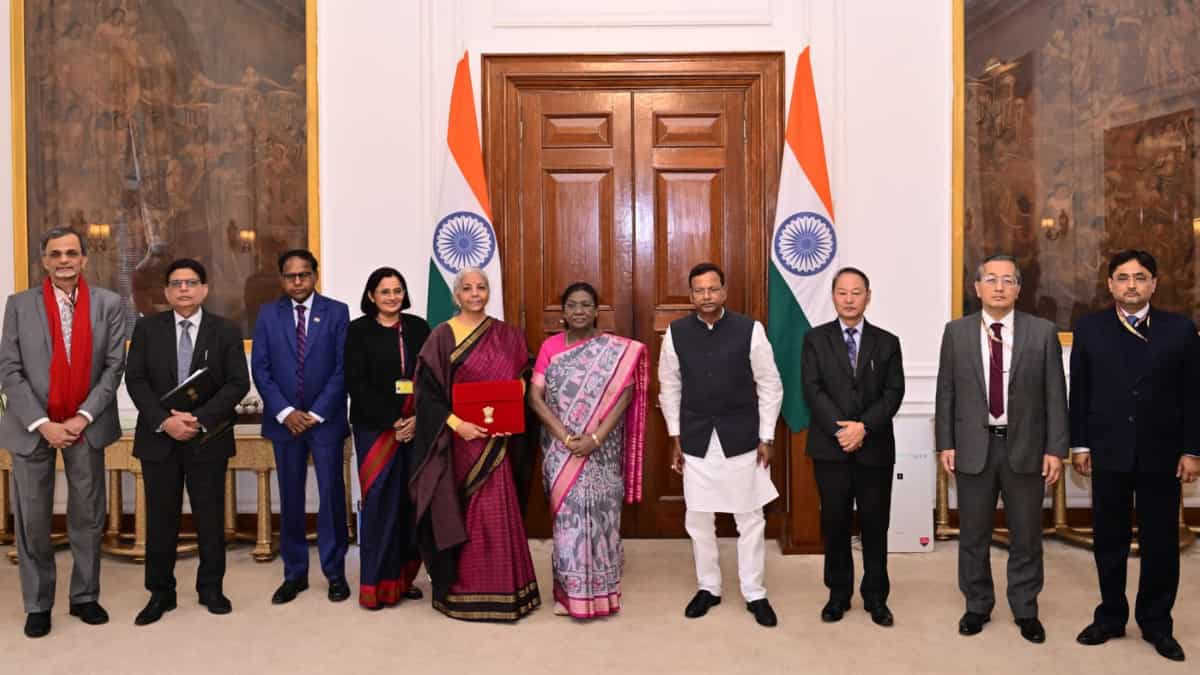
FM Sitharaman's Budget Day 'saree' draws attention once again!
Published on 01/02/2026 11:02 AM
The Union Budget 2026-27 will be presented on February 1 at 11 AM. Union Finance Minister Nirmala Sitharaman, carrying her trademark bahi khata, left Kartavya Bhavan for Rashtrapati Bhavan and has now reached Parliament, where the Budget will be approved during the cabinet meeting.
The Finance Minister's clothing which has developed into a silent symbolic tradition for Budget Day became an object of examination during this year's Budget presentation.
Finance Minister Nirmala Sitharaman wore a handwoven Kancheevaram silk saree from her home state Tamil Nadu before presenting the Union Budget 2026 in Parliament.
The saree had a purple checked body which combined with a coffee-brown border and a mustard-gold pallu that featured violet and gold accents.
Kancheevaram sarees which showcase India's traditional handloom skills create exquisite products that use their premium silk materials and expert craftsmanship.
The colour palette used in this design combines traditional elements with confident modernity to match the important nature of the event.
Here's a look at the previous Budget Day sarees: From Parliament to Handloom: The meaning behind Sitharaman’s Budget sarees
Sitharaman often wear handloom weaves and regional textiles sarees for her Budget appearances which demonstrate India's diverse textile traditions to audiences beyond the political domain.
Sitharaman will present the Union Budget on February at 11 am, which taxpayers, business leaders and industry executives expect to deliver positive results despite current worldwide economic challenges.
She was accompanied by Finance Minister State Pankaj Chaudhary Chief Economic Adviser Dr V Anantha Nageswaran CBDT Chairman Ravi Agrawal and other senior officials from the Finance Ministry. The traditional visit to Rashtrapati Bhavan marks the formal beginning of Budget Day proceedings.
Sitharaman will present the Union Budget for the financial year 2026 27 during the Parliament Budget Session. The Budget will outline the government's estimated receipts and expenditure for the coming year and set the direction for economic policy taxation and public spending.
The Finance Minister will present two essential documents to the Lok Sabha as part of the Budget presentation under Section 3(1) of the Fiscal Responsibility and Budget Management FRBM Act 2003.
The government uses these documents to present its fiscal framework and economic forecasts through the Medium-term Fiscal Policy-cum-Fiscal Policy Strategy Statement and the Macro-economic Framework Statement.
The Finance Bill 2026 will be presented to the House after Sitharaman receives approval to present the Finance Bill. The Finance Bill establishes the legal framework which enables the government to execute its financial plans that involve tax modifications.
Sitharaman presented the Economic Survey of India 2025-26 to Parliament on Thursday.
The Economic Survey which comes out the day before the Budget shows how the economy performed throughout the year, ANI reported.
The economic "report card" which describes the nation's economic status presents detailed data and analysis of developments that occurred in the past year while it shows the way forward for future policy decisions.
The Economic Division of the Department of Economic Affairs prepares the Economic Survey under the direction of the Chief Economic Adviser.
The document presents two distinct sections which examine separate economic aspects. The Survey provides explanations of economic conditions which influence Budget decisions while the Budget reveals upcoming financial expenditures and policy initiatives.
The survey results show that Union Minister Piyush Goyal used the First Advance Estimates to forecast real GDP growth at 7.4 per cent for India which makes India the fastest-growing major economy for the fourth consecutive year.
He showed that between April and December 2025 inflation stayed low at 1.7 per cent because food prices decreased while he also showed the government efforts to improve domestic manufacturing capacity.
The Budget Session of Parliament will proceed through 30 sittings during its 65-day session which will end on April 2. The two Houses of Parliament will take a break on February 13 which they will end on March 9 so that parliamentary committees can study the Demands for Grants which different ministries submitted.