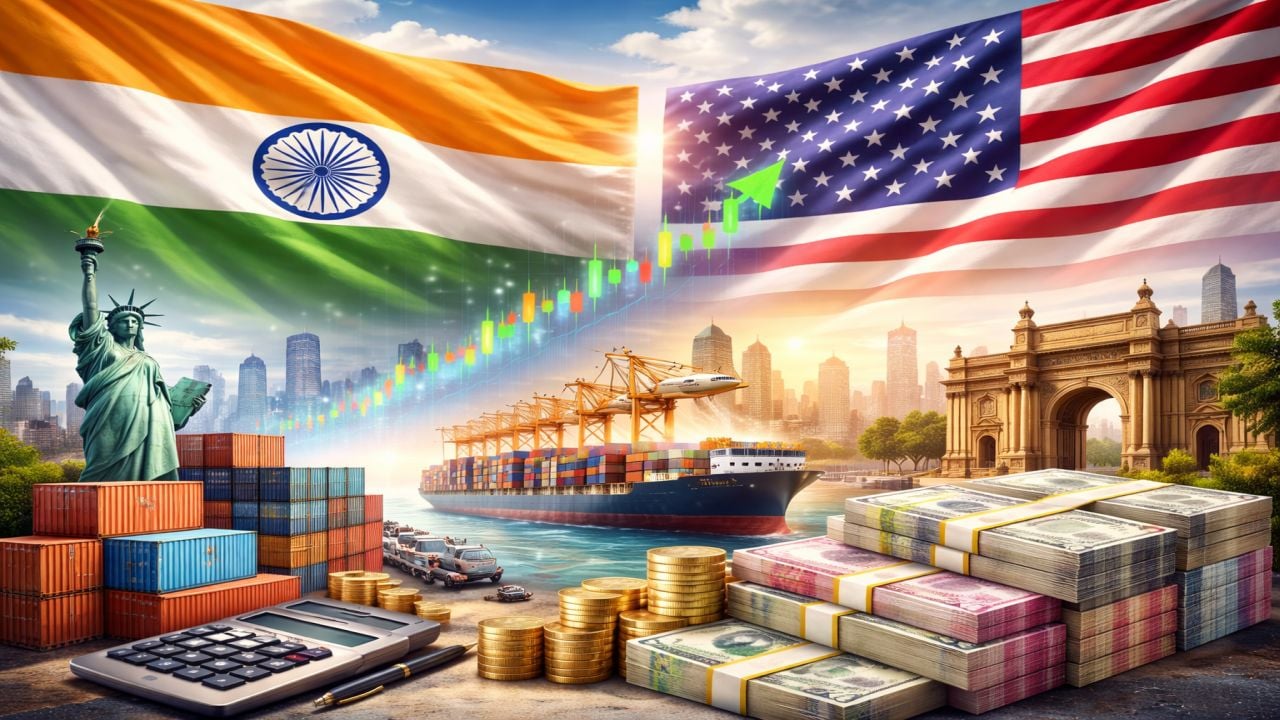
India–US interim trade deal LIVE updates: Framework sends strong signal of confidence to global investors, says industry
Published on 07/02/2026 05:04 PM
The US will cut tariffs on India to 18% from 50% earlier, opening up a $30 trillion market for Indian exporters, especially small businesses, farmers, and fishermen.
here
White House order makes removal of extra 25% tariff on Indian goods effective from 12:01 am EST on February 7.
Piyush Goyal outlined the India–US interim trade framework, promising zero duties on key imports, protection for sensitive sectors, and boosted exports, aiming for $500 billion bilateral trade.
here
Arunachal Pradesh Chief Minister Pema Khandu said the IndiaUS interim trade framework will make Indian businesses more competitive in global markets.
The framework for an interim trade agreement between India and the US sends a strong signal of confidence to global investors and offers a timely boost to competitiveness, technology access, and supply chain resilience, India Inc said on Saturday.
Avinash Gupta, Vice Chairman of the All India Gem and Jewellery Domestic Council (GJC), welcomed the India–US interim trade agreement’s provision that eliminates tariffs on gems and diamonds.
Gupta said the zero-duty access is particularly beneficial for small and medium enterprises (SMEs) and family-run businesses, allowing them to compete on equal footing in the US market. He noted that the move is expected to boost exports, strengthen revenues, and create employment opportunities across the sector.
He added that while finished jewellery continues to attract an 18% duty, the agreement opens the door for broader opportunities and a multiplier effect across allied industries, including logistics, design, and retail. Gupta described the development as both an economic and social milestone, empowering communities nationwide.
The All India Gem and Jewellery Domestic Council (GJC) has welcomed the India–US interim trade agreement provision that sets tariffs on gems and diamonds to zero.
Mr. Rajesh Rode, Chairman of GJC, said the development marks a “landmark agreement” and thanked Prime Minister Narendra Modi and Commerce Minister Piyush Goyal for their leadership in securing the concession.
According to Rode, the zero-duty access to the US market strengthens India’s global competitiveness, boosts margins for exporters, and ensures that the work of Indian artisans reaches international markets at fair prices.
He added that while jewellery continues to attract an 18% tariff, the benefits for gems and diamonds are significant, positioning Indian craftsmanship as a “global symbol of excellence” and creating new opportunities for exporters and the domestic gem and jewellery sector.
Senior Congress leader Vijay Wadettiwar on Saturday said the IndiaUS trade deal would negatively impact the interests of farmers in Maharashtra as agricultural imports will carry zero per cent duty.
India will soon be the world’s third-largest economy, Goyal says. By 2047, India’s economy will be over $30 trillion.
We have been able to balance farmers’ sensitivities by fully protecting and ensuring exemptions for GM food products, cereals, millets, dairy, meat, animal foods, honey, malt, ethanol for fuel, starch, Goyal says.
The trade deal open huge opportunities for India to get high-quality medical devices, machinery, ICT products, goods for data centres.
US and India are strategic partners and allies and are part of PAX Silica as well, Goyal says, as well as working to develop alternate sources for uninterrupted supply.
We need ICT products, AI equipment, Nvidia chips, products for data centres, Goyal says.
US has innovation and technology superior to any country, but many products aren’t able to compete in world markets due to high labour cost, Goyal says.
Collaboration with friendly countries like India will be complementary in approach, Goyal adds.
India to reduce duties to zero on those imports from the US on which it is already import-dependent, Goyal says.
Distilled grain soluble will see limited import from the US as per demands of our poultry and animal husbandry sector, according to Goyal.
Some wines and spirits have been opened up for imports subject to Minimum Import Price to avoid competition with local players, Goyal adds.
Farmers, textile and footwear workers, toy industry, sports goods industry will benefit from increased access to the US market at lower duties than competitors, Goyal says.
Home decor, silk products, pillows, cushions, non-electrical lamps, machinery parts, jewellery, leather and footwear, textiles and apparel to benefit in exports, Goyal adds.
Vegetables, bananas, barley, bakery products, cocoa products, sesame, poppy seeds, citrus products, jams will face zero tariffs in the US, Goyal says.
Exports from India like machinery parts, aircraft parts, elementary auto parts, coins, platinum, essential oils, home decor items, inorganic compounds, paper, plastic, natural rubber will benefit from zero reciprocal tariffs.
Indonesia, Bangladesh, Vietnam will face higher tariffs than India now, Goyal says.
Several Indian exports will face zero duty in the US, spanning across gems, diamonds, pharmaceutical products and smartphones.
Spices, tea, coffee, copra, vegetable wax, areca, chestnut, cashews, several fruits and vegetables exported from India to the US will also face zero duties, Goyal says.
Interests of our exporters and farmers have been protected, Goyal says. The India-US joint statement has been welcomed across the country and sectors.
50% reciprocal tariffs on India’s exports will drop to 18%, Goyal says. It will be lesser than India’s export competitors.
Talks began in February 2025 for a deal aimed at $500 billion yearly bilateral trade between India and the US, says Piyush Goyal in a press conference.
The interim US-India trade deal should give Indian consumers a clearer edge in the coming years, with easier access to a wider range of cheaper American products in premium categories, like advanced tech items (GPUs and data-centre equipment), certain foods and drinks (tree nuts, wines, spirits), and medical devices, said Suresh Nair, Indirect Tax Partner, Consumer Products and Retail Sector, EY India.
Prices in Indian stores should ease lower for several premium and imported items with this interim US-India trade deal, Nair said.
Trade expert Abhijit Das urges caution on the India-US interim trade deal, noting tariff cuts benefit textiles and gems but uncertainty under President Donald Trump remain key risks.
Former diplomat Ashok Sajjanhar has raised concerns over the provision in the India–US interim trade framework that links tariff relief to India curbing purchases of Russian oil, saying it could have diplomatic and domestic implications for India.
The India–US interim trade framework is likely to have uneven but meaningful effects across Indian retail, consumer prices and sourcing strategies, according to Suresh Nair, Indirect Tax Partner (Consumer Products & Retail), EY India.
Prices, margins and what shoppers may see
Nair expects retail prices for several premium and imported categories to soften over time. This is largely because India has agreed to cut or eliminate tariffs on all US industrial goods and ease key non-tariff barriers.
Products likely to become more affordable include high-end electronics, ICT equipment, wines and spirits, tree nuts, processed fruits and medical devices.
In the near term, large organised retailers may be able to retain part of these cost savings, helping them protect or slightly improve margins while also driving higher sales volumes as middle-class demand rises.
The recently announced India-US interim trade framework marks an end to a period of “coldness” in bilateral relations, according to Vikas Khemani, Founder of Carnelian Asset Management.
Jayant Dasgupta warns that despite India and US announcing an interim trade framework and tariff rollback, major gaps and uncertainties remain, with legal and geopolitical risks threatening the deal.
Former Foreign Secretary Kanwal Sibal has sharply criticised the provision in the India–US interim trade framework that links tariff relief to India stopping purchases of Russian oil, describing it as “political bullying” rather than legitimate economic policy.
Sibal argued that the United States itself continues to explore economic and diplomatic engagements with Russia even as the Ukraine conflict persists, making Washington’s stance toward India inconsistent.
He said that India’s bilateral trade with the US has no direct connection to its energy purchases from Russia, and that creating such a linkage was “unfortunate” and politically motivated rather than commercially justified.
Uttar Pradesh Chief Minister Yogi Adityanath on Saturday lauded the interim framework for the USIndia trade agreement, stating that this delivers a decisive boost to Make in India. Calling the announcement of the framework “a landmark step”, Yogi Adityanath emphasised that this will expand global market access for Indian products.He thanked Prime Minister Narendra Modi, hailing his “decisive and dynamic leadership” for securing an “Indiafirst” agreement.
HPCL’s former Chairman and Managing Director MK Surana, while speaking to CNBC-TV18, indicated that while Indian imports of Russian crude are expected to decline, although a transition to zero remains unlikely in the immediate future due to logistical realities and refinery dependencies.
The joint statement on the India–US interim trade agreement appears broadly positive for the Indian pharmaceutical sector, according to Systemactix, with the framework likely to preserve — and in some cases improve — India’s export positioning in the US market.
Under the agreement, India is expected to receive preferred (lower) tariff treatment for several pharmaceutical products. Importantly, generic drugs are set to remain exempt from tariffs in the near term while Section 232 investigations are ongoing, and are likely to continue enjoying preferential rates even after those probes conclude.
Systemactix notes that organic chemicals — including generic and innovator APIs — could attract an 18 per cent tariff under the new regime. However, this rate is still viewed as relatively competitive, suggesting limited risk to profitability. The firm believes most of any incremental cost is likely to be passed on to customers rather than squeezing exporter margins.
Once Section 232 investigations are completed, tariffs on generic APIs and formulations could be revised, but Indian exports are still expected to retain preferred status, reducing the risk of a sharp negative impact.
Another key aspect of the pact is that both countries have agreed to jointly define rules of origin — that is, how the source country of a product is determined for tariff purposes. Systemactix highlights that benefits under the agreement are mutually exclusive, meaning concessions are specific to India–US trade and not automatically extended to third countries.
The recently announced India–US interim trade agreement could have significant macro and market implications for India, particularly by supporting the rupee and reviving foreign investment flows, according to Mihir Vora, Chief Investment Officer at Trust Mutual Fund.
Assam Chief Minister Himanta Biswa Sarma on Saturday said India and the US securing a framework for an interim trade agreement will empower diverse sectors of the country.
Mihir Vora, Chief Investment Officer at Trust Mutual Fund, has described the India–US interim trade agreement as a significant positive for India’s macro and market outlook.
According to Vora, the deal should help stabilise the rupee and create conditions for a revival in foreign portfolio investment (FPI) inflows into Indian markets. He said the reduced trade frictions with the US place India on “stronger footing” relative to other export-driven economies such as Vietnam, Thailand, Bangladesh and even China.NewsLive TVMarketPopular CategoriesCalculatorsTrending NowLet's Connect with CNBCTV 18Network 18 Group :©TV18 Broadcast Limited. All rights reserved.