India-US Interim Trade Deal: Zero duty for gems, pharma, agri exports; farmers fully protected, says Piyush Goyal
Published on 07/02/2026 05:06 PM
India-US Trade Deal: Commerce and Industry Minister Piyush Goyal said the interim trade agreement with the United States has been designed to protect Indian farmers while opening duty-free access for several sectors, including agriculture and MSMEs, in America.
India and the US earlier on Saturday announced that they had agreed on a framework for the interim pact and would continue discussions on a full Bilateral Trade Agreement. The BTA talks were launched in February 2025 and the final agreement is expected by March this year.
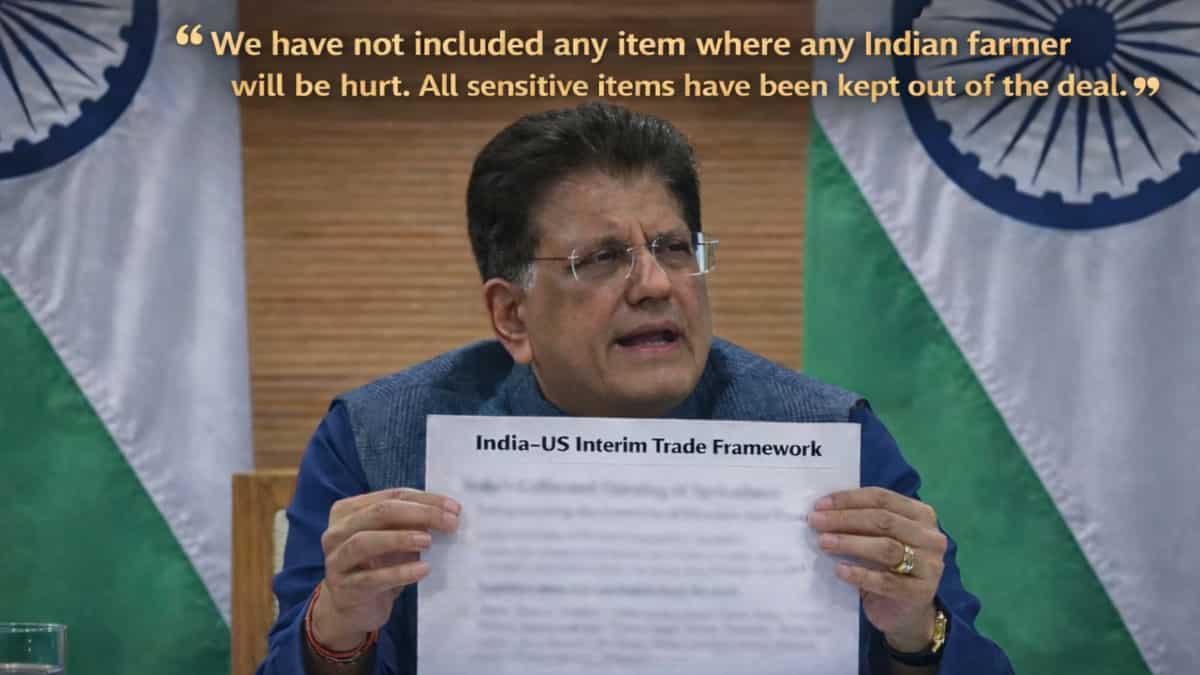
Addressing a press conference later in the day, Goyal said all sensitive items had been kept out of the deal. “We have not included any item where any Indian farmer will be hurt. All sensitive items have been kept out of the deal,” he said.
Goyal said India has not offered any tariff concessions to the US on key agricultural and dairy products. “No genetically modified items will enter India, and no tariff relief has been given on meat, poultry, dairy, soybean, maize, rice, wheat, sugar, millets, fruits such as bananas, strawberries, cherries, citrus fruits, green pea, kabuli chana, moong, oilseeds, ethanol and tobacco,” he said.
Elaborating on the benefits of the agreement, Goyal said the interim deal has been widely welcomed across the country, particularly by small exporters and artisans. “Considering how the interests of our farmers and the dairy sector have been protected, I believe the joint statement between India and the United States has been welcomed in every corner of the country,” he said.
Citing an example, Goyal said he watched a video of a handicrafts artisan from Sambhal in Uttar Pradesh, who welcomed the tariff cut. “He said the tariff has now come down to 18 per cent, and that new orders will come in and business will grow,” the minister mentioned.
Goyal also explained how Indian exporters will have a significant advantage as New Delhi faces lower tariffs than its competitors and neighbouring countries.
The minister said several Indian exports will now enter the US market at zero duty, with duties reduced from as high as 50 per cent to zero. “There are several items on which zero duty will now be levied when our exporters send goods to the United States,” Goyal said.
These include gems and diamonds, pharmaceutical products, generic drugs, smartphones, aircraft parts, machinery parts, some auto components, platinum, clocks and watches, essential oils, home décor items such as chandeliers and lamp parts, some inorganic chemicals, and select paper, plastic and wood products.
In agriculture, Goyal said zero reciprocal tariffs will apply to multiple products. “Several agricultural exports will see zero duty from 50 per cent, such as spices, tea, coffee, copra, coconuts and coconut oil, vegetable wax, areca nut, Brazil nuts, cashew nuts, chestnuts, and several fruits and vegetables,” he said.
These include avocados, bananas, guavas, mangoes, kiwis, papaya, mushrooms, vegetable sap, vegetable roots, barley and certain processed food items.
Goyal said India will get zero duty on several auto components, while others will fall under the 18 per cent tariff category. “We will get zero duty for some auto parts, while others will fall under the 18 per cent tariff category. Half of our auto parts exports will benefit from the zero-duty category,” he said.
He also said Boeing and Airbus are major buyers of aircraft parts from India and are increasingly viewing the country as a key manufacturing hub.
“Both companies are looking at India as their largest foreign original equipment manufacturer,” he said.
The minister acknowledged that India has reduced or removed tariffs on items that it does not produce domestically or does not produce in sufficient quantities. “Some items will see tariffs being removed immediately, while others will see tariffs removed in a phased manner, and some will have quota-based tariffs,” Goyal said.
These include apples, Distillers Dried Grains with Solubles (DDGS), wines and spirits (with a minimum import price), pista, walnuts, almonds, select industrial inputs, cancer and heart medicines, neurological drugs, some cosmetics, organic and inorganic chemicals, ICT-related products, computers, and medical equipment.
Calling it a significant gain, Goyal said the US has agreed to supply critical ICT products required for India’s growth and national security. “It is a big win for India that the United States has agreed to provide us with various ICT products that we need,” he said.
When asked whether references to “non-market policies of third parties” in the India-US joint statement were aimed at China, Goyal replied, “Those who understand, they know.”
Summing up, Goyal said the interim deal strikes the right balance between export growth and domestic protection. “Considering how the interests of our farmers and the dairy sector have been protected, I believe this interim agreement is balanced and in India’s national interest,” he said.