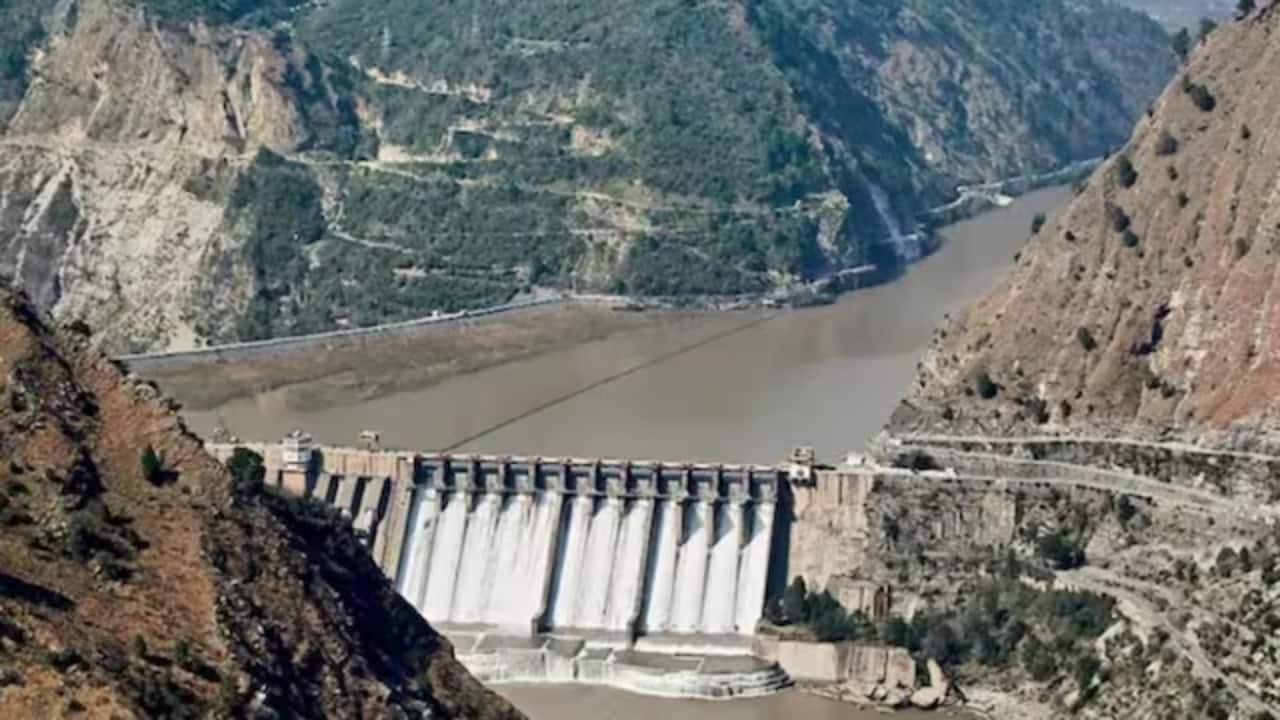
Indus Waters Treaty: Postcolonial story, role of World Bank and Pakistan's complete dependence
Published on 26/04/2025 04:17 PM
Following India's move to place the over 60-year-old Indus Waters Treaty on hold following the brutal terror attack in South Kashmir's Pahalgam that claimed at least 28 lives and injured many more, Pakistan on Thursday declared that any attempt by India to divert water allocated to it under the Indus Waters Treaty would be considered an 'act of war'.
It is widely believed that flows of the Indus, Jhelum, and Chenab form the backbone of Pakistan’s agriculture, its cities and its energy infrastructure and right now they do not have a substitute for these waters.
Precolonial and postcolonial history of Indus
The Indus River has been inextricably linked to the conceptualisation of Indian identity for ages. Its settlers traded with Mesopotamia. Its grandeur was documented by the ancient Greeks and Persians. Both the Buddha and Guru Nanak bathed in its waters. Numerous foreign conquerors failed and while others succeeded in crossing the Indus, the intricate web of rivers flowing from Tibet to the Arabian Sea, according to a report on The Indian express
India and the Indus share not only history but entomology as well. In classical Sanskrit language, the Indus was known as Sindhu, the Persians called it Hindhu, and for the Greeks it was Indhu. From 300 BCE, the West knew only of India as a land bordering the Indus and thereafter, to the world, everything from Afghanistan to Sri Lanka would be known as the lands of Indika or India, the abovementioned publication reported.
How Indus Waters Treaty divided it and its tributaries between India and Pakistan
Signed in 1960 in Karachi, and brokered by the World Bank, the IWT came after nine long years of deliberations. pact allocated water from the Indus River system between India and Pakistan. It assigned India control over the eastern rivers and their tributaries -- Ravi, Beas, and Sutlej -- amounting to an annual flow of approximately 33 million acre-feet (MAF), or 41 billion cubic meters (bcm). All the waters of the eastern rivers have been available for India's unrestricted use. Based on the treaty, Pakistan received rights to the western rivers and their tributaries -- Indus, Jhelum, and Chenab -- totalling about 135 MAF (99 bcm), which is roughly 80% of the system's flow.
The involvement of the World Bank
The involvement of the World Bank in the negotiation process of the Treaty began in September 1951, when Eugene Black, the then President of the World Bank, wrote to Prime Ministers, Jawaharlal Nehru and Liaquat Ali Khan, to invite both states to engage in talks pertaining to the Indus waters. After nine years of intense negotiations, the historic an agreement was signed on September 19, 1960.
The World Bank, being a signatory of the Treaty, assumed two roles under the Treaty. The first related to the financing of the water works in both India and Pakistan. Under the Treaty, the World Bank agreed to provide financial and logistical support in the formation and functioning of the Indus Basin Development Fund.
The main function of the World Bank is regarding the dispute resolution mechanism of the Treaty. Under Annexures F of the Treaty, the role of the World Bank comes in the appointment of the Neutral Expert. In the absence of an agreement between Pakistan and India on the Neutral Expert, the Bank, has the authority to appoint the Neutral Expert. However, the Bank is obliged to consult with both parties, prior to making such an appointment.
Why is IWT vital for Pakistan?
Reports say the Indus Basin rivers support Pakistan’s 25% GDP and play an existential role in maintaining the country’s food security. Pakistan’s 80% cultivated land relies on water from the Indus system, which directly or indirectly supports over 60% of the country’s population. Major cities like Lahore, Karachi, and Multan get water from the system for drinking and industrial purposes.
Ecological factors impacting the Indus river
Many of the problems of today are down to what wasn’t included in the treaty, rather than what was. At the time of signing, there was a lack of comprehensive studies on glacier mass balance. The assumption was that the Himalayan glaciers, which feed the Indus River system, were relatively stable.
The Himalayan glaciers, which supply 60-70% of the Indus River’s summer flow, are shrinking rapidly. A 2019 study estimates they are losing 8 billion tons of ice annually. The rate of glacier melt poses a significant challenge to the treaty’s long-term effectiveness to ensure essential water for all the people who rely on the Indus River Basin. While it may temporarily increase river flow, it threatens the long-term availability of water.
Discover the latest Business News, Budget 2025 News, Sensex, and Nifty updates. Obtain Personal Finance insights, tax queries, and expert opinions on Moneycontrol or download the Moneycontrol App to stay updated!
${res.must_watch_article[0].headline}
Sensex Today RIL Q4 Results 2025 Jammu Kashmir News Live CSK vs SRH Live Score Chris Wood HDFC Securities Asaduddin Owaisi Manipur HS Result KTET Result 2025 IPL Points Table 2025
Business Markets Stocks India News City News Economy Mutual Funds Personal Finance IPO News Startups
Home Currencies Commodities Pre-Market IPO Global Market Bonds
Home Loans up to 50 Lakhs Credit Cards Lifetime Free Finance TrackerNew Fixed Deposits Fixed Deposit Comparison Fixed Income
Home MC 30 Top Ranked Funds ETFs Mutual Fund Screener
Income Tax Calculator EMI Calculator Retirement Planning Gratuity Calculator
Stock Markets
News18 Firstpost CNBC TV18 News18 Hindi Cricketnext Overdrive Topper Learning
About Us Contact Us Advisory Alert Advertise with Us SupportDisclaimer Privacy Policy Cookie Policy Terms & Conditions Financial Terms (Glossary) Sitemap Investors
You are already a Moneycontrol Pro user.